ClipSheet: Clips Worth Cutting
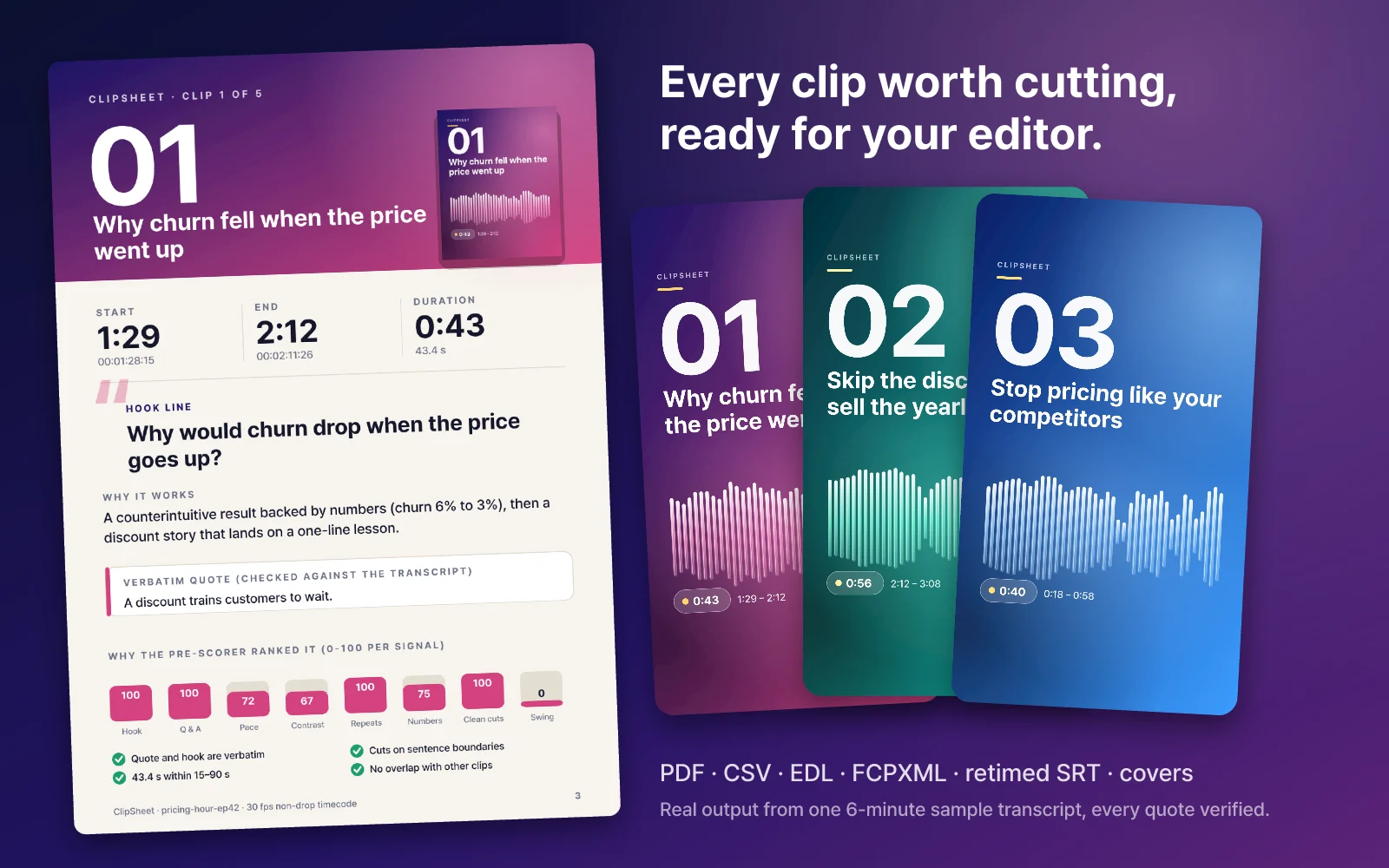
Real output of the skill, rendered from a sample transcript.
ClipSheet is for podcasters, interviewers, teachers, streamers and editors who have a long recording and its transcript and need to decide what to cut. It chooses what to cut and hands it to your editor: a designed clip-sheet PDF, a cut list, markers, one retimed caption file per clip and two cover cards per clip. It does not render video and it does not transcribe speech.
What you attach
A transcript with timestamps (SRT, WebVTT, or text with [mm:ss] or hh:mm:ss at the start of each line, up to 5 MiB). Optionally the video itself, so the EDL and FCPXML carry its name, length and frame size; ClipSheet only reads the MP4 header. Choose Shorts, Reels, TikTok or long-clip length, or your own range between 15 and 90 seconds. Text without timestamps cannot be cut.
How it works in chat
The agent asks only for what is missing, validates your settings and runs a fixed scorer over the transcript. The scorer looks at speech rate, question and answer pairs, numbers, contrast words, hook patterns in the first three seconds, repeated terms and sentiment swings, and proposes candidate windows that start and end on a sentence or a pause. The chat model then picks among those windows by id and writes a title, hook line, reason and quote for each. The model never writes timestamps, so every cut point comes from your transcript timings, and the same transcript with the same settings always gives the same candidates.
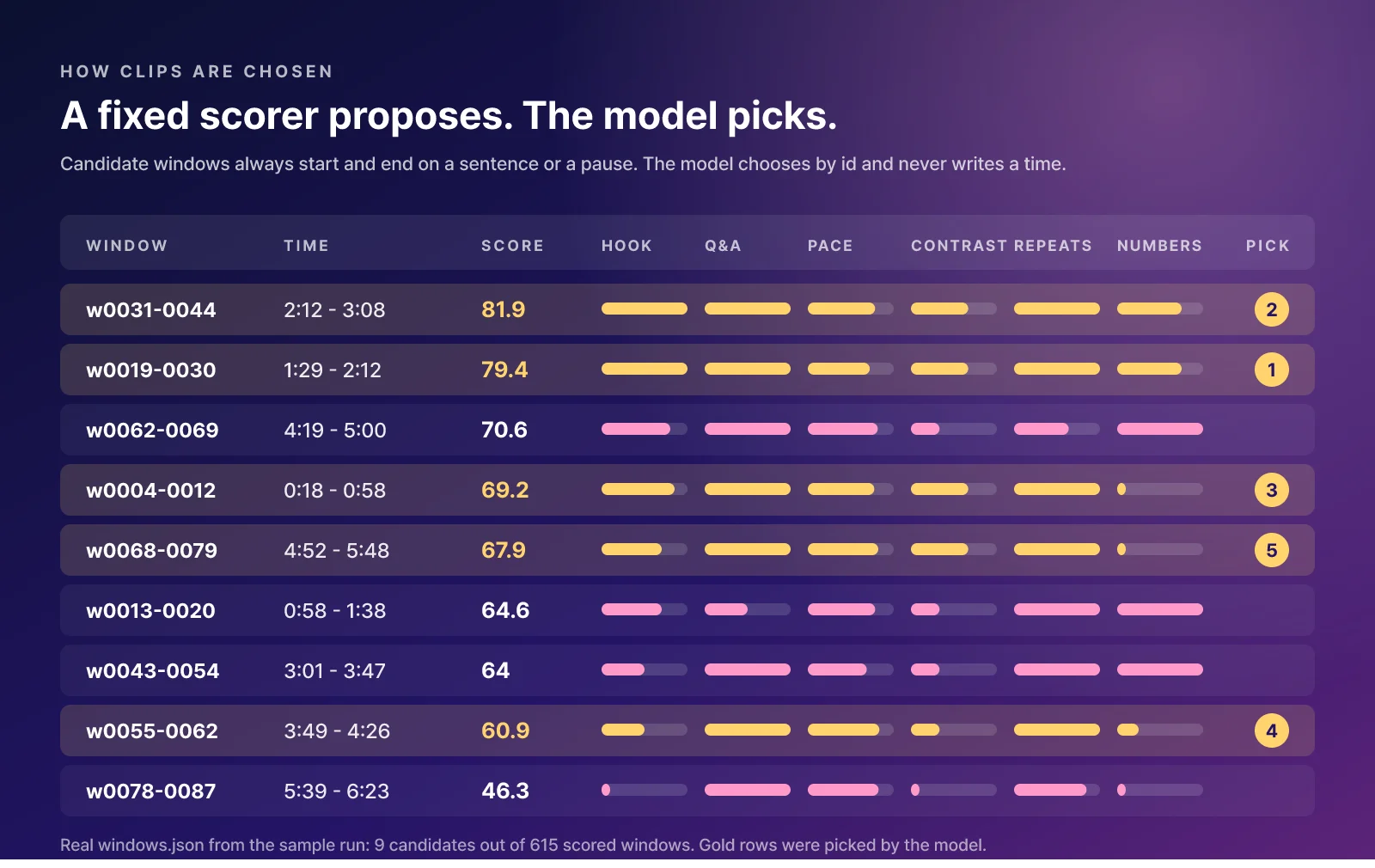
Real output of the skill, rendered from a sample transcript.
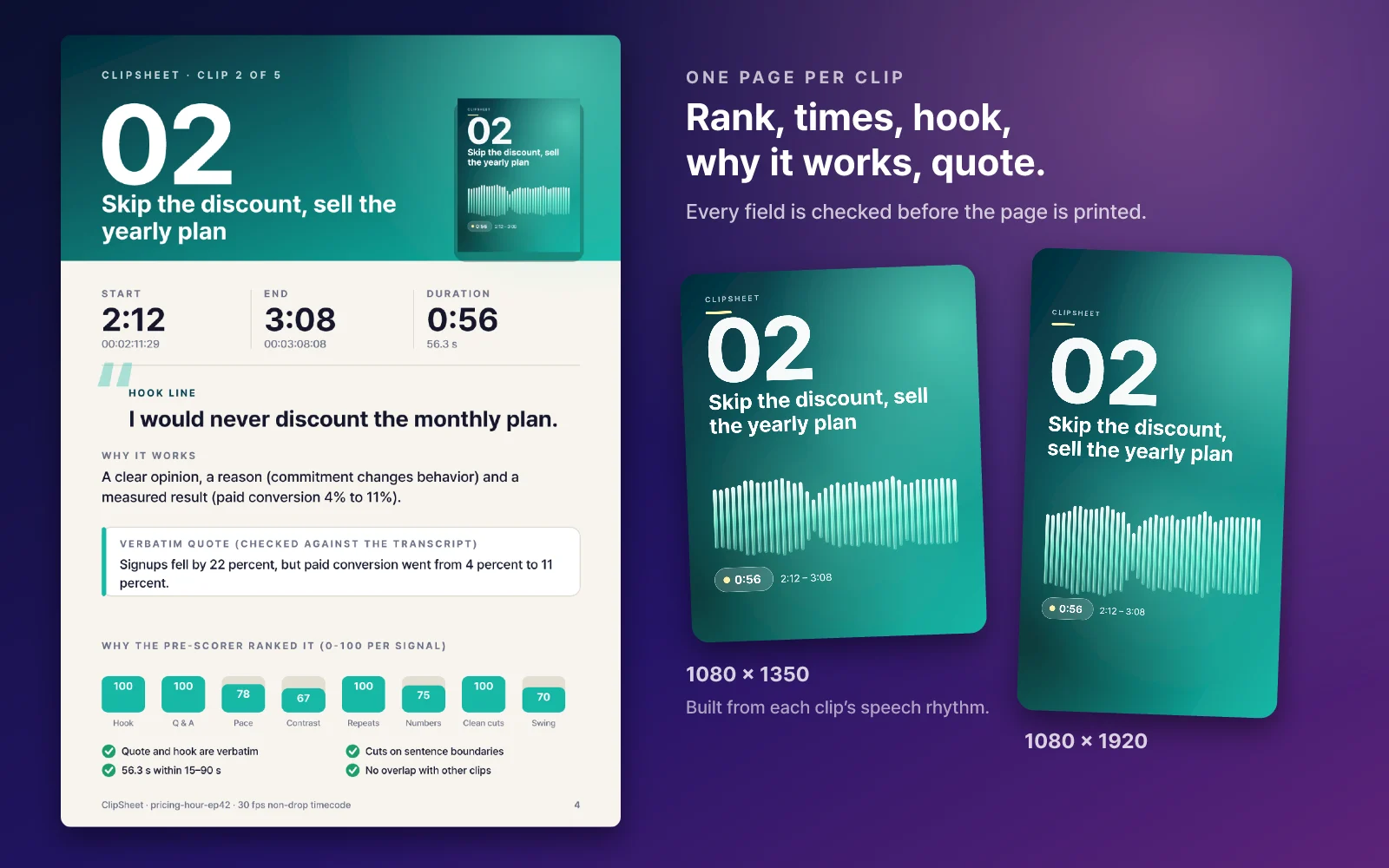
Real output of the skill, rendered from a sample transcript.
Files you receive
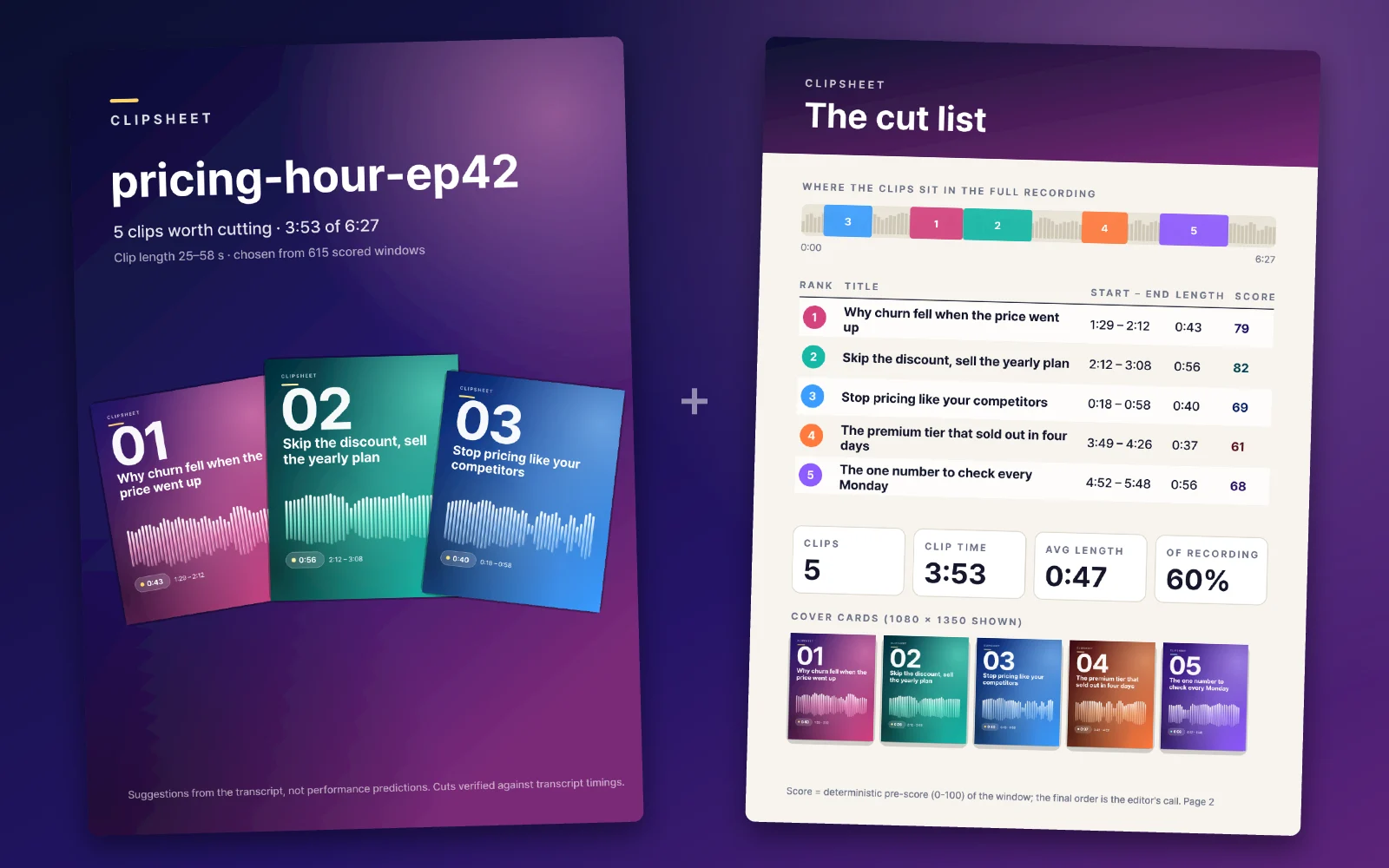
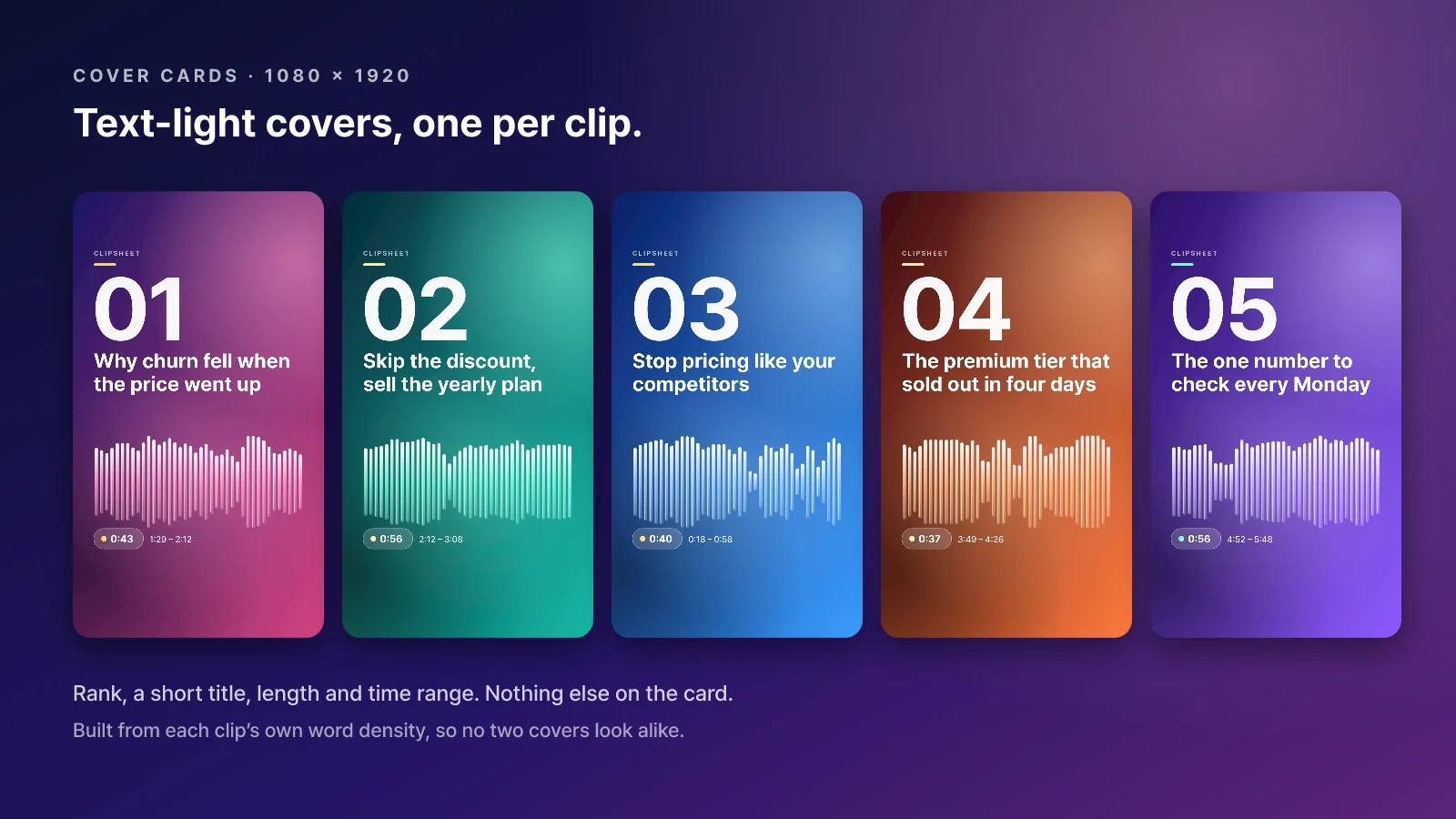
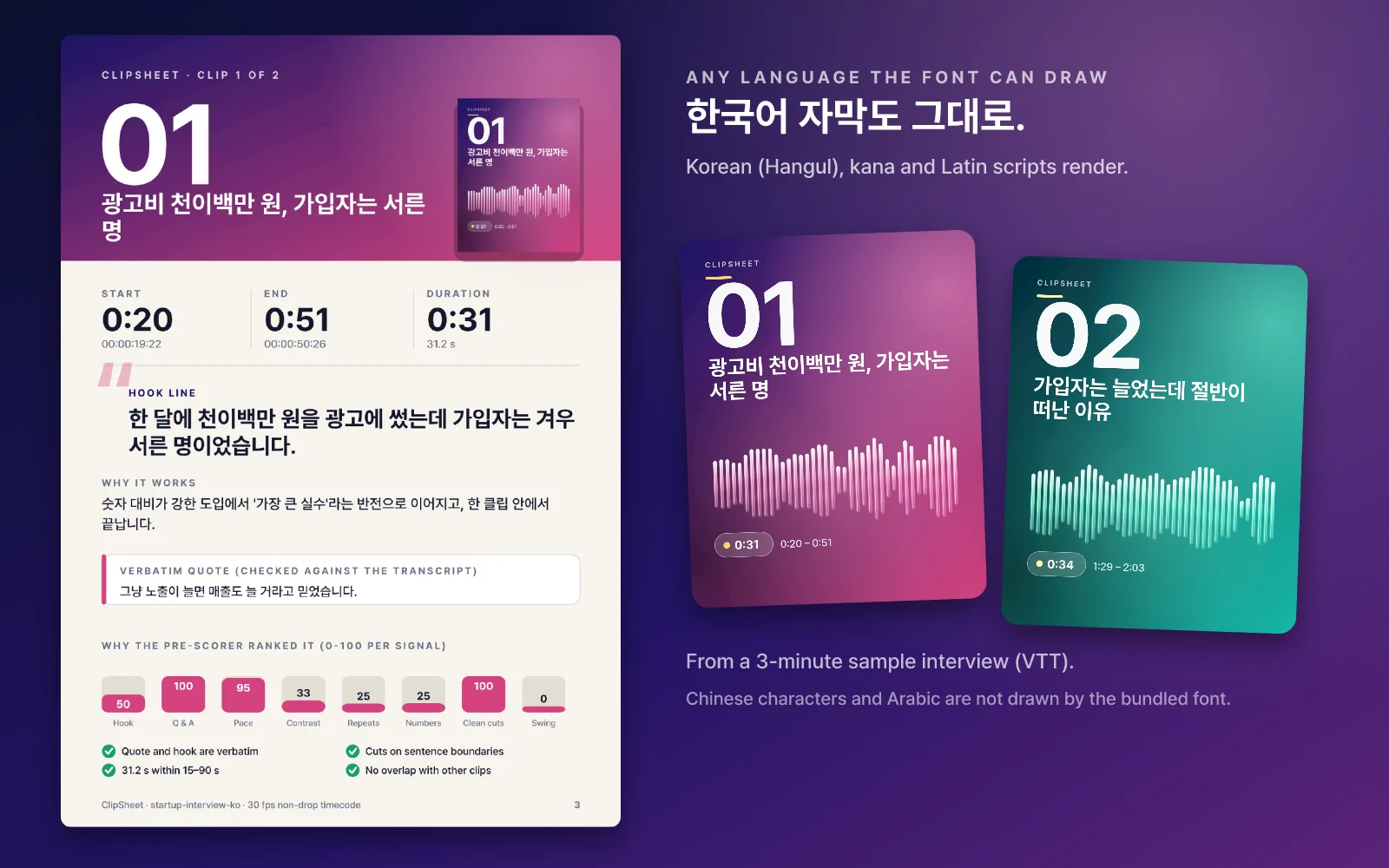
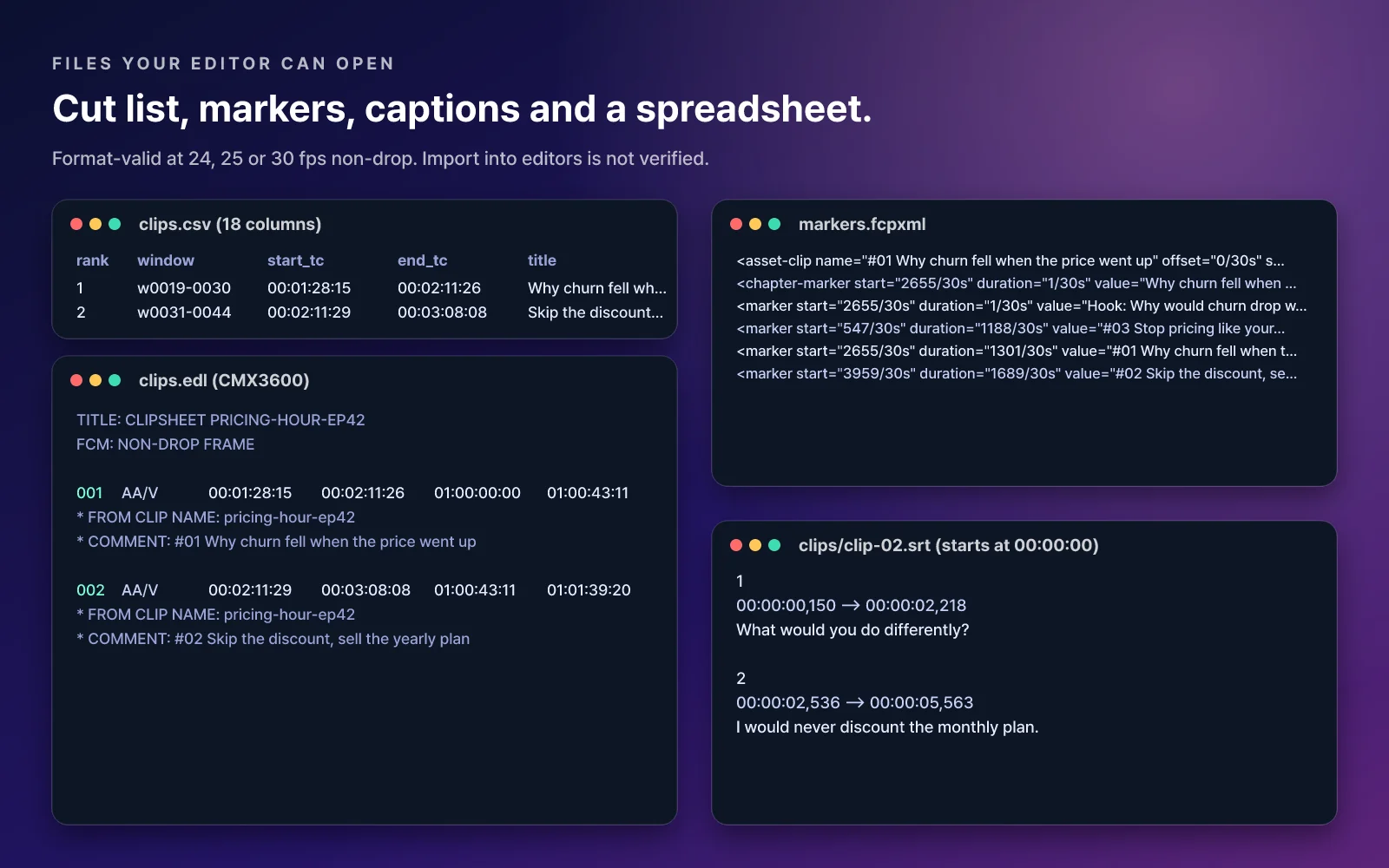
clipsheet.pdf (cover page, overview timeline, one page per clip with rank, start, end, length, hook line, why it works, verbatim quote, signal bars and check marks, plus a verification page), clips.csv, clips.edl (CMX3600 cut list), markers.edl, markers.fcpxml (FCPXML 1.10), markers-premiere.xml (FCP7 XML sequence markers), clips/clip-NN.srt (captions retimed to start at zero), covers/cover-NN-1080x1920.png and covers/cover-NN-1080x1350.png for every clip, plus report.md and report.json.
Real output of the skill, rendered from a sample transcript.
Real output of the skill, rendered from a sample transcript.
Real output of the skill, rendered from a sample transcript.
Real output of the skill, rendered from a sample transcript.
Checks that actually run
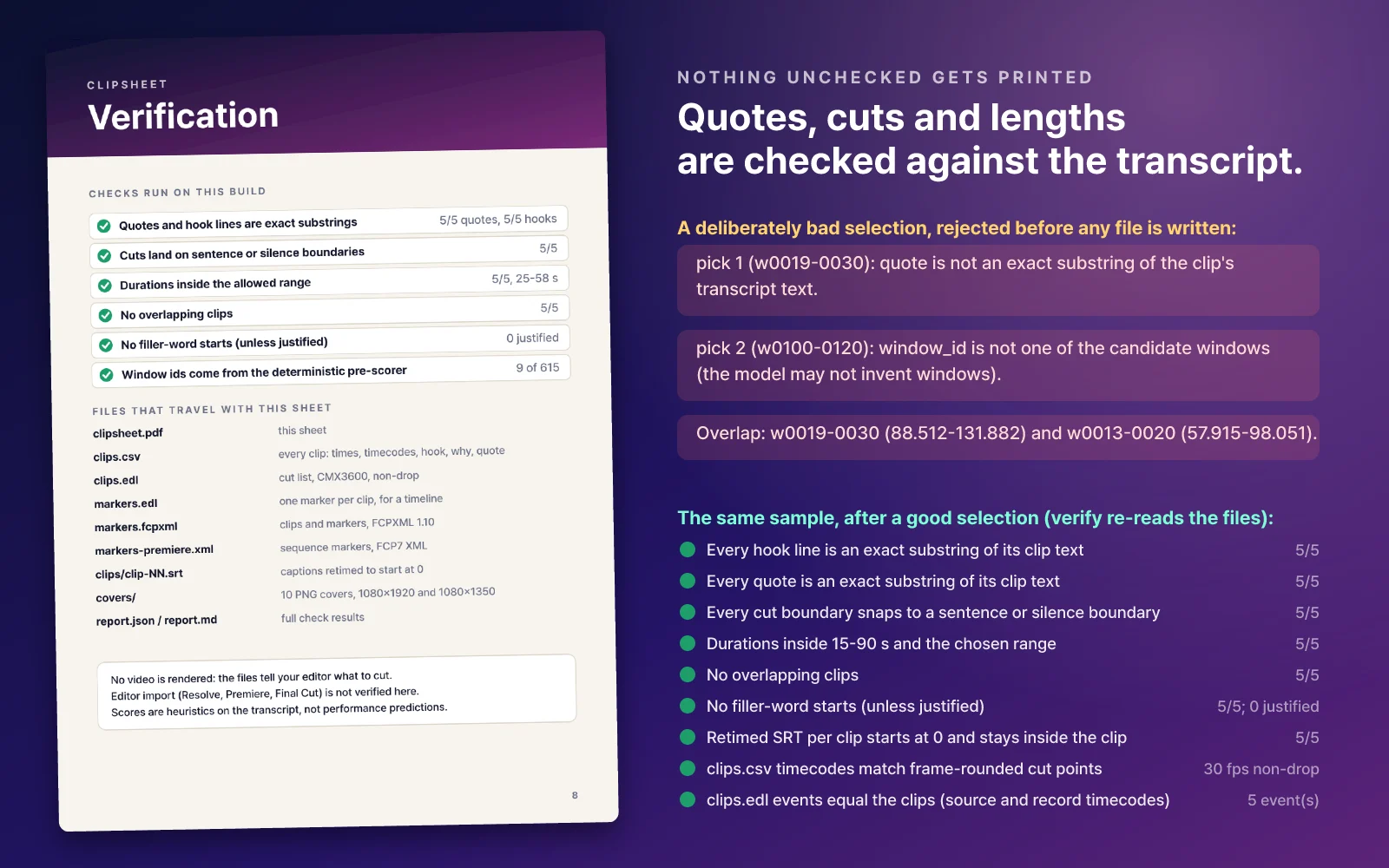
Every hook line and quote is tested as an exact substring of that clip's own transcript text (case and punctuation count, whitespace is collapsed). Every cut start and end must land on a sentence end or a pause of 0.6 seconds or more; mid-sentence cuts are rejected. Clips must be 15 to 90 seconds and inside your range, may not overlap, and may not start with a filler word such as so, um or and unless the model gives a reason. Invented window ids and extra fields are rejected before any file is written. After the build, a separate verify step re-reads the delivered files and re-checks quotes, boundaries, CSV timecodes, EDL events, markers, caption files, cover sizes and the PDF structure against the transcript.
Real output of the skill, rendered from a sample transcript.
Measured speed
Measured speed on one Apple-silicon Mac with Node 26: a 20 minute transcript (267 sentences) with 6 clips took about 10 seconds to build; a 66 minute transcript (890 sentences) with 12 clips about 18 seconds at roughly 0.6 GiB peak memory; a 200 minute transcript with 12 clips about 20 seconds. Speed and memory in Capafy's cloud are unverified.
Honest limits
This is not a video editor, so no clip MP4 files are produced. There is no speech recognition. Scores are heuristics on the transcript, so treat the picks as suggestions, not performance predictions. The EDL and FCPXML follow the common formats at 24, 25 or 30 fps non-drop; import into editing software is not verified, and the FCPXML points to your video by file name, so you may need to relink it. Timestamped plain text has one time per line, so cuts are line-accurate; SRT or VTT is more precise. Covers and the PDF use a bundled font that draws Latin, Hangul and kana; Chinese characters (including Japanese kanji) and Arabic are not drawn, so those titles appear as neutral bars (the CSV, SRT and EDL still carry the text). PDF pages are images, not selectable text. Sample images are real output from three sample transcripts written for this skill, not customer material.
Data handling
The product code makes no network calls; files are read and written inside the Capafy workspace. This is not Capafy's retention policy. You are responsible for having the rights to the recordings and transcripts you use.
Plans
Weekly US$6.99 (5 clip sheets), Monthly US$12.99 (25 clip sheets, featured), Yearly US$79.99 (300 clip sheets, about US$6.67 per month). No free trial.