ColorPages | Printable Coloring Book PDFs
ColorPages: adult coloring books made of patterns, delivered as a print-ready PDF
ColorPages builds a complete adult coloring book from a few choices you type in chat: a title, a theme, a mood, a difficulty from 1 to 5, a number of pages, and a paper size. You get a PDF with a cover, an owner page and numbered pattern pages, plus one SVG file for every page, plus a small record file that lists exactly how the book was built. After building, the agent checks the files automatically inside its working environment and tells you the result in plain words.
There is no image-generation model behind it. Every page is drawn by code from a numeric seed, using only black outlines on white. Nothing is filled with color, so every shape is an empty region waiting for your pencils, markers or digital brush. The same input with the same seed produces the same files again.
It draws patterns only. It does not draw animals, people, characters or scenes. If you need a cat or a portrait, this is the wrong product, and the comparison section below says so plainly.
At a glance
| Item | What you get |
|---|---|
| Output | One print-ready vector PDF, one SVG file per page, one composition record (book.json), and a written summary in chat |
| Audience | Adults. Not designed as children's content |
| Pattern types | 10: mandala, mosaic, floral, waves, truchet, spiral, partition, stained glass, strapwork, snowflake |
| Themes | 12 ready-made themes that decide which patterns appear and in what order |
| Difficulty | 1 (large calm regions) to 5 (very fine detail) |
| Pattern pages | 1 to 100 per book, default 20. The cover and the owner page are added on top |
| Paper | Letter, A4, 8.5 x 8.5 in, 8 x 10 in |
| Line style | Black outlines only, no fills, 0.5 in (36 pt) margin on every side |
| Repeatability | Same title, theme, mood, difficulty, pages, paper and seed give the same files |
| Checks | Page count, paper size, margins, line weight, no fills, PDF structure, file size, narrow-gap sampling, reproducibility |
| Not included | Animals, people, characters, brand or culture-specific designs, color artwork, a print test, any promise about sales |
Who it is for
The hobby colorer. You like the calm of filling in mandalas, stained-glass cells and wave bands, and you are tired of hunting for a printable book that matches your mood. Ask for "Winter Snowflake Mandalas" at difficulty 3 on Letter and print the pages you want. If a page feels too busy, ask for difficulty 2 or a different seed and you get a new book without rewriting anything.
The teacher or workshop leader. You run an adult education class, a library craft evening or a community art group and need a stack of handouts that match the room. Pick a low difficulty with a bold mood for people using thick markers, or difficulty 4 or 5 for participants who like fine pens. Every book has the same layout, so handouts look consistent. The owner page gives each participant a place for a name and a start date. This product is built for adult participants.
The small publisher or seller. You assemble coloring books to sell as printables or as paper books and want a fast way to produce clean interior pages with a cover and an owner page. You can vary the theme, mood, difficulty and seed to make clearly different books. Please read the "Before you sell or print" section: platform rules, print specifications and your rights to sell are yours to confirm. Nothing here promises approval, sales or income.
The cafe or event host. A seasonal table activity, a waiting-area handout or a small event with a coloring corner needs pages that are quick to print and nice to look at. Choose the theme that fits the season, pick the paper size your printer uses, and keep the pattern page count small. A short book of 6 to 12 pages is easy to hand out.
The gift maker. A personalized book for a friend or colleague is a warm gift. Choose a title that suits them, a theme they would like, and a difficulty that fits their patience. The cover carries your title, and the owner page has lines for their name and the date they start. You print and bind it yourself, so the finish is up to you.
The journaling and desk-break crowd. If you want one quiet page between meetings, ask for a one-page pattern book at difficulty 1 or 2. The product makes a book of any length from 1 to 100 pattern pages.
What you can type
You talk to the agent in plain chat. It pulls these fields out of your message. Anything you leave out is filled with a default, and the agent tells you which defaults it used. It builds first and asks later, so you are not blocked by questions.
| Field | Allowed values | Default |
|---|---|---|
| Title | 1 to 80 characters. Printed on the cover | Required |
| Theme | One of 12 themes listed below | Geometric Calm |
| Mood | calm, bold, delicate, playful, dreamy. Mood changes line thickness only | calm |
| Difficulty | A whole number from 1 to 5 | The theme's recommended value |
| Pages | Pattern pages from 1 to 100. Cover and owner page are extra | 20 |
| Paper | Letter, A4, 8.5x8.5in, 8x10in | Letter |
| Seed | A whole number from 0 up to 4,294,967,295 | 1 |
Mood changes the line thickness in small steps: bold adds 0.35 pt, calm adds 0.1 pt, playful adds 0.05 pt, dreamy adds 0, and delicate takes away 0.15 pt. Base line thickness comes from the difficulty, 1.8 pt at difficulty 1 down to 0.85 pt at difficulty 5. The final line is kept between 0.75 pt and 2.4 pt.
You do not have to know the field names. These all work:
- "Make me a calm ocean wave coloring book, easy, 12 pages, A4."
- "Winter snowflakes, delicate, difficulty 3, 14 pages on Letter, seed 11."
- "Something relaxing for a beginner, 10 pages." The agent picks a theme, tells you which one, and uses difficulty 1 or 2.
- "Same book as before but easier." The agent keeps your title, theme and seed and lowers the difficulty.
A complete example input
This is the exact request used for the Ocean Wave Patterns example further down:
Please make a coloring book titled "Ocean Wave Patterns". Theme: Ocean Waves. Mood: calm. Difficulty: 2. Pattern pages: 12. Paper: A4. Seed: 22.
Fields expressed that way become: title "Ocean Wave Patterns", theme ocean-waves, mood calm, difficulty 2, pages 12, paper A4, seed 22, margin 36 pt.
If your title uses characters outside plain English letters, digits and common symbols, for example Korean, the SVG cover shows the title but the PDF cover shows the fixed text "Coloring Book" instead. The agent warns you every time this happens. See the Limits section.
What you get
- A PDF with one page per book page. It is a vector document: lines are stored as paths, so they stay sharp when scaled. It contains no embedded images and uses one black line color. The file is named after your title when the title is made of English letters and digits, for example ocean-wave-patterns.pdf. Other titles produce the file name coloring-book.pdf.
- SVG files, one for each page: page-01-cover.svg, page-02-owner.svg, page-03-pattern.svg and so on. Use them in a layout tool, to print single pages, or to assemble your own book order.
- book.json, the composition record: your settings, paper size, the pattern and seed used on each page, the file names, and a fingerprint (SHA-256 hash) for each file.
- A chat summary with the book layout (total pages, paper, difficulty, theme), the page list (number, kind, pattern), the check results (passed, warnings, errors, with the main warnings explained), the values the agent assumed, and the known limits.
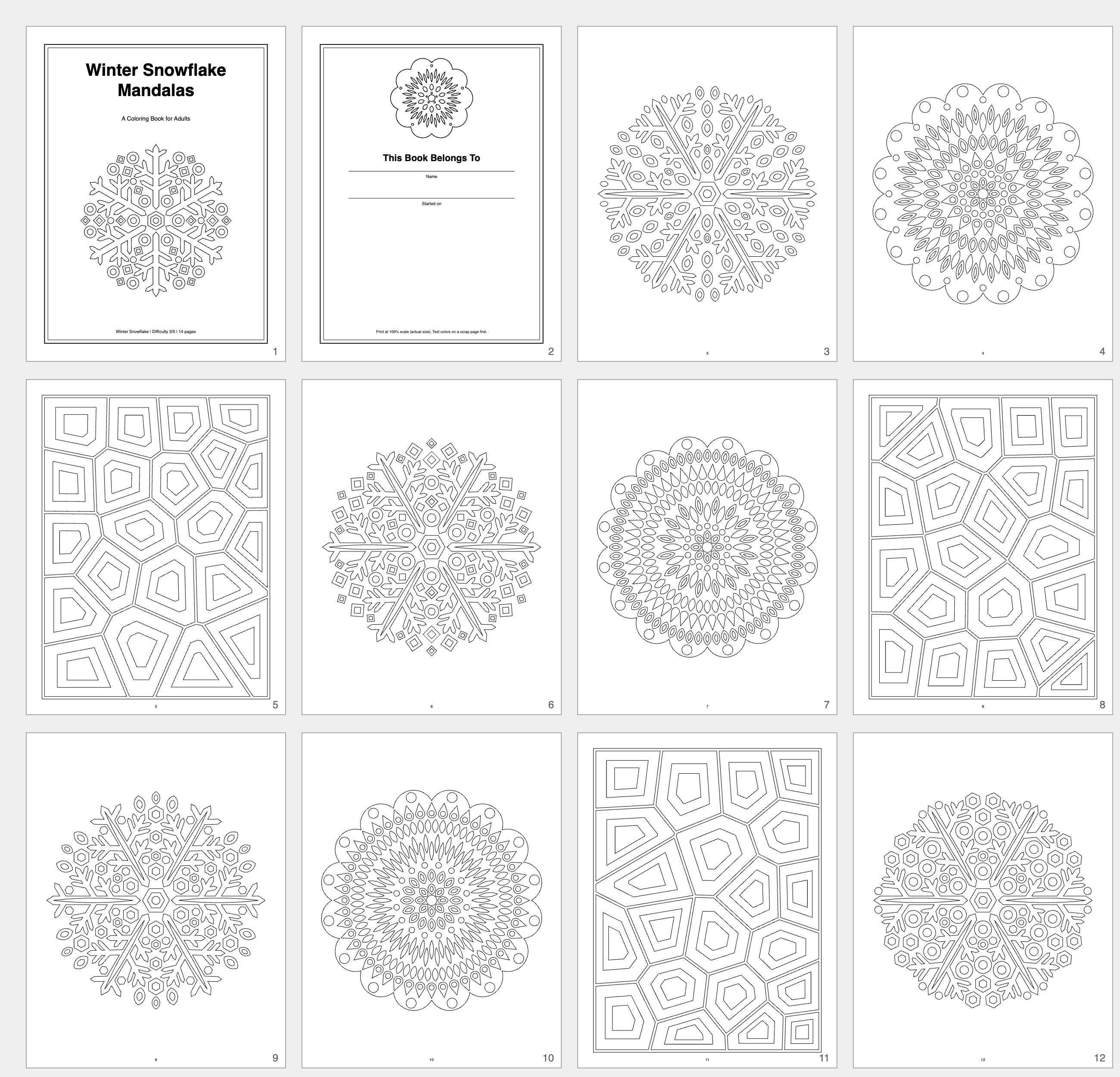
Page structure of every book:
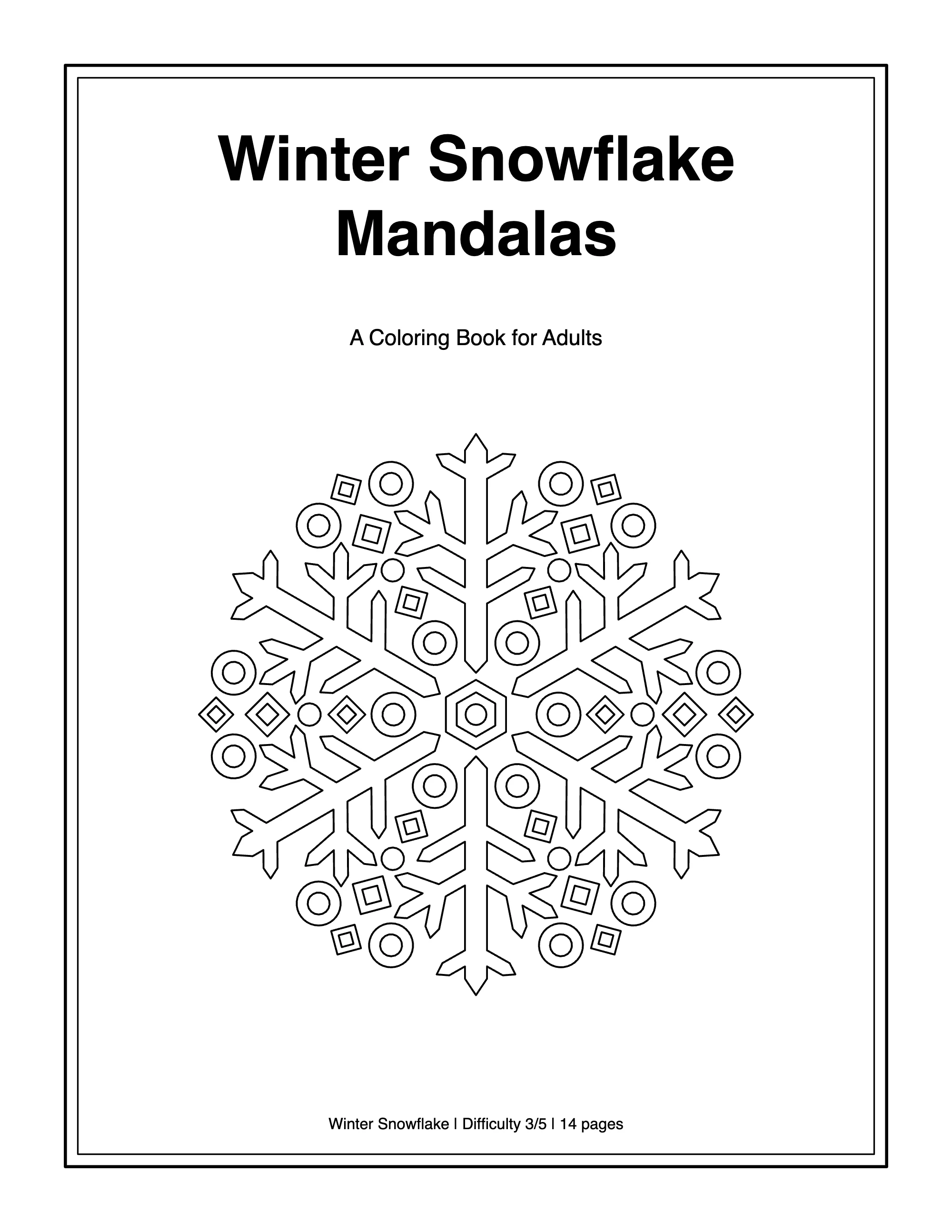
- Page 1: the cover. A double frame, your title, the line "A Coloring Book for Adults", a pattern from the theme's first pattern type at difficulty up to 3, and a footer such as "Ocean Waves | Difficulty 2/5 | 12 pages".
- Page 2: the owner page. "This Book Belongs To", a Name line, a Started on line, a small mandala, and the reminder "Print at 100% scale (actual size). Test colors on a scrap page first."
- Page 3 onward: pattern pages, each with its page number at the bottom, inside the bottom margin.
How it works, step by step
- You describe the book in chat. Title, theme, and anything else you care about.
- The agent reads your message and fills the fields. Missing fields get defaults. A request for animals, people, characters, brands, or children's content is declined with a close alternative offered.
- The agent maps your idea to a theme. "Frost" becomes Winter Snowflake, "sea" becomes Ocean Waves. It tells you how it interpreted your idea, because the match between a word and a pattern is approximate.
- The book is built. The cover, owner page and every pattern page are generated from the seed. Pages are written as SVG, and the PDF is assembled from the same drawings.
- The agent checks the files automatically inside its working environment. Nothing is run on your side. The checks are listed in the table below.
- You get the summary and the files. If any check fails with an error, the agent does not call the book finished. It tells you the reason and tries once more with a different seed or a lower difficulty. If it still fails, it reports the failure instead of pretending.
- You ask for changes. Easier, denser, a different feeling: the agent changes only the difficulty, theme or seed and rebuilds.
If the working environment cannot run the generator or save files in some session, the agent says "automatic build not run", does not claim files that were not made, and offers input suggestions instead.
The 10 patterns
All patterns are lines only. Where a pattern is built from curves, the curves are stored as many short straight segments (polylines), which look smooth at normal print sizes. Each pattern gets more or finer elements as the difficulty goes up.
| Pattern | What it looks like | What changes with difficulty (1 easy to 5 hard) |
|---|---|---|
| Mandala | A central rosette surrounded by rings with 6 to 24-fold symmetry: pointed petals, round petals, offset double petals, scallops, dots, leaf and drop shapes | More rings and more symmetry steps. Ring radii are computed so neighboring lines keep a minimum spacing for that difficulty |
| Mosaic | A square grid where each cell holds nested polygons, stars or concentric circles | 3 to 7 columns, more nested layers, and from difficulty 3 curved corner arcs. Cell borders are drawn once |
| Floral | Flowers and leaves scattered without overlapping | 7 to 19 flowers. From difficulty 3 flowers get inner petals, from difficulty 4 stamens and leaf veins |
| Waves | Either overlapping scale arcs or flowing wave bands, chosen by the seed | More nested arcs, 5 to 13 bands, and a center line at higher levels |
| Truchet | Square tiles, each holding two corner arcs in a random orientation, which join into winding paths | 6 to 14 columns, double lines from difficulty 3, triple lines at difficulty 5 |
| Spiral | A central spiral band and rings of half-moon shapes that alternate direction | 4 to 8 layers, and from difficulty 4 the spiral makes 3 turns |
| Partition | A rectangle divided into regions, each filled with concentric shapes, circles, hatching, dots or diamonds | 8 to 24 regions, with tighter interior spacing. Regions are separated by a 6 pt gap |
| Stained glass | A Voronoi-style division into cells, each shrunk to leave a gap, with smaller copies inside | 11 to 31 cells and 1 to 3 inner layers. The gaps look like lead lines |
| Strapwork | Star polygons with crossing lines, an inner star and a circle around it | A grid of 1 to 4 columns, plus extra circle and polygon layers |
| Snowflake | Six-fold ice crystals: a main arm, side branches 2 to 3 levels deep, a hexagonal center and decorations between the arms | Branch length, depth and decoration change with difficulty and seed. Short branches near each other drop their side branches |
Difficulty explained in plain terms:
| Level | Feel | Line thickness | Rough number of regions on a default page | Who it suits |
|---|---|---|---|---|
| 1 | Large, relaxed regions | 1.8 pt | Dozens | First-timers, thick markers |
| 2 | Comfortable middle | 1.5 pt | Dozens to about a hundred | A light, easy sitting |
| 3 | Balanced | 1.2 pt | Around a hundred to a few hundred | Most adults |
| 4 | Dense | 1.0 pt | A few hundred | Colored pencils, thin pens |
| 5 | Very fine | 0.85 pt | A few hundred to over a thousand | Fine pens and plenty of time |
The region counts are approximate figures for the default working area, not measured promises for every seed. Difficulty applies to the whole book. If you want two difficulties, make two books.
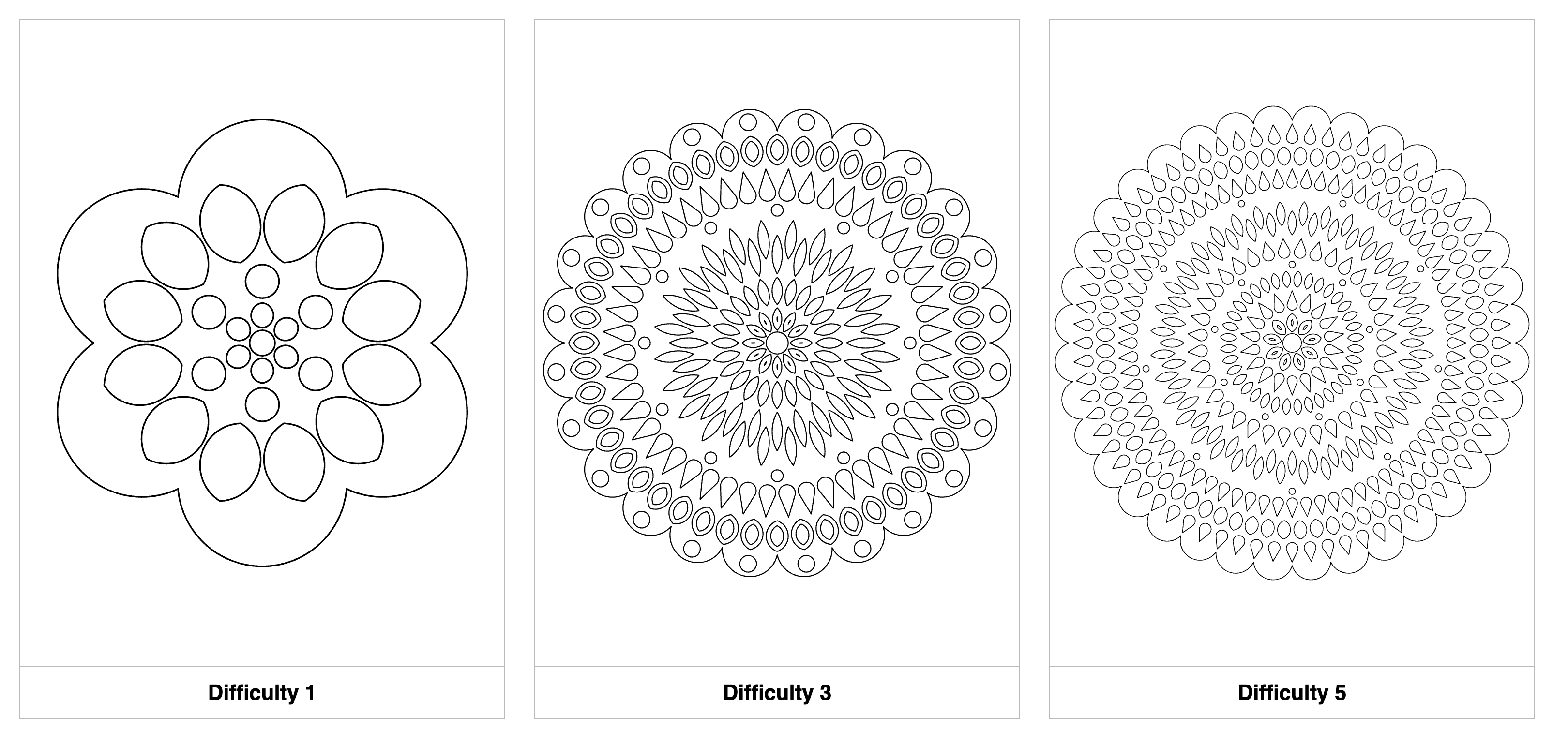
Here are single-pattern samples drawn by the same generator. These are individual sample pages, shown for style.
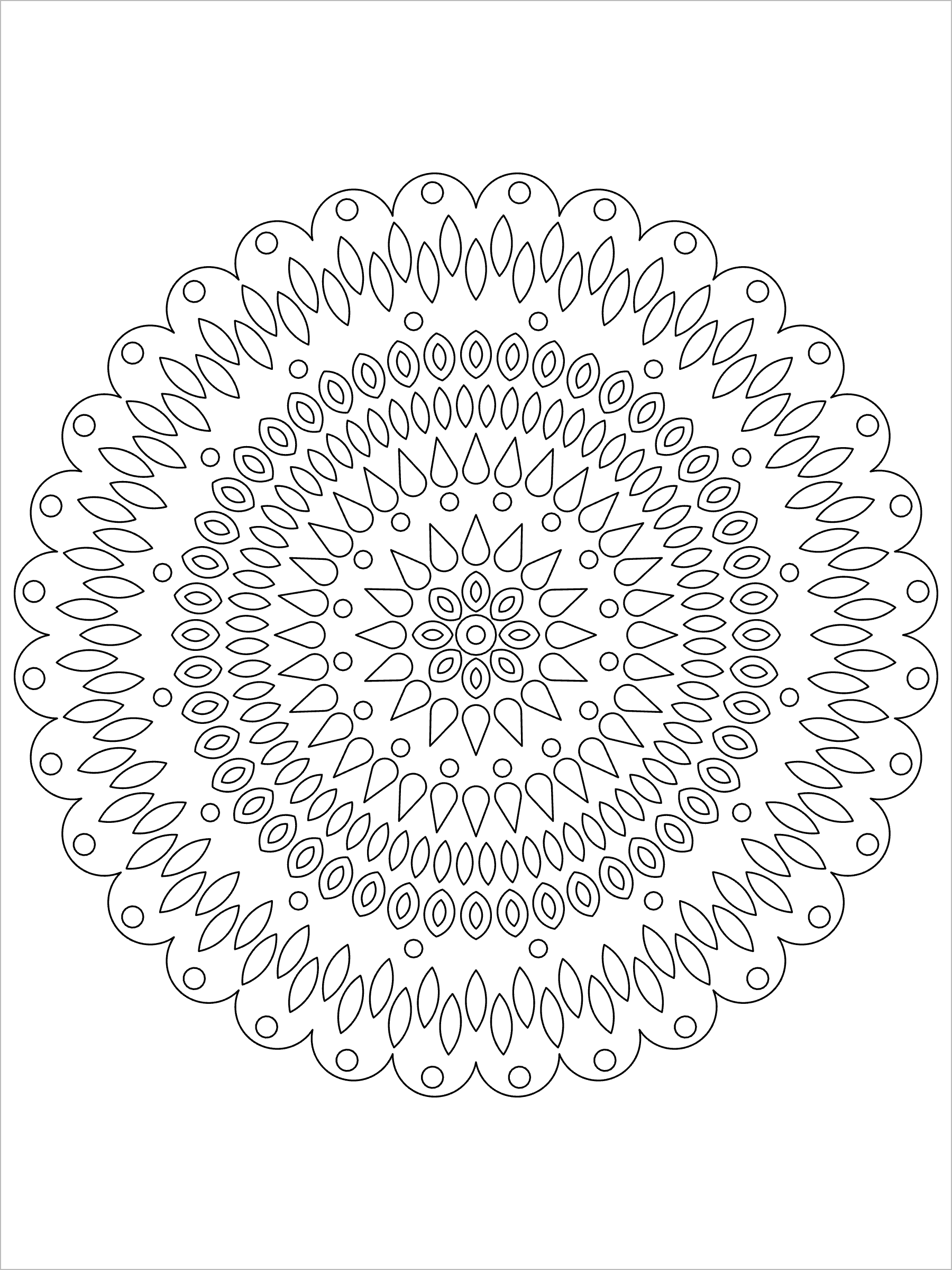
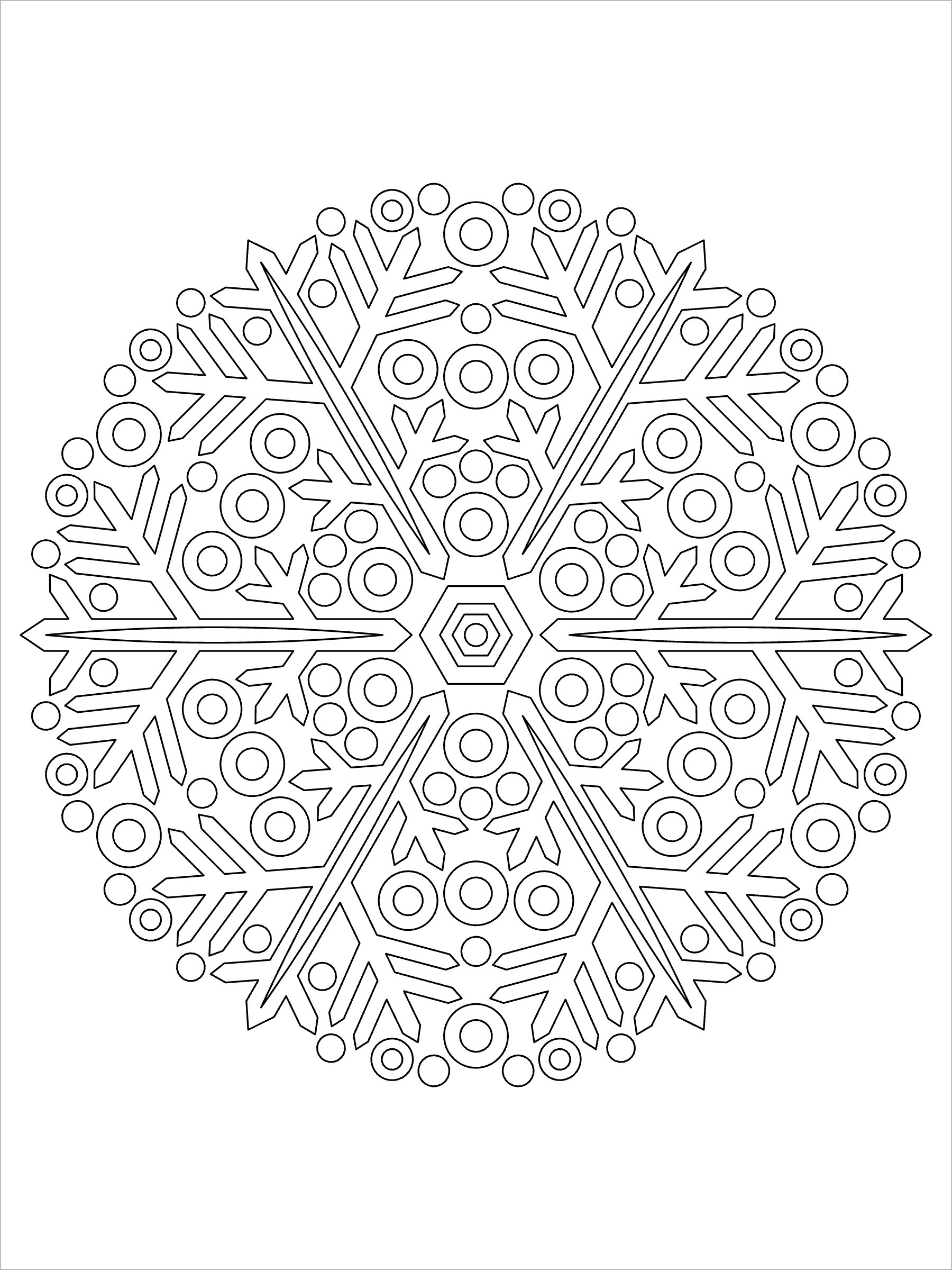
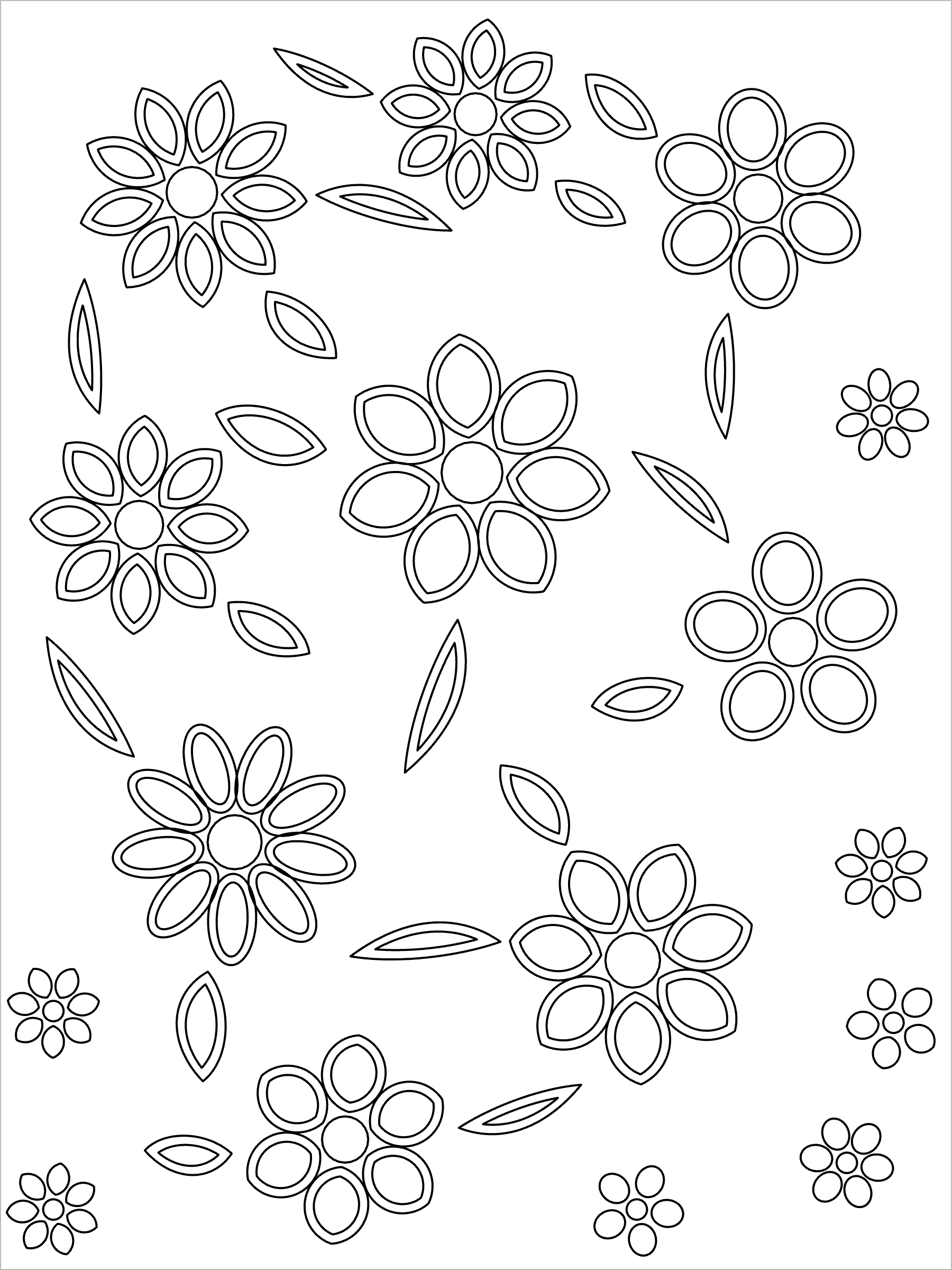
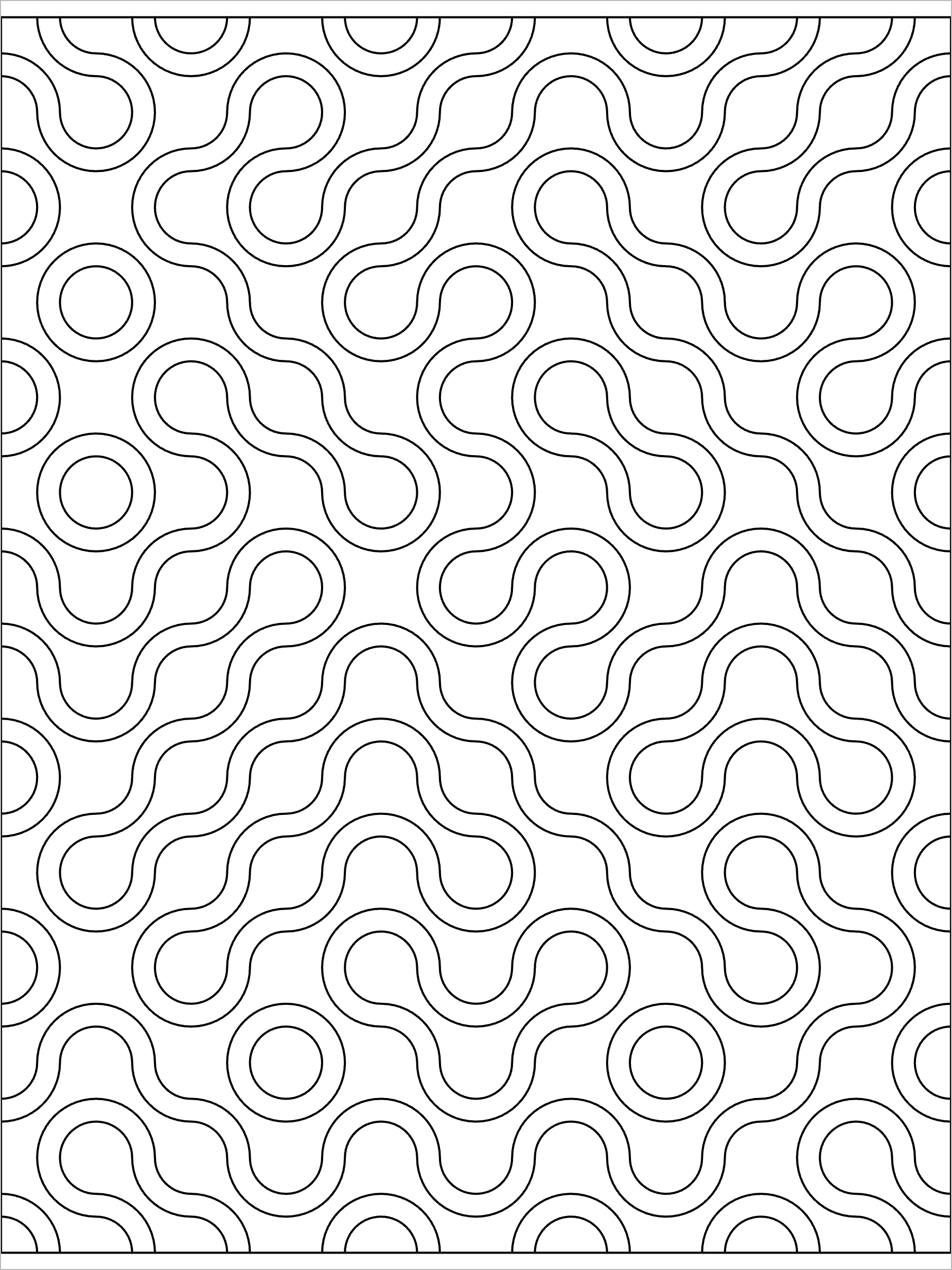
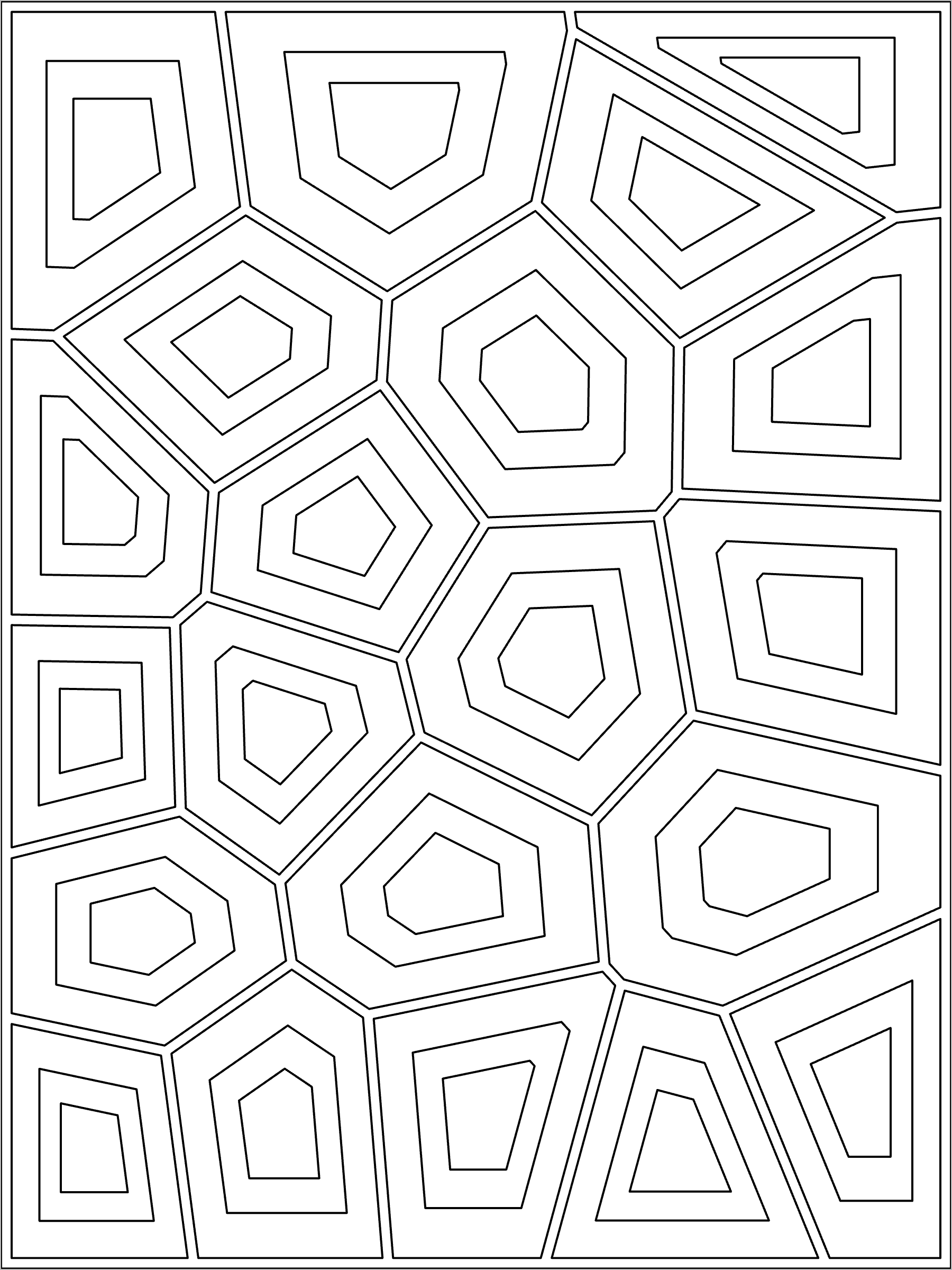
The preview set shows five of the ten pattern types. The other five (mosaic, waves, spiral, partition and strapwork) are described in the table above, and the agent can show you the page list for any book you build.
The 12 themes
A theme is a short recipe: which patterns appear, in what order, and what difficulty is recommended. Pattern pages cycle through the theme's list, so page 1 of the patterns uses the first pattern, page 2 the second, and so on, then it starts over.
| Theme | Pattern order | Moods it suits | Recommended difficulty |
|---|---|---|---|
| Spring Garden | floral, mandala, mosaic | calm, playful | 2 |
| Winter Snowflake | snowflake, mandala, stained glass | calm, delicate | 3 |
| Ocean Waves | waves, spiral, truchet | calm, dreamy | 2 |
| Cosmic Mandala | mandala, spiral, strapwork | dreamy, delicate | 4 |
| Autumn Leaves | floral, partition, stained glass | calm, playful | 3 |
| Forest Canopy | floral, truchet, partition | calm, bold | 3 |
| Geometric Calm | mosaic, truchet, strapwork | calm, bold | 3 |
| Stained Glass Garden | stained glass, floral, mandala | playful, bold | 3 |
| Sunrise Rays | mandala, spiral, partition | playful, bold | 2 |
| Desert Dunes | waves, partition, truchet | calm, dreamy | 2 |
| Moon Phases | spiral, mandala, waves | dreamy, delicate | 3 |
| Crystal Gems | stained glass, strapwork, mosaic | bold, delicate | 4 |
The themes use only general geometric and natural motifs. They do not copy any character, trademark, brand or culture-specific design. A theme name is a hint about the mood of the patterns, not a promise of a literal picture: "Autumn Leaves" gives leaf-and-flower shapes and patchwork panels, not a photograph-like tree.
The 4 paper sizes
| Paper | Size | Points (1 pt = 1/72 in) |
|---|---|---|
| Letter | 8.5 x 11 in | 612 x 792 |
| A4 | 210 x 297 mm | 595.28 x 841.89 |
| 8.5x8.5in | Square, 8.5 x 8.5 in | 612 x 612 |
| 8x10in | 8 x 10 in | 576 x 720 |
Every paper size has a 0.5 in (36 pt) margin on all four sides, and the pattern lines stay inside it. There are no bleed areas and no crop marks, so the line art does not run to the paper edge. Choose the size your printer or your print service expects.
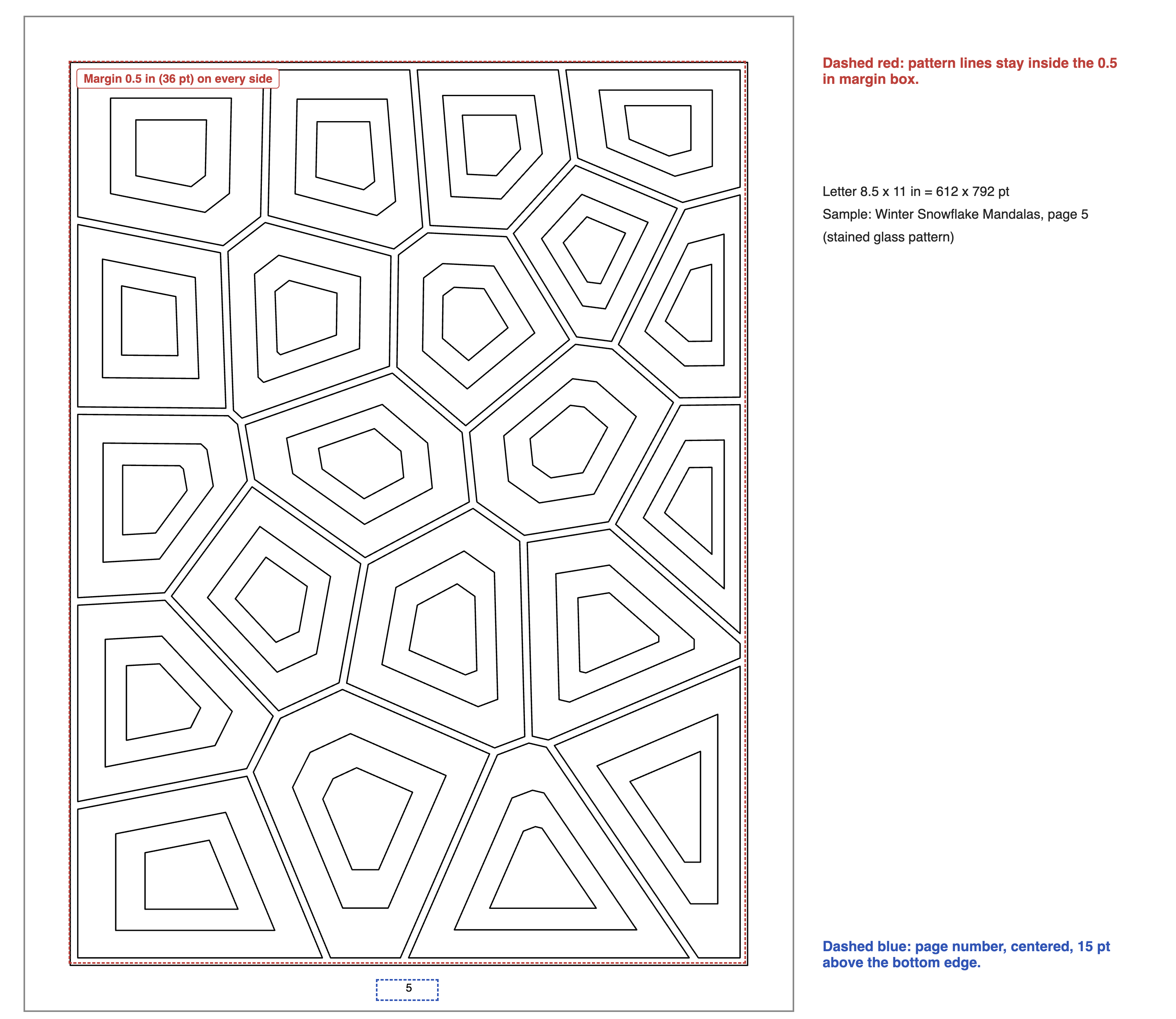
The automatic checks
After building a book, the agent runs a verification pass over the files. Errors stop the agent from calling the book finished. Warnings do not stop it, but the agent tells you how many there are. This table lists what the verification pass actually does, and nothing more.
| Check | What it looks at | If it fails |
|---|---|---|
| Page count | The record lists exactly your pattern pages plus 2 (cover and owner page) | Error |
| PDF present | The PDF file exists | Error |
| PDF structure | The file starts and ends correctly, the cross-reference table points at real objects, the page tree is consistent, stream lengths match, and the PDF has the expected number of pages | Error |
| Paper size | Every PDF page has the media box of the chosen paper | Error |
| PDF size | Under 50 MB. A warning appears over 25 MB | Error over 50 MB, warning over 25 MB |
| PDF matches the record | The PDF fingerprint equals the one in the record | Error |
| No fills in the PDF | The PDF art contains no fill operators | Error |
| Line weight in the PDF | No line thinner than 0.5 pt | Error |
| SVG files present | Every page in the record has its SVG file | Error |
| SVG matches the record | Each SVG fingerprint equals the one in the record | Error |
| SVG view size | Each SVG's view box equals the chosen paper | Error |
| No fills in the SVG | No fill color anywhere in the art, in attributes or styles | Error |
| Every path unfilled | Each drawn path is marked as not filled | Error |
| Line weight in the SVG | No path or group thinner than 0.5 pt | Error |
| Margins | No point of any drawn line lies inside the 36 pt margin | Error |
| Something drawn | Each page has at least one path | Error |
| SVG size | A single SVG over 2 MB | Warning |
| Narrow gaps | On pattern pages, sampled points on lines that have a nearly parallel neighbor closer than the narrow-gap limit (twice the line thickness, at least 2.5 pt). More than 15% of samples gives a warning | Warning |
| Reproducibility | The book is rebuilt twice from the same settings and all fingerprints must match each other and the record | Error |
| Build warnings | Warnings raised while building, for example the non-English title notice | Warning |
What the checks do not tell you: whether a page looks good to you, whether a print service accepts the file, or how your printer renders thin lines. The narrow-gap check is sampling-based, so it flags likely hard-to-color places but does not catch every one.

Three example books, from input to check result
These three books were built and checked by the product itself. Every number below is taken from the actual output. The titles and themes are fictional.
Example 1: Winter Snowflake Mandalas
Input: title "Winter Snowflake Mandalas", theme Winter Snowflake, mood delicate, difficulty 3, 14 pattern pages, Letter, seed 11.
Layout: 16 pages in total. Page 1 is the cover (a snowflake). Page 2 is the owner page (a mandala). Pages 3 to 16 are pattern pages: 5 snowflake, 5 mandala and 4 stained glass, repeating snowflake, mandala, stained glass. Line thickness is 1.05 pt (difficulty 3 gives 1.2 pt, delicate takes away 0.15 pt). Paper is 612 x 792 pt.
Check result: passed with 0 errors and 0 warnings. The PDF has 16 pages and is 1,571,230 bytes (about 1.5 MB). It has 0 fill operators and 0 reproducibility mismatches. The 16 pages hold 2,448 paths in total, from 64 to 322 per page. The highest narrow-gap ratio on any pattern page is 0.023, far under the 0.15 warning limit.
Example 2: Ocean Wave Patterns
Input: title "Ocean Wave Patterns", theme Ocean Waves, mood calm, difficulty 2, 12 pattern pages, A4, seed 22.
Layout: 14 pages. Page 1 is the cover (waves). Page 2 is the owner page. Pages 3 to 14 repeat waves, spiral, truchet four times (4 of each). Line thickness is 1.6 pt (difficulty 2 gives 1.5 pt, calm adds 0.1 pt). Paper is 595.28 x 841.89 pt.
Check result: passed with 0 errors and 0 warnings. The PDF has 14 pages and is 550,606 bytes (about 538 KB). It has 0 fill operators and 0 reproducibility mismatches. The pages hold 1,462 paths in total, from 14 to 177 per page. The narrow-gap ratio on pattern pages runs from 0.001 to 0.067.
Example 3: Garden Geometry
Input: title "Garden Geometry", theme Spring Garden, mood playful, difficulty 4, 16 pattern pages, 8.5x8.5in, seed 33.
Layout: 18 pages. Page 1 is the cover (floral). Page 2 is the owner page. Pages 3 to 18 repeat floral, mandala, mosaic: 6 floral, 5 mandala and 5 mosaic pages. Line thickness is 1.05 pt (difficulty 4 gives 1.0 pt, playful adds 0.05 pt). Paper is 612 x 612 pt.
Check result: passed with 0 errors and 0 warnings. The PDF has 18 pages and is 3,219,876 bytes (about 3.1 MB). It has 0 fill operators and 0 reproducibility mismatches. The pages hold 5,284 paths in total, from 50 to 381 per page. The highest narrow-gap ratio is 0.126, the closest of the three books to the warning limit, and still below it. That is typical of a difficulty 4 book, where dense pages leave less room.
These numbers show what the checks measured on these three books. They do not predict the result for every possible input.
How this differs from image-generation coloring book services
Some services build coloring books by asking an image-generation model to draw each page from a text prompt. ColorPages works differently, and neither approach is better for everyone. Here is an honest side-by-side. The right column describes typical behavior of that kind of service in general. Services differ, so check the one you are comparing.
| Question | ColorPages | Image-generation coloring book services (typical) |
|---|---|---|
| Can it draw a specific animal, person or scene? | No. Patterns only. This is the main limitation | Usually yes. This is their main strength |
| Can you ask for "my dog in a garden"? | No | Often yes, with varying accuracy |
| Subject variety | 12 themes, 10 pattern types, endless variations by seed | Very open-ended, limited by the prompt and the model |
| Are the shapes closed and colorable? | Mostly. Petals, polygons and circles are closed shapes | Varies by prompt and by run. Open or messy line areas can happen |
| Fills or gray areas | None. Outlines only, checked automatically | Varies. Some output may have shading or gray tones |
| Same input, same result? | Yes. Same settings and seed reproduce the same files, and this is verified | Usually not. Results change from run to run |
| File type | Vector PDF and per-page SVG | Often raster images. Check the format you receive |
| Ready-made book structure | Cover, owner page, page numbers, one paper size per book | Varies. Often single images you assemble yourself |
| Automatic file checks | Yes, listed above | Rarely described in detail |
| Control over line thickness | Yes, through difficulty and mood | Limited |
| Control over detail level | Yes, difficulty 1 to 5 | Through prompt wording |
| Cost to run an image model per page | None here, because no image model is used | A model is used per image |
| Lettering on the cover in the PDF | English letters, digits and basic symbols only | Varies |
| Personal touches (names in artwork, a pet, a landmark) | Not possible beyond the cover title and owner page | Possible to some degree |
| Surprise factor | Patterns are clean and orderly, rarely surprising | Can be surprising, for better or worse |
Choose ColorPages if you want clean, consistent, repeatable pattern books with a book structure and file checks. Choose an image-generation service if you want pictures of particular things.
Before you sell or print
This is general information and not legal advice. You are responsible for confirming each item below before you publish or sell.
- Platform rules. Check the current rules of every marketplace or print-on-demand service you plan to use, including how they treat computer-generated content, minimum page counts, repeated or low-content books, cover and metadata rules, and adult-audience labeling. These pages are made by code, not by an image-generation model, but how a platform classifies that is for the platform to say. Ask their documentation or support.
- Print specifications. Paper size, margins, bleed, file format, font embedding and whether the cover must be uploaded separately all differ by printer. ColorPages gives general values only: 0.5 in margins, no bleed, no crop marks, PDF 1.4, built-in Helvetica font reference, no embedded fonts.
- Your rights to sell. What you may do with the output is governed by the terms of this product and the marketplace you use. Nothing in this description grants any right.
- Similar books. Many books built with the same settings look alike. Change theme, mood, difficulty and seed, and judge for yourself whether your books are different enough for readers and for platform rules.
- Do a test print. No real print was made for this product. The agent will say so too. Print one or two pages at 100% scale on your paper before ordering a batch.
- No promises. Nothing here promises sales, income or acceptance by any platform.
What the checks cover: file structure, page count, paper size, margins, minimum line weight, no fills, and reproducibility. What they do not cover: platform approval, print service compatibility, visual taste, and sales results.
Plans and price
| Plan | Price | Included runs |
|---|---|---|
| Weekly | US$5.99 | 15 runs per week |
| Monthly | US$12.99 | 50 runs per month |
There is no free trial. The platform's plan page defines exactly what counts as one run and how renewal works, so read it before you subscribe. The agent does not charge or process payments by itself.
Frequently asked questions
1. Is this made by an image-generation model?
No. Every page is drawn by code from a numeric seed. No image model is called.
2. Can it draw animals, people or characters?
No. It draws patterns only. If you ask for a cat, the agent says it cannot draw one and offers the closest pattern theme, such as Spring Garden or Geometric Calm.
3. Is it for children?
No. It is made for adults, and the cover says "A Coloring Book for Adults". Requests for children's content are outside this product.
4. What do I receive?
A PDF, one SVG for each page, a composition record (book.json), and a chat summary with the page list and check results.
5. How many pages can I make?
1 to 100 pattern pages. The cover and the owner page are added, so a book with 12 pattern pages has 14 pages.
6. Which paper sizes are supported?
Letter, A4, 8.5 x 8.5 in and 8 x 10 in.
7. Can I print on both sides?
The layout assumes single-sided printing. The product does not insert blank back pages. If your printer or service needs them, add them yourself or follow that service's rules.
8. What does difficulty change?
The number of regions, how fine the details are, and the line thickness. Difficulty 1 uses about 1.8 pt lines with large regions. Difficulty 5 uses about 0.85 pt lines with very fine detail.
9. What does mood change?
Only the line thickness, by small steps between minus 0.15 pt and plus 0.35 pt. Bold is thickest and delicate is thinnest.
10. What is the seed?
A number that controls the random choices. The same seed with the same settings gives the same book. A different seed gives a different book in the same style.
11. Can I get exactly the same book again?
Yes. Keep the title, theme, mood, difficulty, pages, paper and seed. The agent also verifies that rebuilding gives identical file fingerprints.
12. Can I mix difficulties in one book?
Not in this version. One book has one difficulty. Make separate books for separate levels.
13. Can I choose which pattern appears on which page?
Not directly. The theme decides the pattern order and pages cycle through it. You can ask for a different theme or a different page count to change what you get.
14. Can I get a single pattern page instead of a book?
Yes, you can ask for a one-page book, or ask the agent for a single pattern at a chosen seed and difficulty as one SVG page.
15. Can I use a Korean title?
You can, but the PDF cover cannot show it. The PDF cover shows the fixed text "Coloring Book". The SVG cover shows your real title, and the agent warns you each time. Use the SVG cover, or add a title in your own layout tool.
16. Why does the PDF cover not show my non-English title?
The PDF uses a built-in basic font that has no Korean letters and no embedded fonts. Fixing this would need embedded fonts, which this version does not have.
17. Does the agent ever hide a failed check?
No. If a check ends with an error, the agent says the book is not finished, explains the reason, retries once with a different seed or a lower difficulty, and reports the outcome either way.
18. What is a narrow-gap warning?
On pattern pages the checker samples points along the lines and counts those with a nearly parallel neighbor that is too close, which makes coloring hard. If more than 15% of samples are like that, you get a warning. Lower the difficulty by one step, or switch the mood to bold, to reduce it.
19. If the checks pass, will the print be good?
No. They verify the files, not your printer. Print a test page at 100% scale.
20. Can I sell the books I make?
That depends on this product's terms, your sales platform's rules and your local rules. This description is not legal advice. See "Before you sell or print".
21. Will a platform accept these books?
Nobody here can say. Check the platform's current policies on computer-generated content, repeated content, minimum pages and adult labeling.
22. Are the pages hand-drawn quality?
No. They are procedurally generated patterns. They are clean and orderly, but they are not hand-drawn illustrations, and the product does not claim otherwise.
23. Why are curves slightly faceted if I zoom a lot?
Curves are stored as many short straight segments. At normal print sizes they look smooth. At extreme zoom you may see tiny corners.
24. Why is the spiral pattern so simple?
The spiral is a central spiral band with rings of half-moon shapes. It is the plainest of the ten patterns, so do not expect the detail of a mandala or a snowflake from it.
25. Can I color on screen instead of printing?
The SVG pages are plain line art and open in many drawing apps. This was not tested in specific apps, so try one page first.
26. How big are the files?
It depends on difficulty and pages. The three example books produced PDFs of about 0.5 MB (14 pages), 1.5 MB (16 pages) and 3.1 MB (18 pages). In a stress build of 100 pages at difficulty 5 with the Cosmic Mandala theme on Letter, the PDF was 13,245,604 bytes, passed with no errors and gave 33 narrow-gap warnings.
27. What if I want a bigger margin or a different line color?
Those are not options in this version. The margin is fixed at 0.5 in and the line is black.
28. Are there bleed or crop marks?
No. If your print service needs bleed, this version does not provide it.
29. Is there a free trial?
No.
30. Where do I get help?
Ask in this chat, or contact the seller through the platform's message system.
Limits, stated plainly
- Patterns only. No animals, people, characters, lettering art or scenes. This is the largest limit of the product.
- No named designs. Brand, character, trademark and culture-specific design requests are declined, and a general geometric or natural alternative is offered.
- The PDF cover uses a built-in basic font. Titles with Korean, other non-English letters or unusual symbols show as the fixed text "Coloring Book" on the PDF cover. The SVG cover shows the real title, but how it looks depends on the fonts available on the device that shows it. In our check, a 14-character Korean title fit inside the cover frame in a web browser. The text width for non-English titles is only estimated, so a very long title may sit close to or beyond the frame. Keep such titles short.
- The PDF has no embedded fonts. It references a basic standard font for the cover, the owner page text and the page numbers.
- The PDF file name. Titles that are not plain English letters and digits produce the file name coloring-book.pdf.
- No real print test. We have not printed these books on a physical printer, so we cannot state how thin lines will look on your paper. Print a test page.
- Curves are polylines. Curved lines are made of many short straight segments.
- The narrow-gap check is sampling-based. It flags likely trouble but does not find every tight spot. Strapwork pointed tips and very dense mandalas at high difficulty can still have tiny areas.
- Visual quality is not machine-checked. Balance and taste are yours to judge.
- Higher difficulties make bigger files. Mandala, snowflake, mosaic and truchet at difficulty 4 or 5 can produce larger files and more narrow-gap warnings. In a 100-page difficulty 5 Cosmic Mandala stress build, 33 pages carried a narrow-gap warning. Lowering one level or using the bold mood helps.
- The spiral pattern is simple. It is the plainest of the ten patterns.
- One difficulty and one paper size per book. No mixed difficulty within a book.
- Single-sided layout only. No blank back pages are inserted.
- No bleed, no crop marks, no cover separation. The cover is page 1 of the same PDF.
- Theme matching is approximate. A theme gives the right mood and kinds of shapes, not a literal picture of the word you typed.
- Adults only. Children's content is outside the scope.
- Run-based plans. The number of runs depends on your plan and the platform's own rules.
- Preview coverage. The preview images show five of the ten pattern types, the three example books' check results, and layout pages. Other pattern types are described in text.
- No promises. No result is promised in sales, income, platform approval or print quality.
Support
Ask your question in this chat. Tell the agent your settings (title, theme, mood, difficulty, pages, paper, seed) and the page number you are unsure about, and it can rebuild or adjust the book for you. For billing and plan questions, use the platform's own pages.