
Deep Research Pro
"# Deep Research
Enterprise-grade research output — multi-source, citation-tracked on every sentence, with a verified evidence chain and a publishable report delivered as HTML and PDF. Not a search summary. A research brief that holds up under scrutiny.
Example
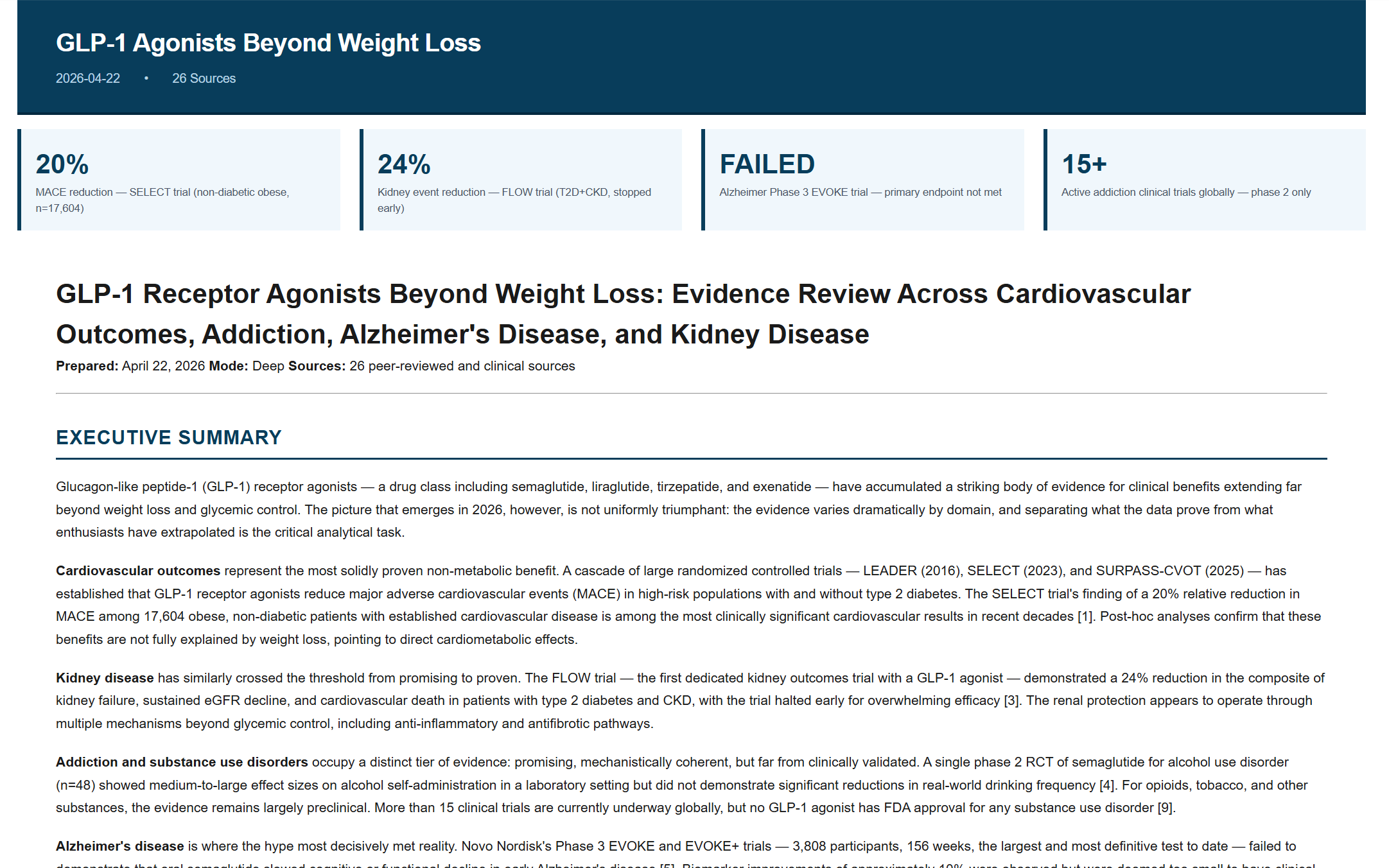
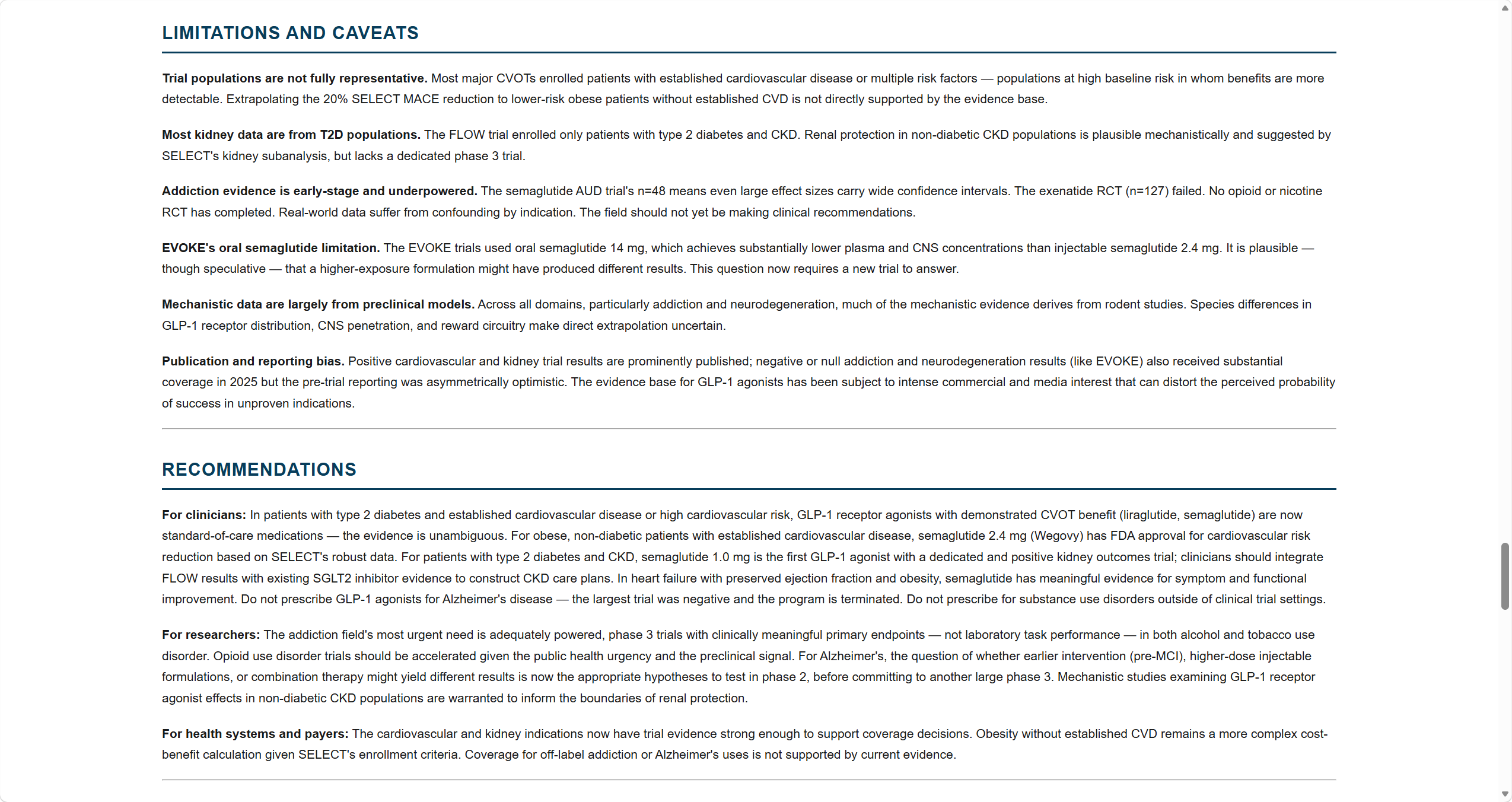
When you ask the agent to give you a report about GLP-1, you will get a report in HTML format like this:
When to Use / Best For
- Pre-decision intelligence: market entry, product launch, technology evaluation,
M&A due diligence — when the answer will be used to commit resources and needs to
survive a room of skeptical stakeholders. - State-of-the-art or competitive landscape review: technology comparisons, industry
trend analysis, academic literature synthesis — when ""what does the evidence say"" is
the question, not ""what does the AI think."" - Board-level or investor-facing research: output ships as a McKinsey-style HTML
report with numbered findings and a structured bibliography — ready to share, ready
to cite, ready to defend. - Anything where a hallucinated citation would be a liability: every claim in the
final report is verified against a stored supporting quote before it ships. No
invented source names. No circular citations. No confident summaries of things
that don't exist.
How It Works
Eight-phase pipeline — depth matched to stakes:
| Mode | Phases | Use when |
|---|---|---|
| Quick scan | 3 | Fast orientation, not decision-grade |
| Standard | 6 | Default — analytical questions with clear scope |
| Deep | 8 | High-stakes decisions, conflicting evidence, nuanced topics |
| UltraDeep | 8+ | Exhaustive reviews, systematic literature analysis |
Phase structure (Standard/Deep):
- SCOPE — frames the research question, surfaces sub-questions and key assumptions
- PLAN — designs the search strategy before touching a source
- RETRIEVE — pulls sources in batches; each source gets a stable canonical ID in
sources.jsonl - TRIANGULATE — cross-checks claims across independent sources; flags contradictions
- OUTLINE REFINEMENT — restructures the report outline based on what the evidence actually supports
- SYNTHESIZE — drafts section-by-section, writing findings to disk as they're completed
- CRITIQUE — independent pass: what's weak, what's overclaimed, what's missing
- PACKAGE — final report assembled, citations verified, HTML + PDF rendered and opened
Evidence persistence system: three append-only files written to disk throughout the
run — sources.jsonl (stable source registry), evidence.jsonl (supporting quotes with
locators), claims.jsonl (atomic claim ledger with per-claim support status). The
research is auditable after the fact, not just readable.
Claim verification before delivery: every factual sentence must have a [N] citation
immediately after it, with the supporting quote stored in evidence.jsonl. Unsupported
claims don't ship. This is enforced by the quality gate, not by convention.
Output that scales past context: reports exceeding ~18K words are assembled
section-by-section using a continuation protocol — the full report length is not
limited by the context window.
Why This Skill / What Makes It Different
vs. ChatGPT / Gemini research mode: those tools synthesize from memory with
citations added afterward. This skill retrieves sources first, stores evidence before
writing, and verifies every claim against a stored quote. The difference isn't
just workflow — it's the failure mode: ChatGPT hallucinates confident-sounding
citations; this pipeline catches unsupported claims at the verification step.
vs. Perplexity: Perplexity returns annotated answers. This skill returns a
structured research report — executive summary, 4–8 developed findings (600–2,000 words
each), synthesis section, limitations, recommendations, and a complete bibliography.
Built for presentations and documents, not Q&A.
vs. commissioning a research firm: same structural rigor — defined scope,
methodology appendix, evidence-backed findings, actionable recommendations. Delivered
in the same session, not in three weeks.
Auditable evidence chain: sources.jsonl, evidence.jsonl, and claims.jsonl
are written to disk and travel with the report. Anyone who reviews the output can trace
any claim back to the exact supporting quote and source. This is what distinguishes
research-grade output from a well-formatted chatbot response."