Global Stock Market Analysis
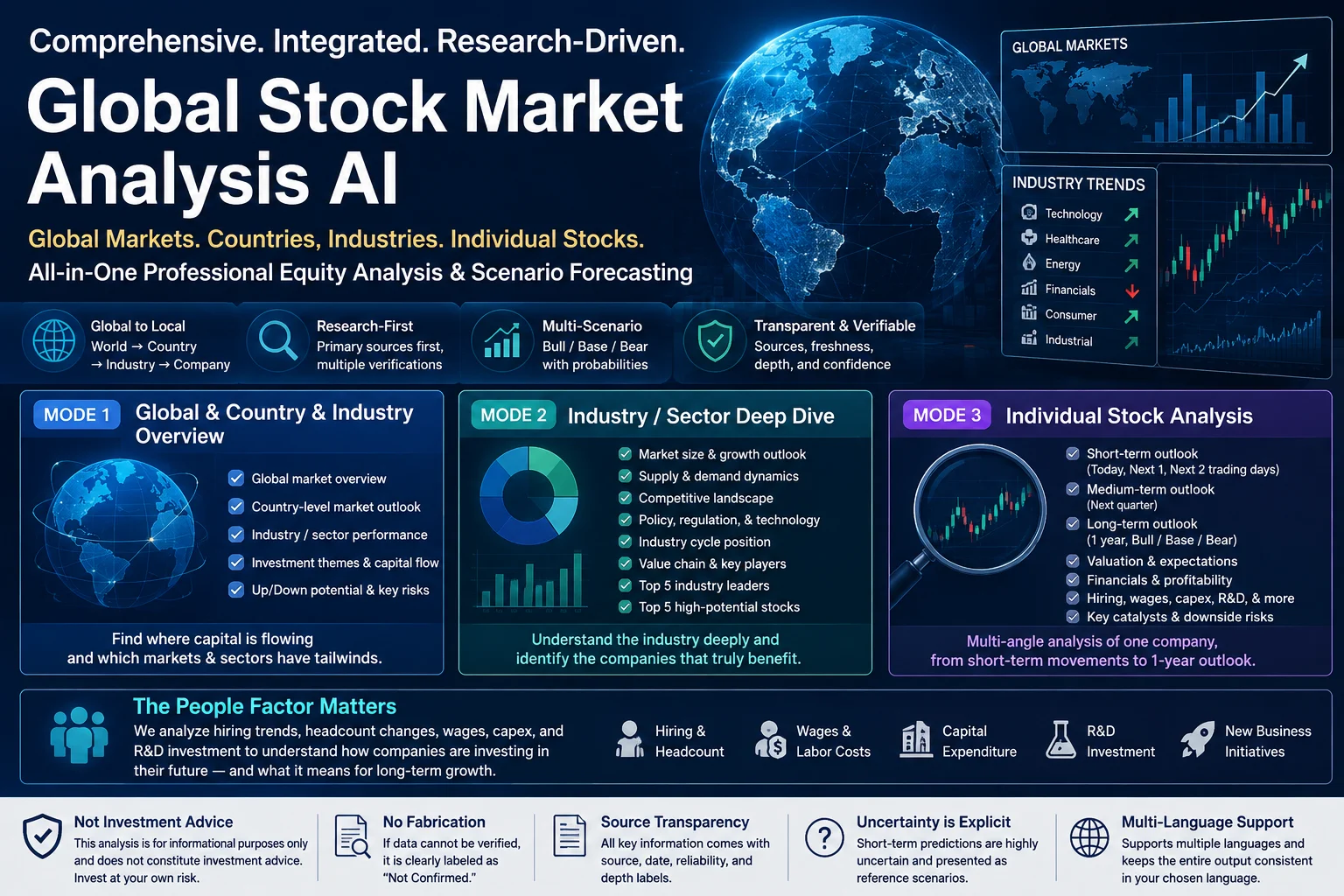
📈 Analyze global stock markets based on "structure," not just intuition.
When watching the news, you might think:
"This stock looks like it will rise."
"This industry seems poised for growth."
However, it is not easy to clearly articulate:
Why will it rise?
Has that expectation already been priced into the stock?
Conversely, what events could cause it to fall?
This tool offers more than just simple price forecasting.
It is a practical, integrated stock analysis skill that organizes the complex stock market from multiple angles—analyzing everything from global and national markets to specific industries, investment themes, and individual stocks.
🔍 Three modes to analyze exactly what you want to know
MODE 1 | Global, National, and Industry Analysis
"Which industries in which countries are currently strong?"
By taking a bird's-eye view of the global market,
you can analyze the flow from Global → Country → Industry → Theme.
Compare the upside potential and downside risks across countries and industries to identify markets and themes worth watching.
MODE 2 | In-Depth Industry Analysis
"What is the future outlook for this industry?"
Analyze factors such as market size, growth rates, supply and demand, industry cycles, the competitive landscape, government policy, and technological innovation.
Furthermore, the tool organizes details including:
- Top 5 representative companies in the industry
- Top 5 companies with the most significant upside catalysts
- The industry's growth stage
- Supply chain structure
Go beyond looking at famous names to identify companies truly positioned to benefit from the industry's growth.
MODE 3 | Detailed Analysis of Individual Stocks
Specify a company name or ticker symbol to analyze a single company from multiple perspectives.
For the short term,
analyze the price direction and projected fluctuation range for today, the next trading day, and the day after.
For the medium-to-long term,
organize outlooks for one quarter and one year ahead using multiple scenarios: bullish, base, and bearish. ---
📊 It’s Not Just About Whether It’s a "Good Company"
This skill set focuses on more than just
determining whether a company is "good" or not.
Even an outstanding company won't necessarily see its stock price rise if expectations for its growth are already priced in.
Therefore, we conduct a comprehensive analysis of:
Corporate Performance × Valuation × Industry Environment × Market Expectations
We also analyze the extent to which
the current stock price already reflects future growth.
👥 Focusing on "People" for a One-Year Outlook
Standard stock analysis tends to center on
figures like sales, profits, PER, and PBR.
This approach goes further by analyzing factors such as:
- Changes in employee headcount
- Hiring trends
- New graduate vs. mid-career recruitment
- Salaries and personnel costs
- Capital expenditure
- R&D
- New business initiatives
In short, we analyze
what the company is investing in for the future.
However, we avoid making simplistic judgments like
"hiring more staff means the stock price will rise"
or "cutting staff means the price will fall."
We analyze the underlying reasons:
Why are they increasing staff?
Why are they reducing staff?
📰 Don't Fabricate Information When It's Unavailable
Reliability in information gathering is a key priority.
We prioritize primary sources and verify critical information across multiple sources whenever possible, while also tracking the reference dates and recency of the data.
Most importantly,
we do not fabricate plausible-sounding data when the actual information is unavailable.
Information that cannot be verified is labeled "unverified," and the use of proxy indicators is clearly disclosed.
We also organize details regarding:
- Information reliability
- Depth of analysis
- Recency of information
- Sources
- Scope of research
📈 Deciphering the Future, Not Just "Predicting" Stock Prices
There is no such thing as a 100% accurate prediction in the stock market. That is precisely why this skill clarifies:
What triggers a rise in price
What triggers a decline in price
What the current stock price already reflects
What information is missing
For short-term forecasts, it identifies direction and volatility ranges.
For the medium-to-long term, it outlines multiple scenarios: bullish, base, and bearish.
Rather than making definitive predictions about the future, it organizes the uncertainties of the stock market into a format that facilitates informed decision-making.
That is the essence of this practical, integrated stock analysis skill.
From global markets and specific industries to the future of an individual company—
experience a multifaceted approach to stock analysis that goes beyond mere intuition.
This Agent’s analysis is intended solely for information and research support; it does not recommend the purchase or sale of any specific financial instruments. It does not guarantee future stock prices or earnings. Please make all investment decisions at your own discretion and consult a financial professional if necessary.