
Podcast Audio Overview — Local Kit (Download)
Podcast Audio Overview
What you're buying: a one-time purchase download package (skill instructions + Python scripts) that runs on your own computer inside your own AI agent — it is not a cloud service.
You need: an AI agent that supports skills (e.g. Claude Code or Codex) — its subscription or API costs are yours; Python 3.9+, ffmpeg andedge-tts.
Third-party services: voices come from Microsoft's free online text-to-speech viaedge-tts(each dialogue line is sent to generate audio). If you give a URL as the source, that page is downloaded. Your files are read locally. No API keys.
One document in, a ready-to-publish two-host podcast episode out — and every fact the hosts say can be traced back to your source.
What you get
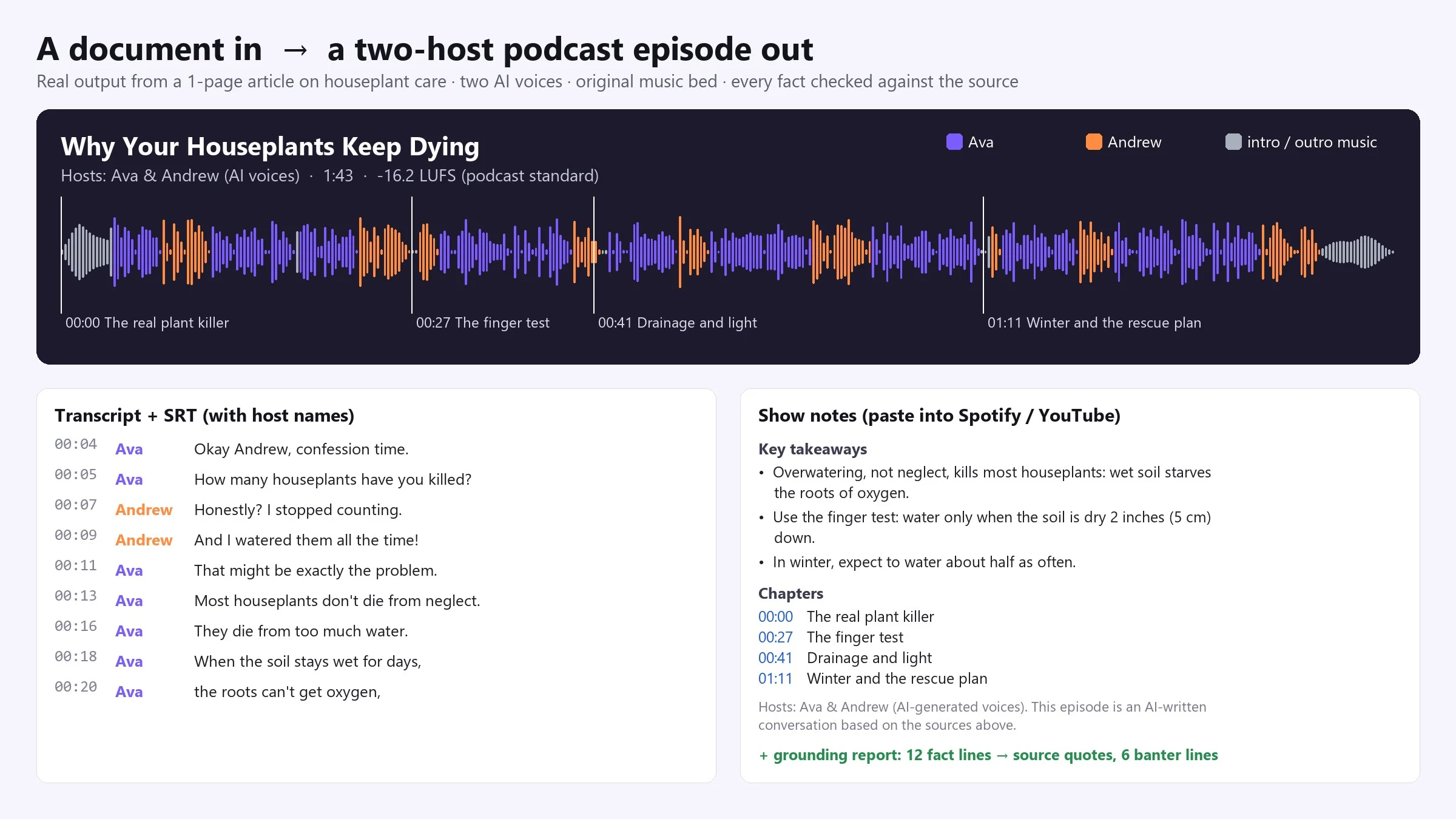
- 🎙️ Podcast MP3: two hosts in a natural back-and-forth, two different AI voices, an original intro/outro music bed that ducks under speech, mastered to the podcast loudness standard (-16 LUFS)
- 📝 Show notes: summary, key takeaways, chapter timestamps (paste into Spotify or YouTube), sources and an AI disclosure
- 💬 SRT captions with host names — turn the episode into a video or upload captions
- 📄 Full transcript with timestamps
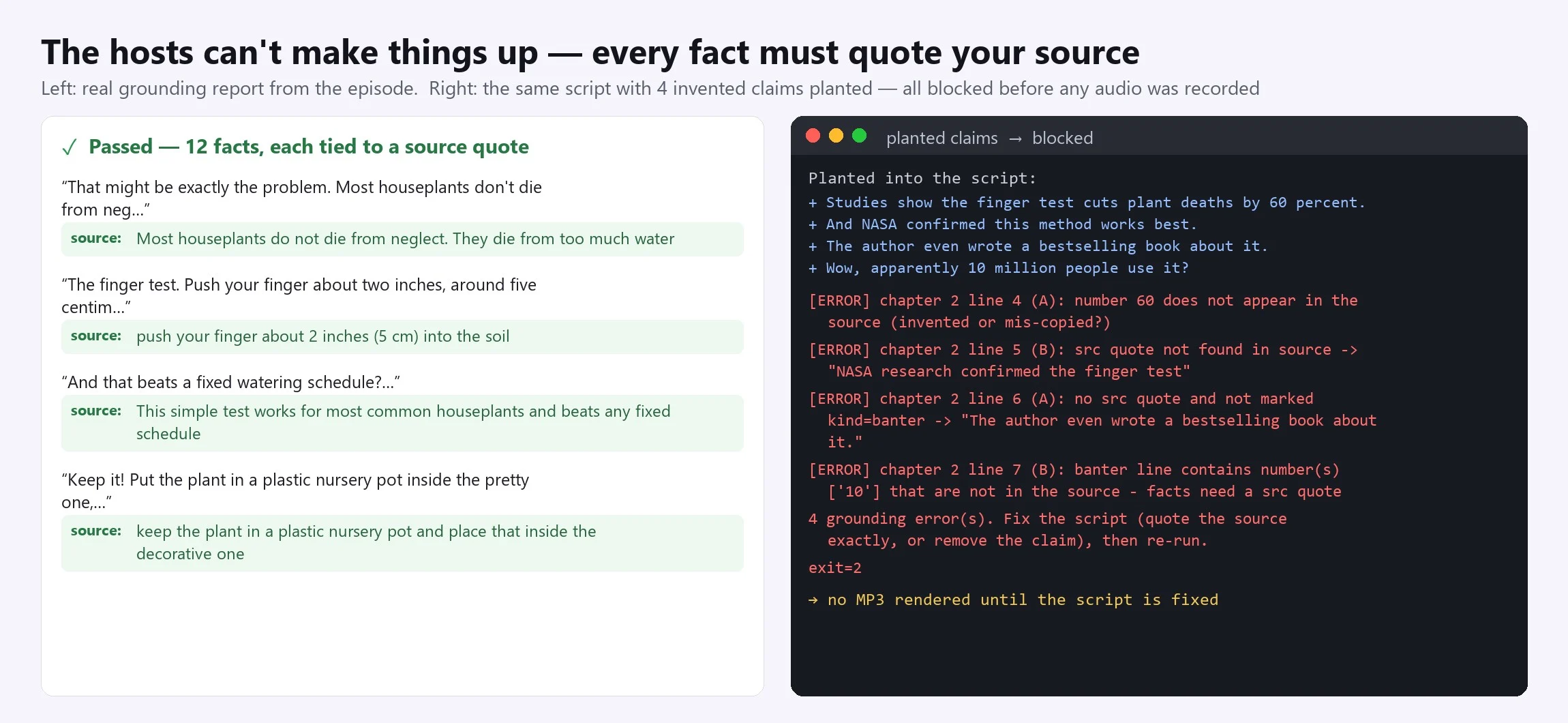
- 🔍 Grounding report: every fact line mapped to the source passage it came from
Example
A one-page article on houseplant care became "Why Your Houseplants Keep Dying": 1 min 43 s, hosts Ava and Andrew, 4 chapters, -16.2 LUFS. The grounding report tied all 12 fact lines to exact quotes from the article; the other 6 lines were questions and reactions with no new facts.
Then 4 invented claims were planted in the script — "cuts plant deaths by 60 percent", "NASA confirmed this method", "the author wrote a bestselling book" and "10 million people use it" — all 4 were blocked before any audio was recorded.
A Traditional Chinese episode on the Pomodoro technique (2 min 21 s, 26 lines, 5 chapters, -16.3 LUFS) passed the same check; when it was run back through speech recognition, every line was transcribed correctly.
Try it — copy a prompt
- "Turn
onboarding_guide.pdfinto a 6-minute two-host episode for new employees, hosts Maya and Leo." - "Make a short podcast from this blog post: https://example.com/my-article — English, upbeat, with show notes."
A podcast that doesn't make things up
The biggest risk with AI conversations is that they sound smooth but the content is invented. Every line in this skill is one of two kinds:
- Fact lines must carry a word-for-word quote from your source, and the checker finds it there
- Banter lines — questions, reactions, transitions — can't introduce new facts
Numbers must match the source. Quotes that can't be found, numbers that don't match and fact lines without a source are blocked and must be fixed. Recording only starts once the check passes.
Sources it reads
Article URLs, PDFs with a text layer, Word, Markdown and plain text — several at once.
Three lengths
- Short, 3–4 min: a quick overview
- Standard, 6–8 min: a full introduction
- Deep dive, 10–12 min: long articles, reports and course material
You can change
- Host names, voices (400+ edge-tts voices including English, Chinese and Japanese) and speaking rate
- Your own intro/outro music, or none
- Pronunciation of tricky names (the captions keep the correct spelling)
- Any line — only changed lines are re-recorded
Why buy it
One payment, unlimited episodes — and unlike one-click audio overview tools, you can edit every line, pick the voices and get a publish-ready MP3 with captions and show notes.
Who it's for
Bloggers and newsletter writers adding an audio channel, trainers and HR turning SOPs into commute-friendly audio, teachers and students turning notes into review episodes, and anyone making content accessible to people who prefer listening.
Requirements
- Python 3.9+ and ffmpeg (the skill checks your setup first and tells you what's missing)
pip install -U edge-tts(addpypdfium2 python-docxfor PDF and Word)- An internet connection (speech uses Microsoft's free voice service)
Limitations (please read)
- This is AI-generated content: the dialogue is AI-written and the voices are synthetic. Keep the AI disclosure in the show notes and label it as platforms require.
- The checker confirms quotes really exist and numbers match, but you should still listen before publishing to make sure paraphrases keep the meaning.
- The hosts don't add knowledge beyond your sources; to add background, provide it as another source.
- Only built-in standard voices — no voice cloning, and no imitating real people or real shows.
- Only publish content you have the rights to; turning someone else's paid article into a public podcast may infringe copyright.
- Scanned PDFs without a text layer can't be read; OCR them first.
- It relies on Microsoft's free speech service; if that service changes, the author will update compatibility (free updates for buyers).
Files
SKILL.md— agent workflowscripts/extract_source.py— reads PDF / Word / URL / text into one source filescripts/make_podcast.py— grounding check, speech, mixing, loudness, captions and show notesreferences/dialogue-guide.md— how to write a two-host scriptreferences/episode-schema.md— script formatreferences/example_zh.json,example_en.json— Chinese and English example scripts (with source articles)
