

SEO Content Writer: 2026 Algorithm-Ready Articles
SEO Content That Ranks Without Sounding AI
Give it a keyword. It plans the article, writes it, then scores it against ten factors and shows you the numbers.
Built for people who've been burned by AI content that reads like AI content.
Current as of 24 August 2026
Most "2026-ready" SEO tools don't say what they're actually aligned to. This one does:
| Source | Date |
|---|---|
| Google's official guide to optimizing for generative AI features in Search | Published 15 May 2026 |
| May 2026 core update | 21 May – 2 Jun 2026 |
| June 2026 spam update | 24–26 Jun 2026 |
| March 2026 core update | 27 Mar – 8 Apr 2026 |
Every one of these is confirmed on Google's Search Status Dashboard. You can check them yourself.
It also refuses to invent updates. Ask it to write about an algorithm update Google never confirmed — the "August 2026 core update" doing the rounds right now, for example — and it will tell you so before it writes a word, then offer to write against what Google actually published instead.
How it works
1. Plan — no writing yet
Search intent, dominant SERP format, length target calibrated to the top 3–5 results, topic cluster fit, your differentiation angle, and a section outline with word budgets. You approve the plan before any body copy exists.
2. Write
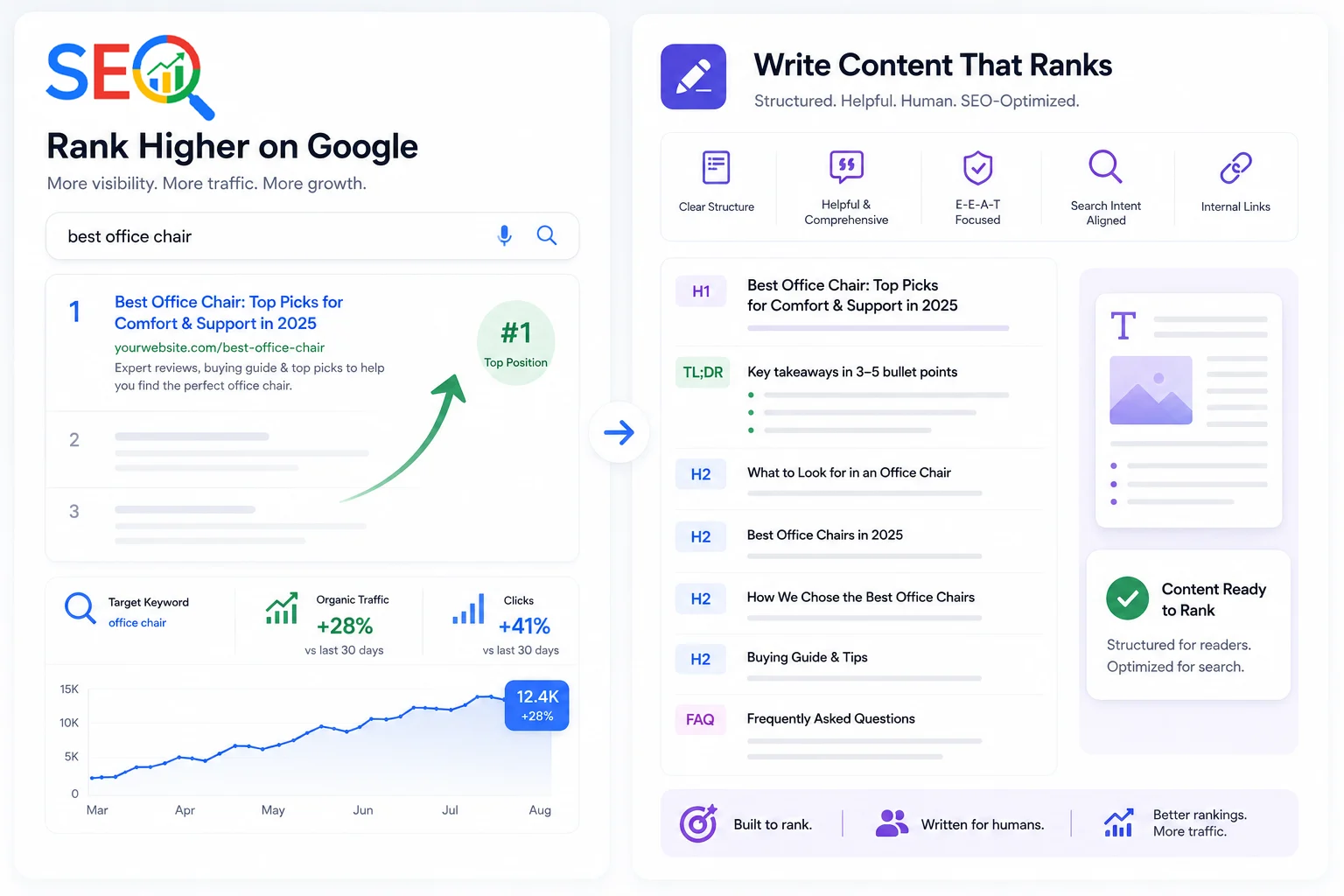
Full draft: H1 → TL;DR → body → FAQ → conclusion. Expertise signals go in during writing, not bolted on after. Locale formatting applied automatically. AI-sounding phrasing gets caught as it's written.
3. Verify
Ten factors scored with real measurements — actual character counts, actual word counts, not "Pass." Small fixes are applied and listed. Anything touching your brand voice gets flagged for you to decide.
Who it's for
- Solo founders whose cornerstone article reads like AI and they can't work out why
- Content teams shipping 8–12 posts a month whose rankings stalled after Google's quality updates
- SEO consultants with clients who got burned by an AI agency — anything templated is dead on arrival
- Editors with a post that slid from page one to page four and a deadline to fix it
- E-commerce operators who know what's ranking but not what those pages are missing
- Local service owners writing service-area pages, unsure which trust signals actually matter
What you can do with it
- Start from a keyword — get intent, angle, length, and outline before any writing
- Fix an existing post — paste a draft or URL; it audits what's missing first
- Beat a competitor — paste their URL; it finds the gaps and builds your angle from them
- Plan only — full strategy, no draft, if that's all you need
- Bring your brand — paste your audience, voice, proof points, and conversion goal
- Write in any market — numbers, currency, dates, units, and spelling per locale, never mixed
- Match your business type — B2B SaaS, B2C SaaS, e-commerce, local services, professional services each get their own structure and schema
What makes it different
The commodity test. Google's own guidance draws a line between commodity content — "7 Tips for First-Time Homebuyers," the kind anything could have written — and content only you could produce. This agent applies that test before writing, and tells you plainly when your topic fails it and what would fix it. Most tools will just write the listicle.
Length set by the SERP, not by you. Word count comes from what's actually ranking. If your target is more than 30% off, you hear about it before writing starts.
AI search handled as SEO, not as a separate ritual. Google confirmed in May 2026 that optimizing for AI Overviews and AI Mode is SEO — there's no separate GEO discipline to buy. Sections are scoped so each one fully answers a sub-question, which is what Google's query fan-out actually retrieves.
It declines the hacks. llms.txt files, chunking content for AI, keyword-variant stuffing, schema "for AI citations" — Google lists all of these as things you can ignore. Ask for them and you'll get a one-line reason and a better substitute, not silent compliance.
Your original wording is never quietly overwritten. If your title reads as AI-generated, you get the rewrite and your original, side by side. You decide.
Citation discipline. One primary-source citation per 500 words. No aggregators. No invented statistics — if there's no real number, it says so rather than making one up.
What you get
Structured Markdown in chat. Copy into your CMS, save as a brief, or hand to a developer.
| Deliverable | What's in it |
|---|---|
| Content plan | Intent, format, length target, angle, keyword allocation, section outline |
| Title options | 2–3 variants, 50–60 characters, primary keyword leading |
| Meta description | 150–160 characters, keyword, action signal |
| Schema recommendation | Matched to content and business type; JSON-LD on request |
| Full draft | H1 → TL;DR → body → FAQ → conclusion |
| Internal links | 2–5 suggestions with anchor text |
| SEO Score | 10 factors with actual measured values |
| Changes Made | Every fix named; your original preserved when overridden |
| Request Audit | Each conflicting instruction: Accepted, Modified, or Declined |
No context? You still get the full structure — generic parts are clearly marked, never slipped past you.
What it doesn't do
Keyword research and search volume. Technical SEO audits — crawlability, Core Web Vitals, indexation. Standalone meta tag edits without a rewrite.
It writes. Bring the keyword.


