SkillSmith Grant Architect
Strong projects lose grants for avoidable reasons — a missed scored criterion, a format breach, a generic Broader Impacts section. Reviewers grade against a rubric, not your prose. This Skill builds that rubric first, then aligns and stress-tests your draft against it.
What it does
Grant Architect is the RFP-compliance-alignment and reviewer-review wedge that subscription suites under-serve. You give it the funding call (NIH, NSF, SBIR/STTR, EU Horizon, federal Grants.gov, or a private foundation) plus your org profile, past results, and — if you have one — your draft. It deconstructs the solicitation into a checkable Requirement-to-Section Matrix, aligns (or drafts) each section against every scored criterion, then switches into a simulated-reviewer voice and scores the result with a prioritized fix list. You get the matrix, the aligned/drafted sections, the self-scorecard, and a clean .docx export.
How it works
An 8-step workflow, matrix-first — no prose is written until the criteria are mapped:
| Step | Output |
|---|---|
| 1. Parse & classify | Extract RFP text; identify funder family to load the right expectations |
| 2. Extract criteria | Pull eligibility, page/word/format limits, scored criteria + weights, attachments, budget cap — verbatim |
| 3. Requirement matrix | A checkable table: each requirement → target section → status (the spine of everything after) |
| 4. Evidence (optional) | deep-research to verify literature/exemplars — all facts flagged for applicant verification |
| 5. Draft to matrix | Each section written against its matrix rows; gaps marked [PLACEHOLDER], never fabricated |
| 6. Budget justification | Every line tied to a specific aim; budget cap respected |
| 7. Self-scorecard | Simulated-reviewer scoring per weighted criterion; weak sections flagged RED/AMBER/GREEN |
| 8. Export | Format-compliant .docx via scripts/build_docx.py; page count re-checked against the RFP |
⭐ Featured example — an NSF Smart Health proposal
Input: "NSF 24-XXX (SCH) solicitation + our lab profile + a partial draft for 'Federated Learning for Early Sepsis Prediction Across Rural Hospitals.' Decode the call and tell me where we'd lose points."
Output — Step 3, the Requirement-to-Section Matrix. Every scored criterion, format limit, and mandatory attachment becomes a checkable row mapped to a target section, with a live coverage status — the Data Management Plan surfaces as NOT STARTED (a compliance blocker) before it can sink the submission:
![Requirement-to-Section Matrix: each RFP criterion mapped to a target section with coverage status]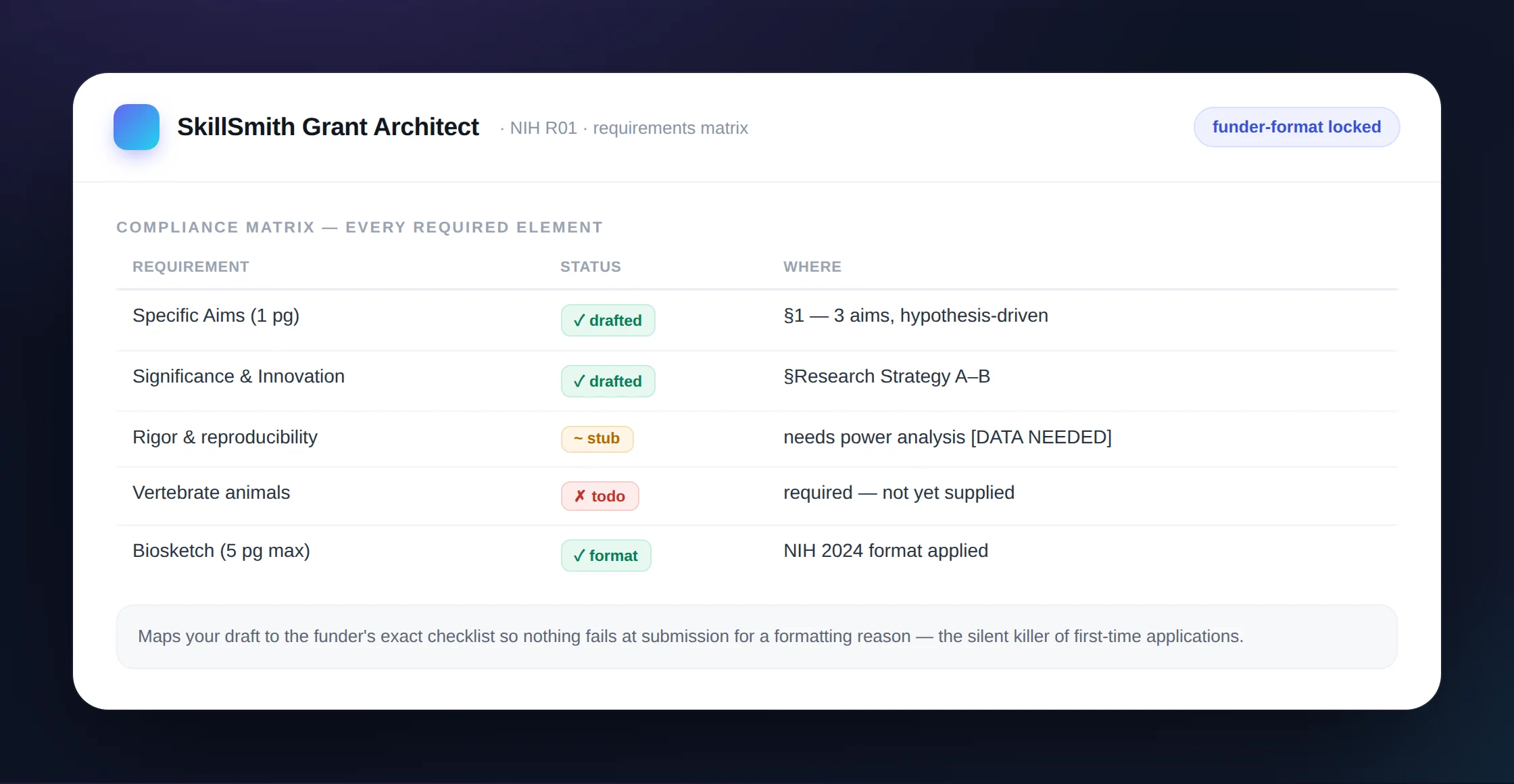
Output — Step 7, the Reviewer-Perspective Self-Scorecard. The Skill scores the draft from a panel's chair against the NSF weights, flags weak sections RED/AMBER/GREEN, and emits a prioritized, doable fix list — here a 70% weighted total, not fundable as-is, with the missing DMP called out as a P0 blocker:
![Reviewer self-scorecard: per-criterion scores, RED/AMBER/GREEN flags, and a prioritized fix list]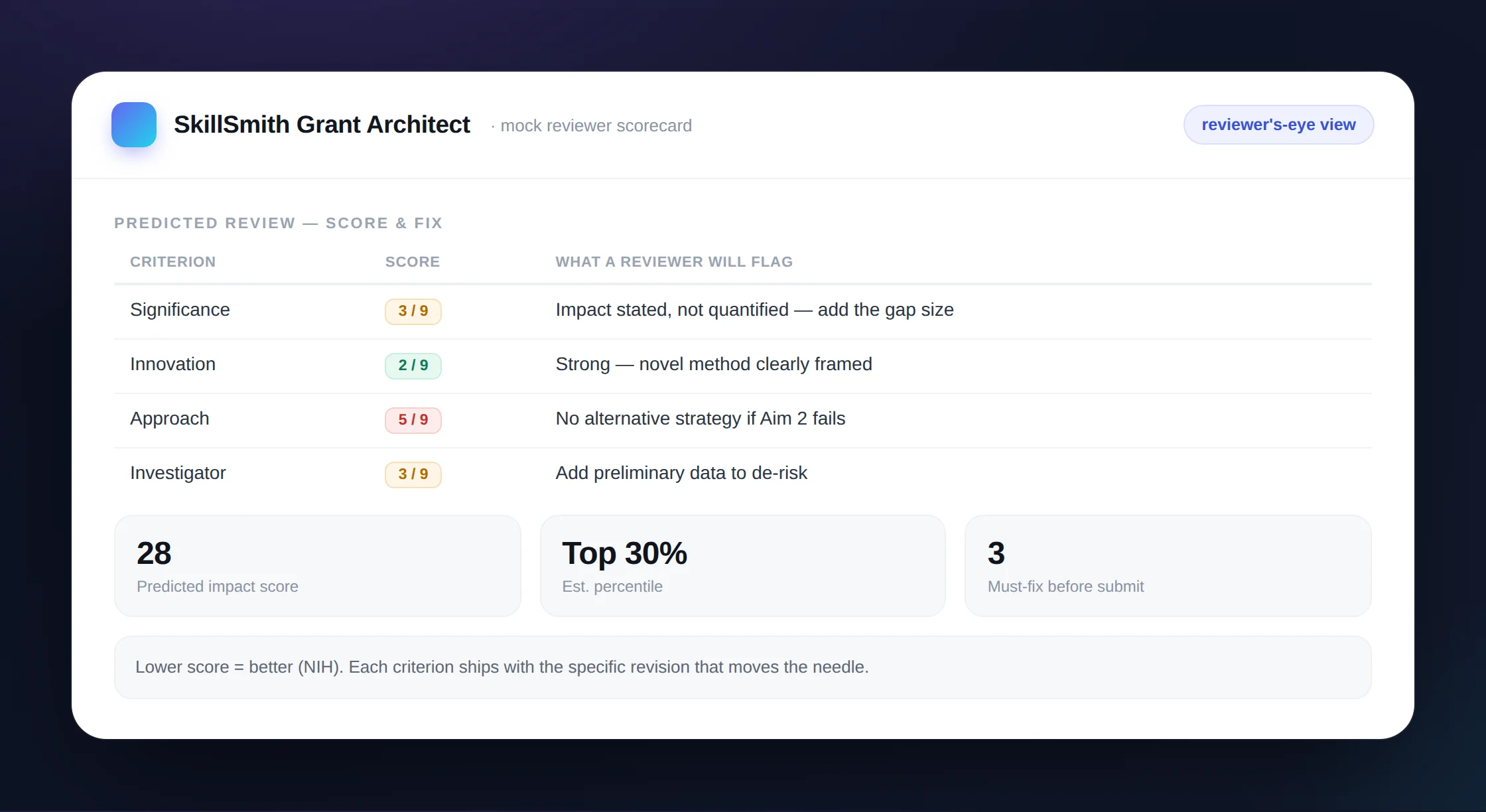
Why it's different
- It does the one slice subscriptions under-serve. Grantable (~$24–150/mo) and Instrumentl ($179+/mo) are full platforms; this is a buy-once layer that maps a specific solicitation's scored criteria to your draft, clause by clause. Use it alongside them, not instead of them.
- No funder-discovery pretence. It does not find funders, search grant databases, or tell you "where the money is" — that is a discovery tool's job (e.g. Instrumentl). It owns the writing-and-review-alignment wedge only, and says so up front rather than faking a feature.
- A built-in reviewer self-scorecard simulates the panel and flags weak sections before you submit — the "is my draft actually going to score?" check that subscriptions bury or skip.
- Matrix-first, no-fabrication guardrails — gaps become labeled placeholders, external facts are cited and marked for applicant verification, and the RFP always overrides any reference default.
Disclaimer / Scope
This Skill improves competitiveness and reduces avoidable losses (missed criteria, format violations, weak sections). It does not guarantee an award, certify eligibility or compliance with the final published rules (always defer to the actual solicitation), or fabricate preliminary data or institutional facts. Funding outcomes depend on panel composition, budget, and factors outside any draft. The bundled funder references are a verified starting point — confirm format and criteria against your call's current version before submitting.