SkyKeep: Star Map Poster Maker
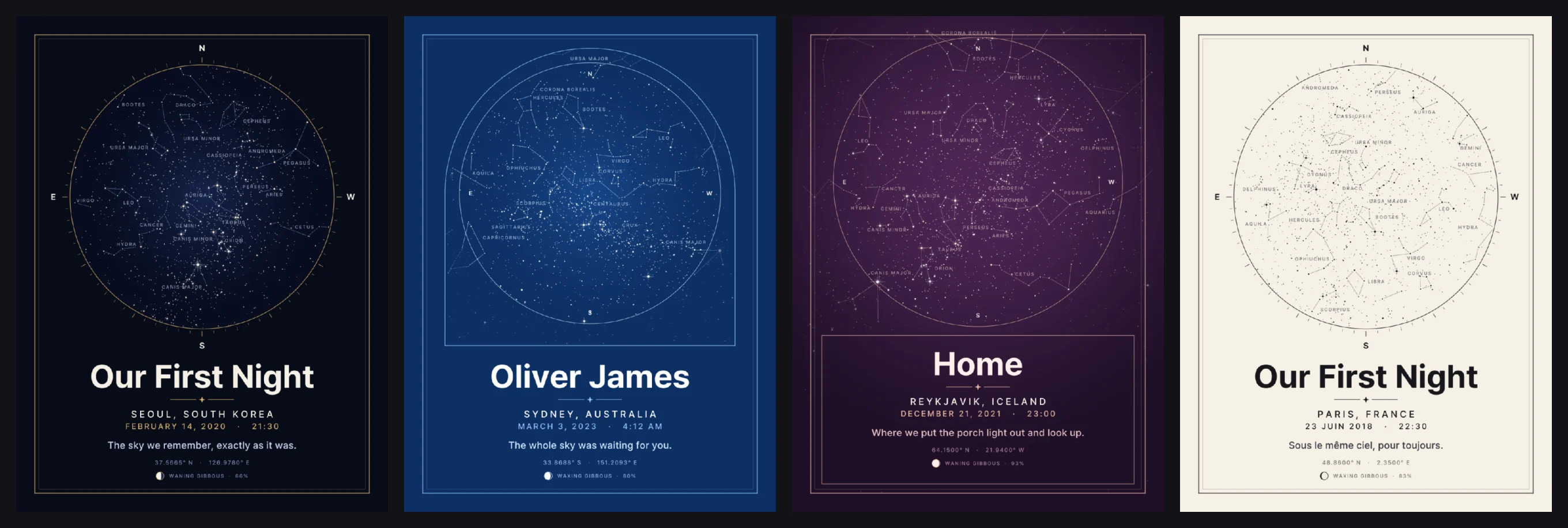
Four real SkyKeep posters. This is real output of the skill, not a mockup.
Turn any place and moment into a print-ready star map poster: real star positions, your own words, PDF plus 300 dpi PNG and SVG, made in chat.
What you get
Tell me where and when: an anniversary, a birth, a trip, the porch you call home. I compute the night sky as it looked from that spot and lay it out as a finished poster with your title, place name, date, short message, coordinates and the moon phase of that night.
- Files:
poster.pdf(vector, the one to print),poster.png(300 dpi by default),poster.svg, plusmanifest.jsonandqa-report.json. - Nine sizes: A5, A4, A3, A2, 8 × 10, 11 × 14, 12 × 16, 16 × 20 and 18 × 24 in. Optional 3 mm bleed.
- Three layouts: a classic circle with compass ring, an arch window, or a full-page sky with a text panel.
- Eight themes: Midnight, Ink on Paper, Blueprint, Warm Sepia, Mono, Deep Sea, Rose Dusk and Forest Gold.
- Switches: constellation lines and names (36 constellations), names of the brightest stars, an altitude grid, a frame, the moon-phase glyph and the coordinates line.
The gallery images and the GIF are real SkyKeep output, not mockups: an anniversary over Seoul, a birth poster for Sydney, a Korean trip poster and a Reykjavik home poster were all generated and verified.
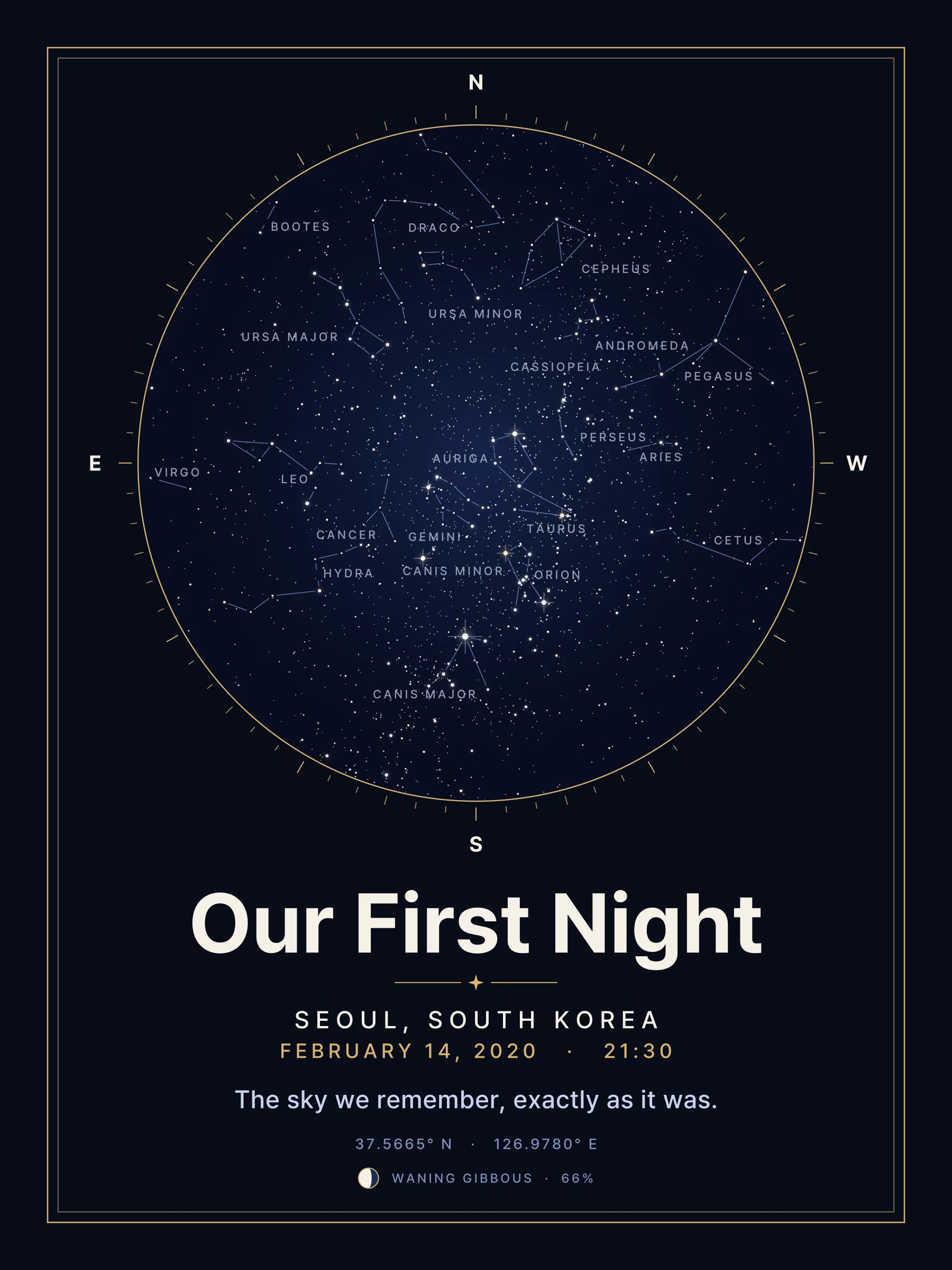
An 18 x 24 in Seoul anniversary poster. Real output of the skill (sample input).
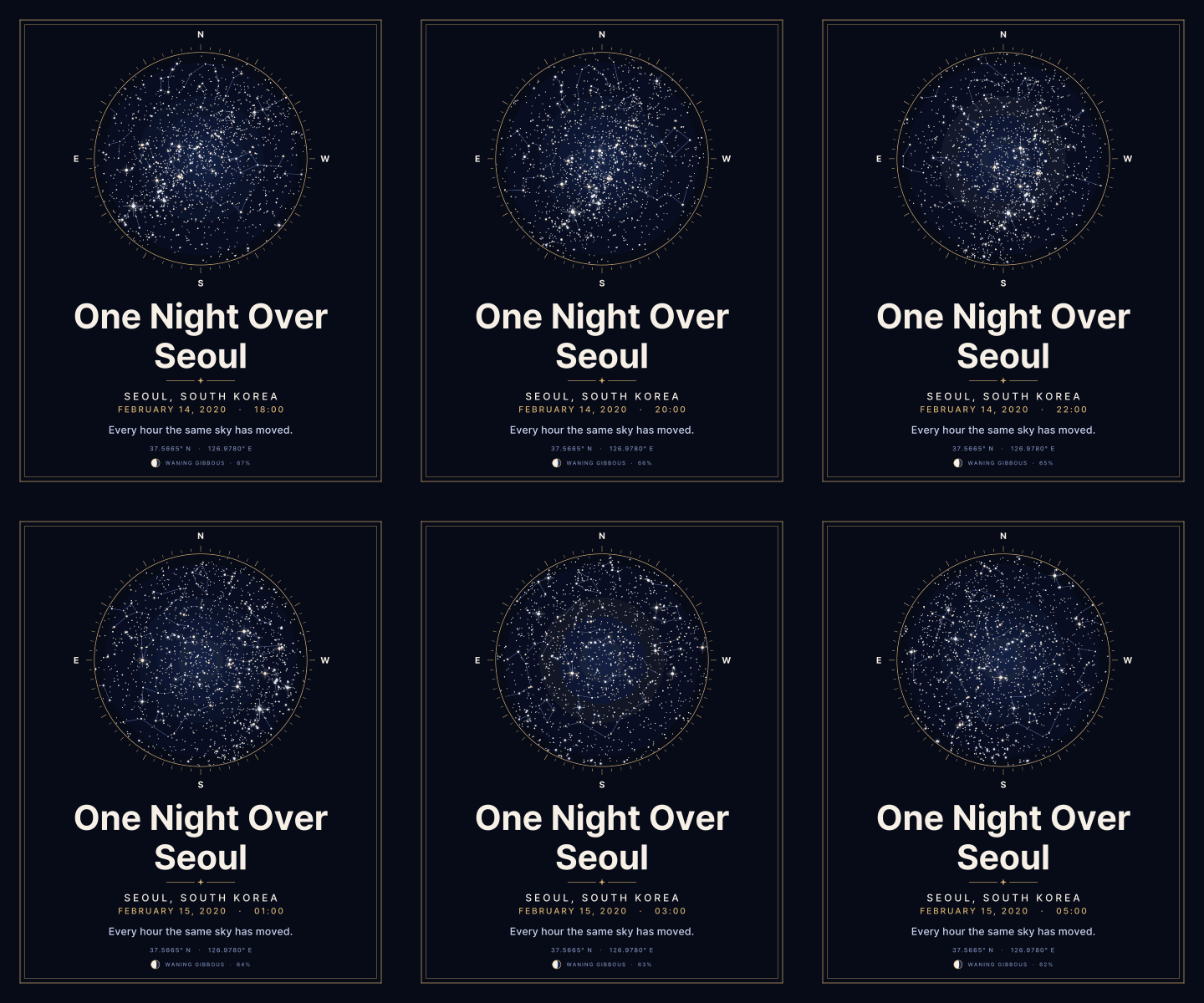
The same Seoul night hour by hour, 12 frames. Real output of the skill (sample input).
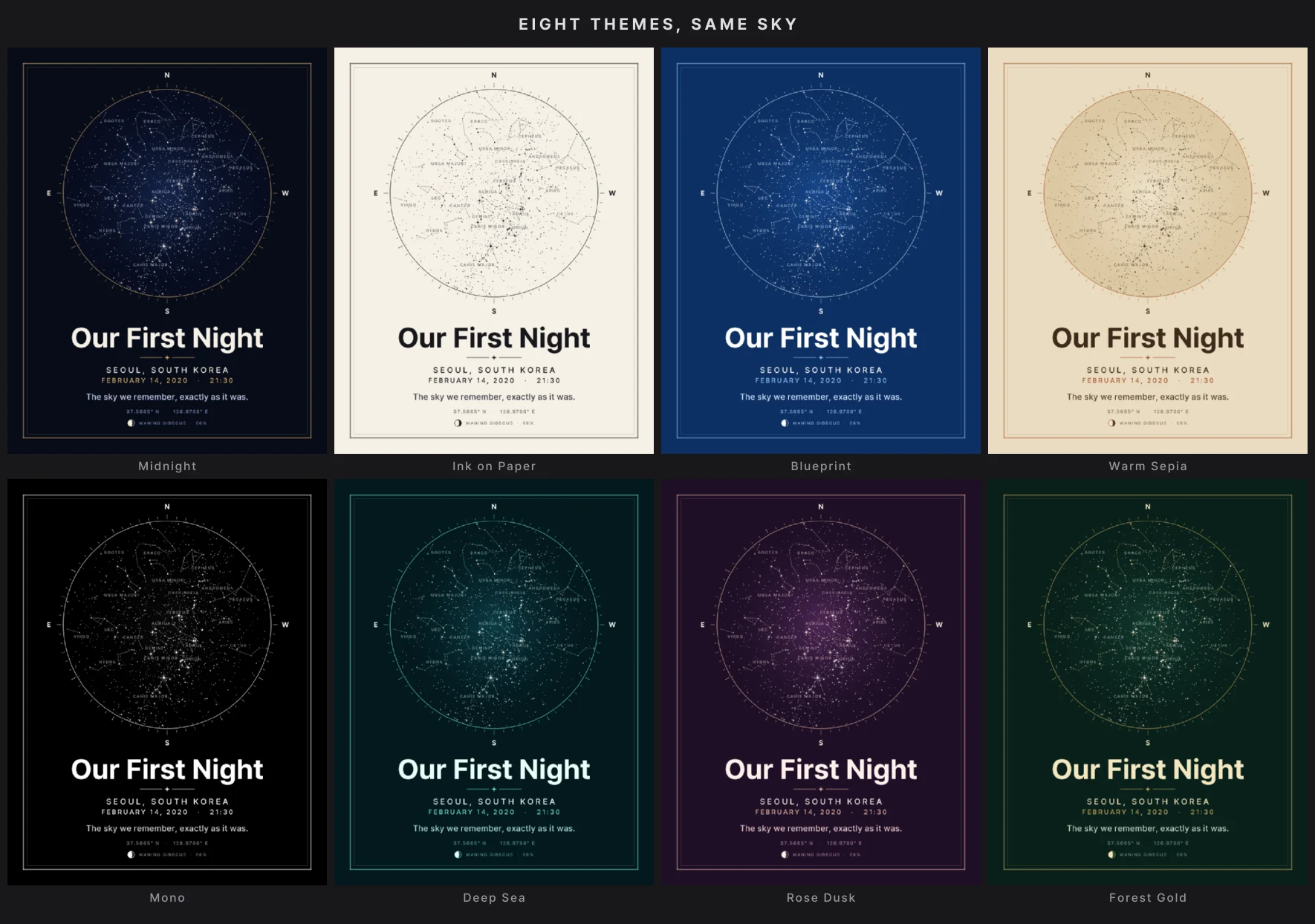
The eight themes on the same sky. Real output of the skill (sample input).
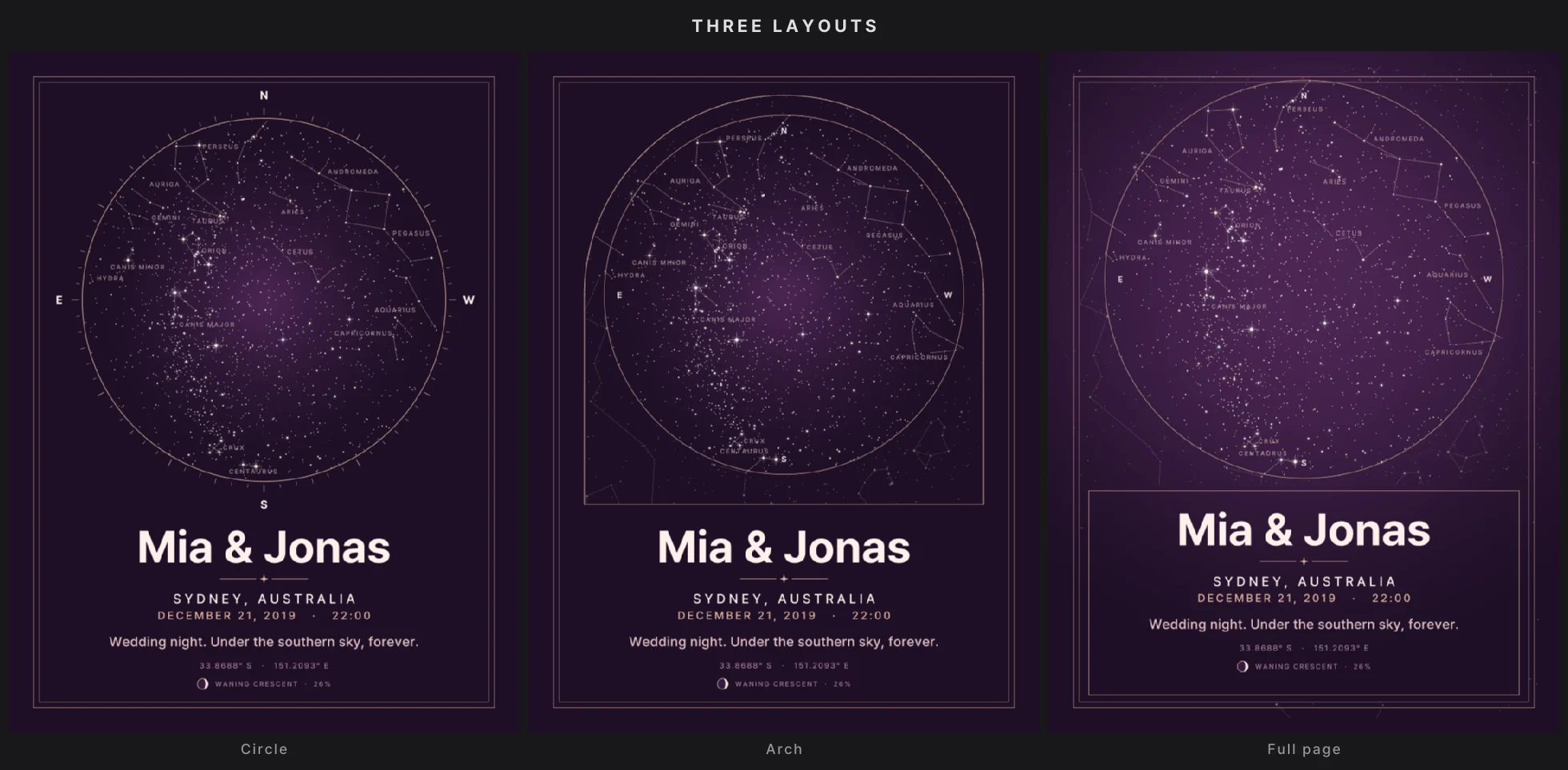
The three layouts. Real output of the skill (sample input).
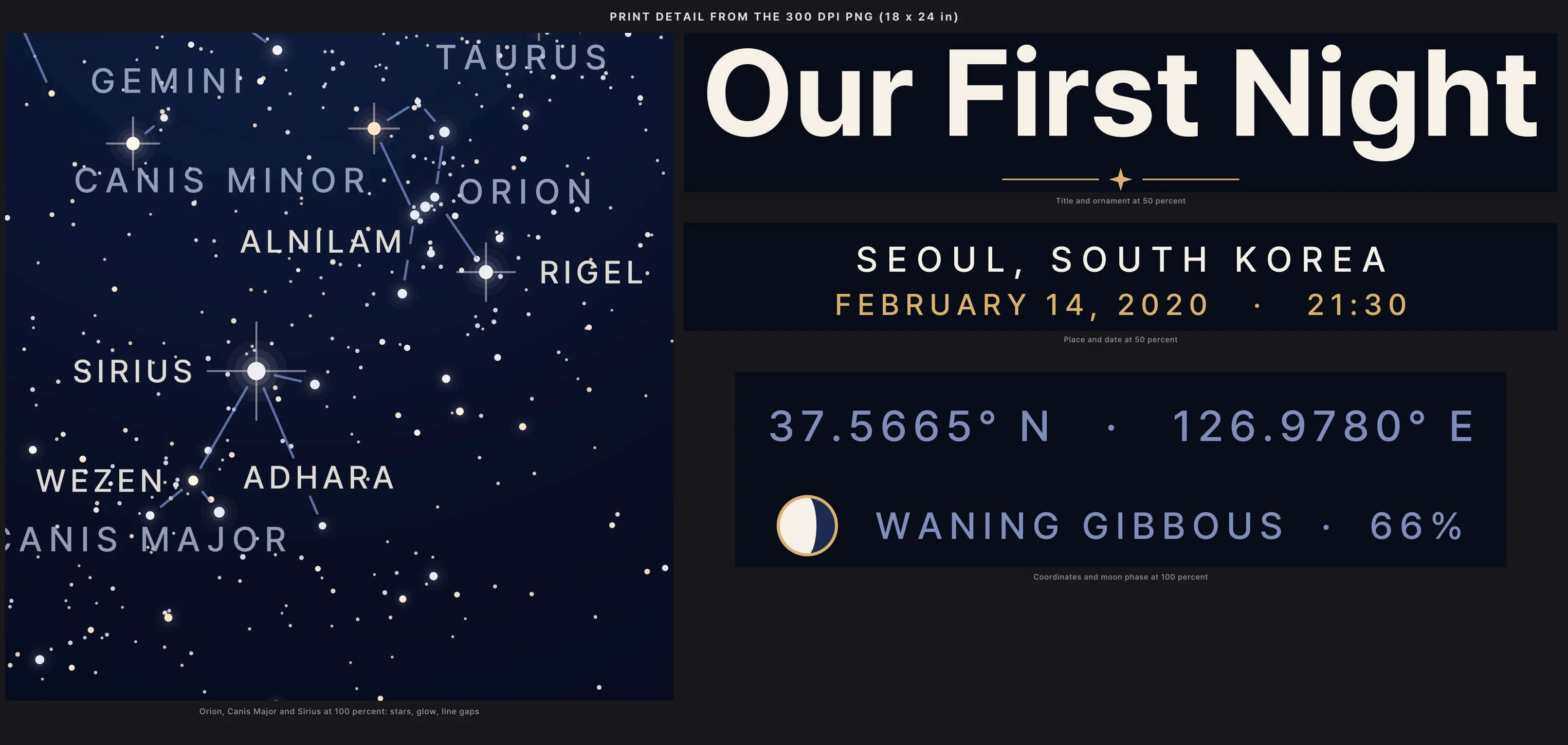
Print detail from the 300 dpi PNG of the Seoul poster. Real output of the skill (sample input).
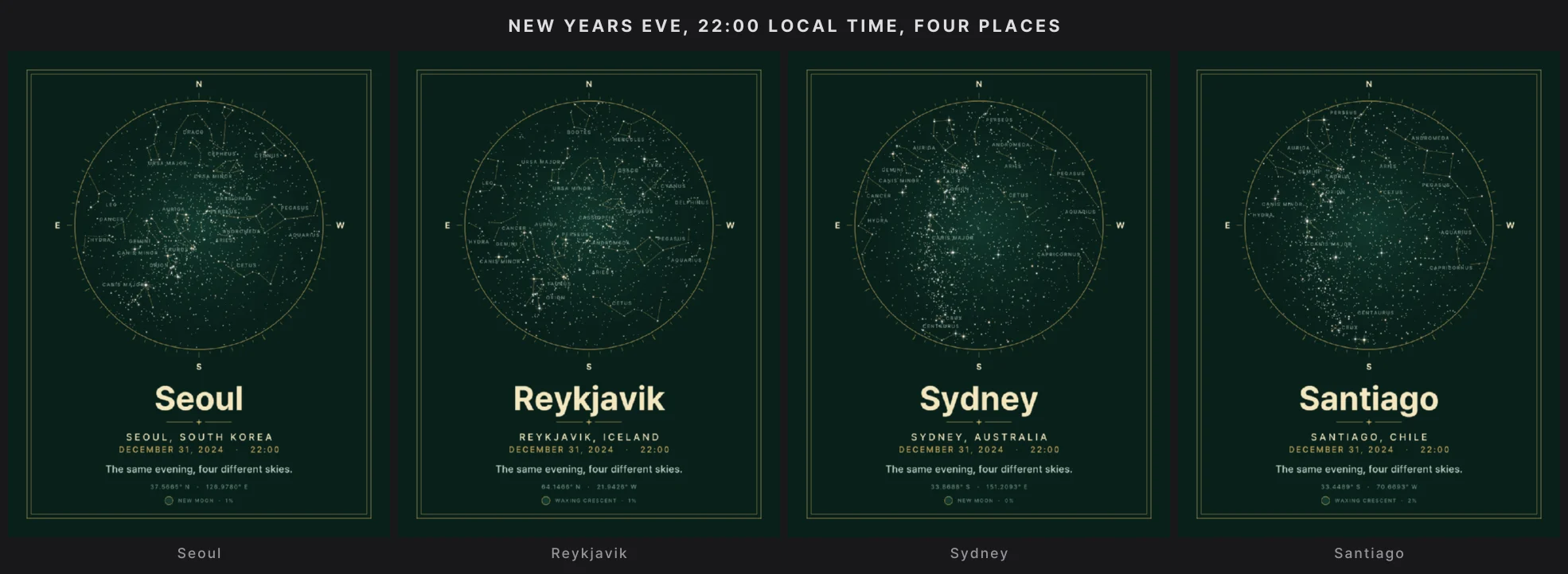
New Year's Eve at 22:00 local time in four places. Real output of the skill (sample inputs).
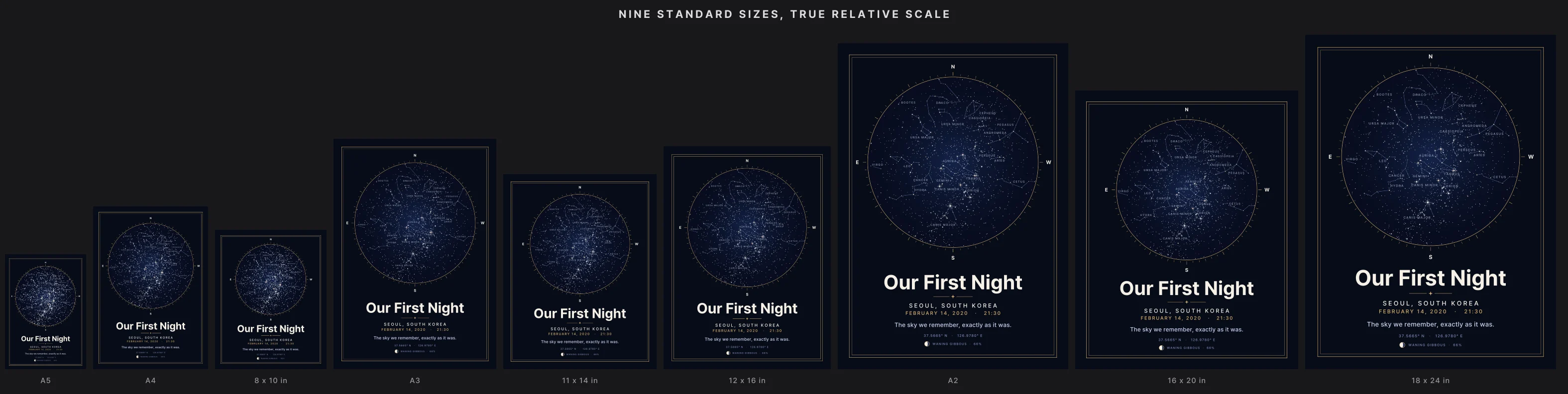
The nine sizes side by side. Real output of the skill (sample input).
How it works
- Tell me the words (title, optional place label and message), the place (a city, or exact latitude and longitude), and the date and local time. Add size, layout and theme if you already know them; otherwise I suggest 18 × 24 in, circle, Midnight.
- I check the details and tell you plainly if something will not fit or a character cannot be drawn. I never cut your words off.
- I generate the files, read them back to verify them, and share them in chat. Print the PDF at 100% / Actual Size. Ask for another theme or layout of the same sky whenever you like.
Computed, not generated
Star positions come from the Yale Bright Star Catalogue (8,404 stars down to magnitude 6.5), moved to your date with proper motion and precession. Sidereal time, altitude and azimuth use published formulas. The moon phase is a published low-precision algorithm. Automated tests compare against worked examples from Meeus' Astronomical Algorithms (sidereal time, precession, altitude and azimuth) and against all 1,485 new, quarter and full moon times for 2001 to 2030 from NASA's published table: the largest difference is 17 minutes, the median 4. The sky is drawn from the zenith with north up and east on the left, as you see it looking up.
Quality checks that really exist
Every job checks that all text sits inside the print-safe area, that no text overlaps, and that the thinnest stroke is at least 0.5 pt, the smallest star at least 0.30 mm and the smallest text at least 6.5 pt. Verification then re-reads the files: PNG size and 300 dpi tag, whether each text line is really at its predicted place in the pixels, PDF structure and trim box, SVG structure, and that the same input rebuilds the same file. That is 21 checks per poster. Text is converted to outlines, so no fonts are needed to print. On an Apple M3 Pro Mac, an 18 × 24 in poster at 300 dpi (5400 × 7200 px) takes about 3 seconds and an A4 about 0.8 seconds; cloud speed is unverified.
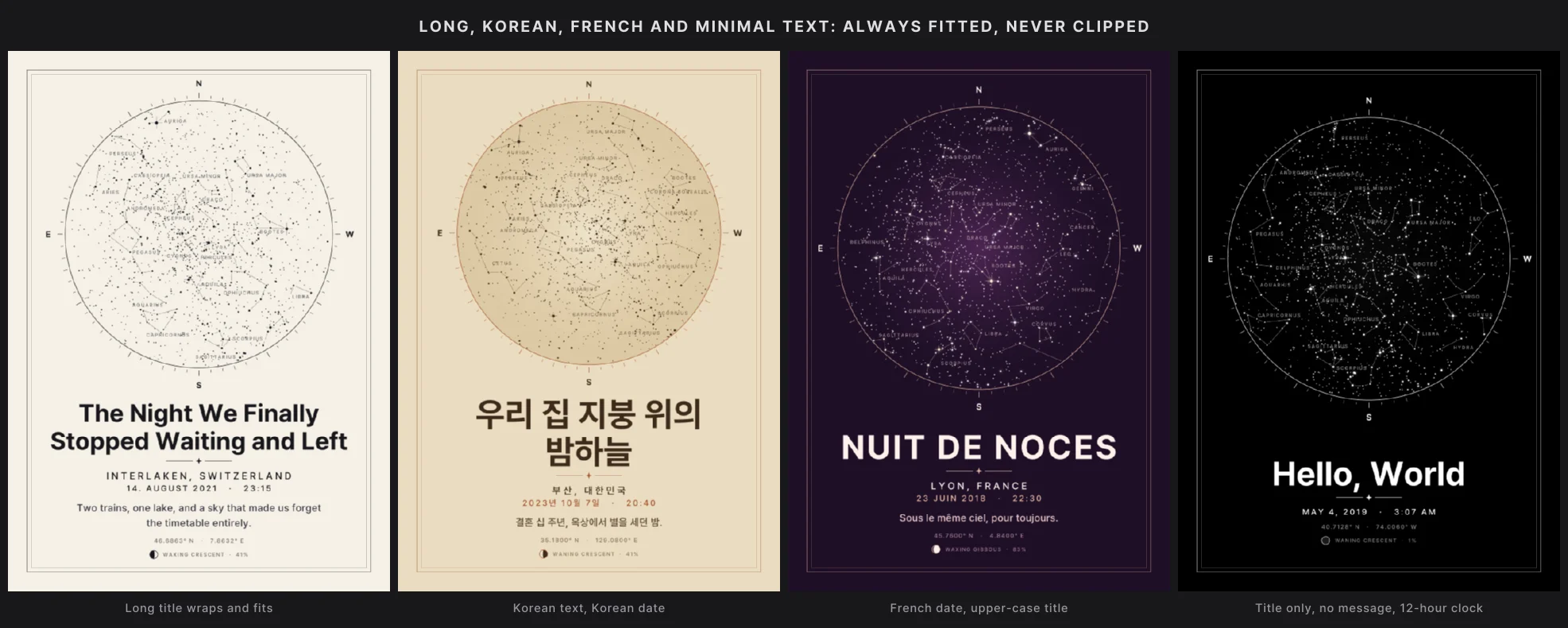
Long, Korean, French and minimal text, all fitted. Real output of the skill (sample inputs).
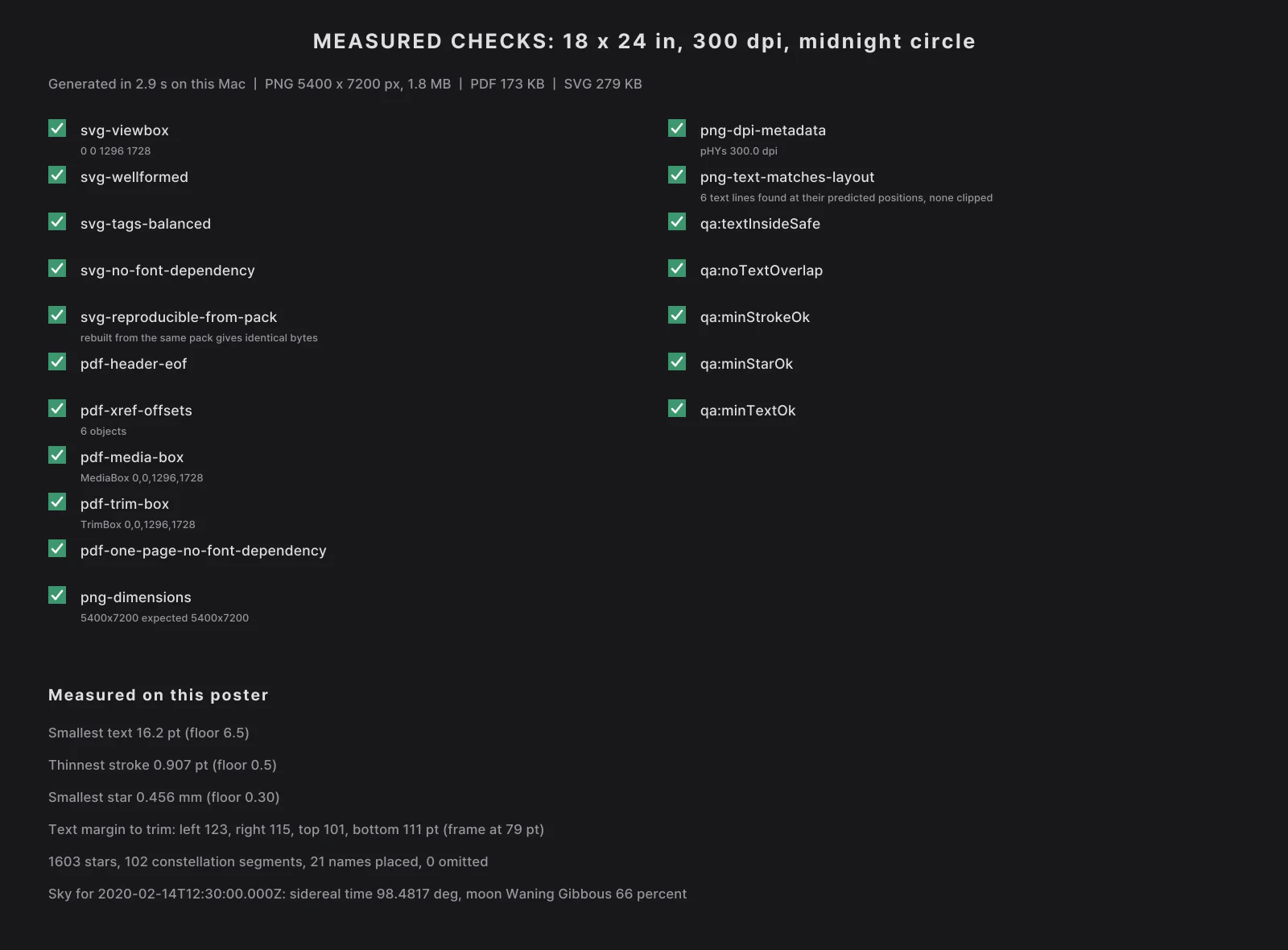
A real qa-report.json from a generated poster (sample input).
Limits
- Accuracy is about 1 arcminute from the date alone. This is a keepsake, not a navigation or telescope tool.
- No planets, Milky Way, Sun position or twilight, light pollution or atmospheric refraction. A poster for noon still shows the stars above the horizon.
- Constellation lines are hand-drawn stick figures for 36 well-known constellations; other constellations show stars only.
- Title up to 48 characters, message up to 140. The font draws Latin letters with accents, Cyrillic, Greek, Hangul and Japanese kana. It does not contain Chinese characters, Arabic, Hebrew, Thai, Devanagari or emoji; I will tell you which character is missing.
- Dates from 1800 to 2100. Portrait posters only. Colour is RGB; your printer converts to CMYK. No crop marks, no physical print proof and no printer approval.
- 89 cities are built in for quick coordinates; for anywhere else I ask you for latitude and longitude and the time zone.
- The poster generator makes no network calls; that does not describe how the chat service handles data.
Rights
The star data is public-domain scientific data and the font is open source (SIL Open Font License), so you may print and sell the posters you make. The words you add must be yours or used with permission. The posters contain no third-party logos or brand names.
Plans
- Weekly: US$5.99 for 12 requests.
- Monthly (featured): US$12.99 for 40 requests.
- Yearly: US$69.99 with 40 requests per month (480 per year).
- No free trial.