
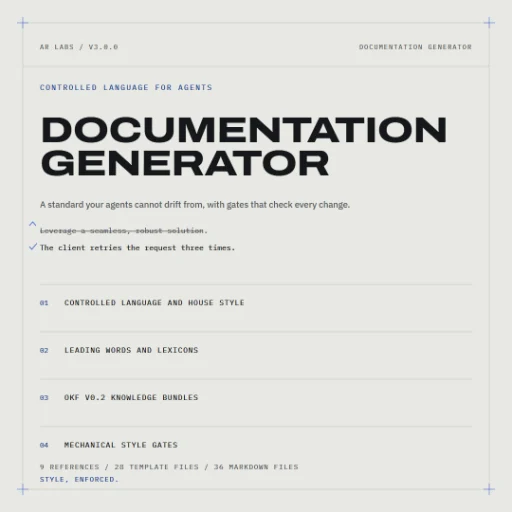
Documentation Generator
Documentation workflow
Documentation Generator guides an AI agent through producing, auditing, co-authoring, and maintaining software documentation of any type. It covers eleven documentation phases across four major workflows, each with dedicated reference material and explicit routing guidance. Version 3.0.0 adds the discipline layer: controlled language, a codified house style with mechanical gates, canonical vocabulary, OKF v0.2 knowledge bundles, and the 2026 spec-driven development landscape with tool-neutral templates.
New in 3.0.0
- Controlled language for software docs: ten STE-derived principles, from one word per meaning to 15-20 word sentences and verb-first procedures. The evidence label states the level: practitioner consensus, not a controlled study.
- A distilled house style: 27 rules from the Google developer documentation style guide, each with a rationale, a wrong and right example pair, and a link to its source page.
- Mechanical style gates: vale with the Google style package, markdownlint, and cspell, with a starter vale.ini, a one-page style checklist, and a commit-message checklist.
- Commit, PR, and changelog discipline: the 50/72 structure, Chris Beams' seven rules, Conventional Commits, and the AI-era addendum that the body gets written before the diff is re-read.
- Leading words: canonical vocabulary as steering. 18 software fundamentals, each with its book origin and what it changes in a prompt, plus a project-lexicon method and template.
- Agent knowledge layers: the four-layer stack of docs as durable agent memory, an OKF v0.2 deep dive covering trust tiers, provenance, and staleness signals, and a conformant starter bundle whose deterministic attester fails on tamper.
- Spec-driven development: Spec Kit, OpenSpec, BMAD, Kiro, Agent OS, and OpenAgentsControl compared, with a choosing rubric, an artifact taxonomy, EARS requirement syntax, drift control, and 11 tool-neutral templates.
Supported routes
- README, API docs, architecture docs, changelogs, wiki, and AI-readable docs
- comprehensive technical manuals generated from existing codebases
- interactive co-authoring for specs, RFCs, decision docs, and proposals
- agentic spec-folder scaffolding for spec-driven development
- style standard work: house rules, controlled language, and the gates that enforce both
- canonical vocabulary work: project lexicons and glossaries
- agent knowledge layer design and OKF v0.2 bundle authoring
- spec-driven development adoption; specs, plans, tasks, stories, and ADRs for agent execution
Documentation lookup policy
- Context7: use proactively for third-party library or API docs, setup steps, configuration details, and code-generation grounding when it is available.
- Astro Docs MCP: if the task is Astro-specific, use it first for Astro APIs, integrations, setup, config, import paths, and version-specific behavior when it is available.
- Official live web sources via search or fetch: still use these for freshness-sensitive public facts such as latest versions, release dates, deprecations, migration notes, or current support status.
- Fallback order: MCP docs first for structured reference, official live web sources second for freshness, local repo docs, code, and tests for project-specific behavior.
What the package includes
This download packages the documentation skill layer plus its workflow, reference, and template files: 9 references, 3 template families (28 files: the SDD artifact set, the OKF v0.2 bundle, and the style-gate starter), and the markdownlint configuration used for the release. It does not depend on a hosted service to function. Optional tools such as Git or an issue tracker may improve specific documentation routes, for example changelog generation or OPEN-item tracking, but they are not required to install the package. The style gates are optional too: vale, markdownlint, and cspell run only if you want the checks in CI, and Python 3.8 or newer is needed only for the bundled attester.
واجهات API الخارجية
mcp.context7.com/mcp · mcp.docs.astro.build/mcp


