Sales Enablement — Scale how your top rep sells
Sales enablement — deploy-ready decks, playbooks, scripts, and objection handling.
What you get
You do not need another template library. You need sales collateral that carries the way your best seller thinks, speaks, qualifies, handles pushback, and moves a deal forward.
This skill turns your product knowledge, buyer context, proof, pricing, objections, and competitor notes into seven deploy-ready assets: pitch deck, one-pager, objection handling doc, demo script, buyer persona card, sales playbook, and ROI calculator.
How it works
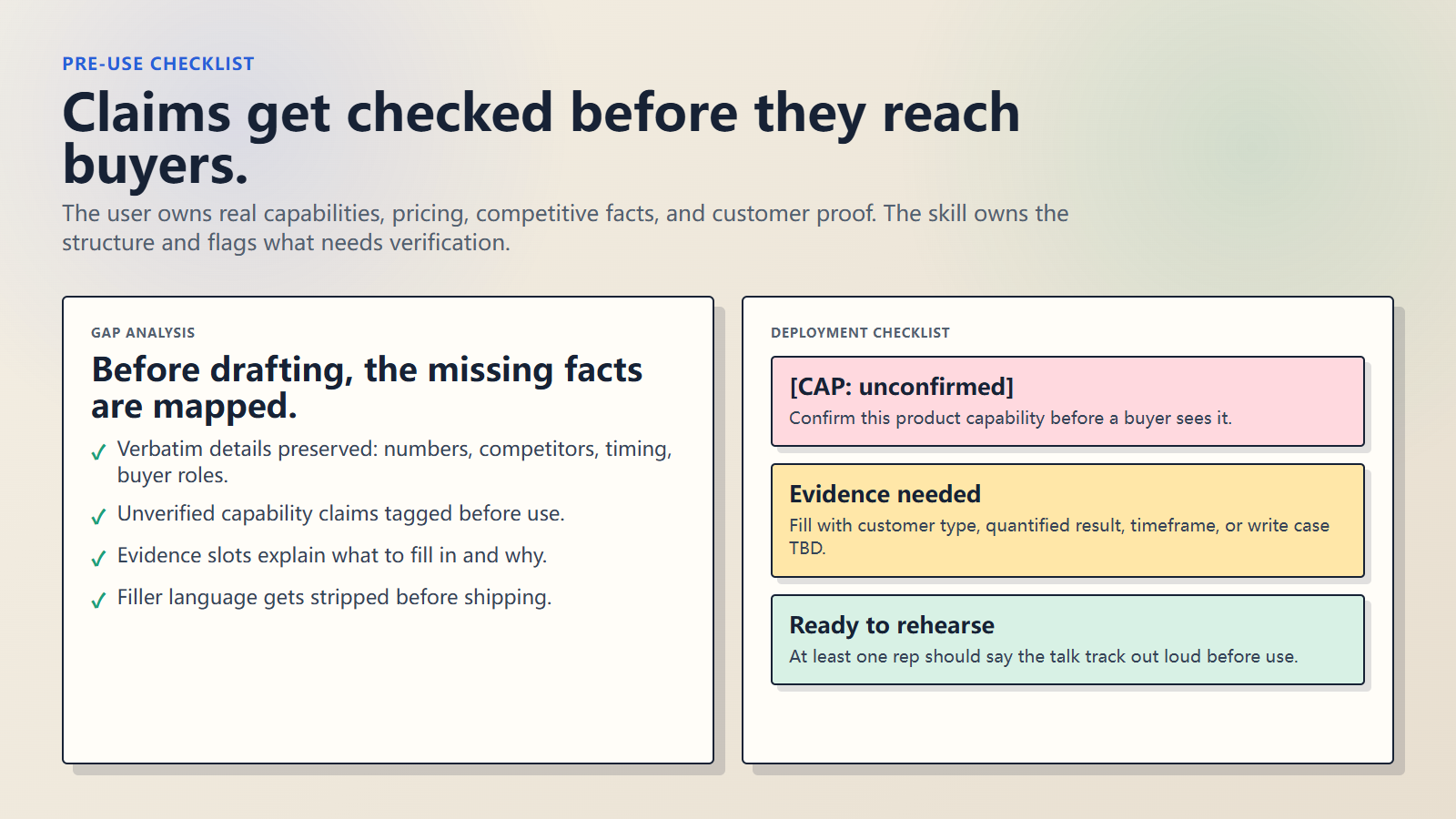
Before anything is drafted, the skill separates what is known from what still needs proof. That keeps the output useful without inventing customer stories, capability claims, or competitive facts.
- Share the selling context — product, buyer role, competitors, pricing, objections, proof, and the collateral you need.
- Get pre-analysis first — verbatim detail extraction, buyer-role mapping, capability gating, and shared positioning across every piece.
- Receive structured assets — built with the right framework for the job: SCR, Challenger, NABC, ACR, Feel-Felt-Found, Diagnose-First, MEDDIC, or SPIN.
- Use the pre-use checklist — verify claims, fill evidence slots, confirm pricing, and rehearse the talk track before it reaches a buyer.
Buyer-facing and rep-facing collateral
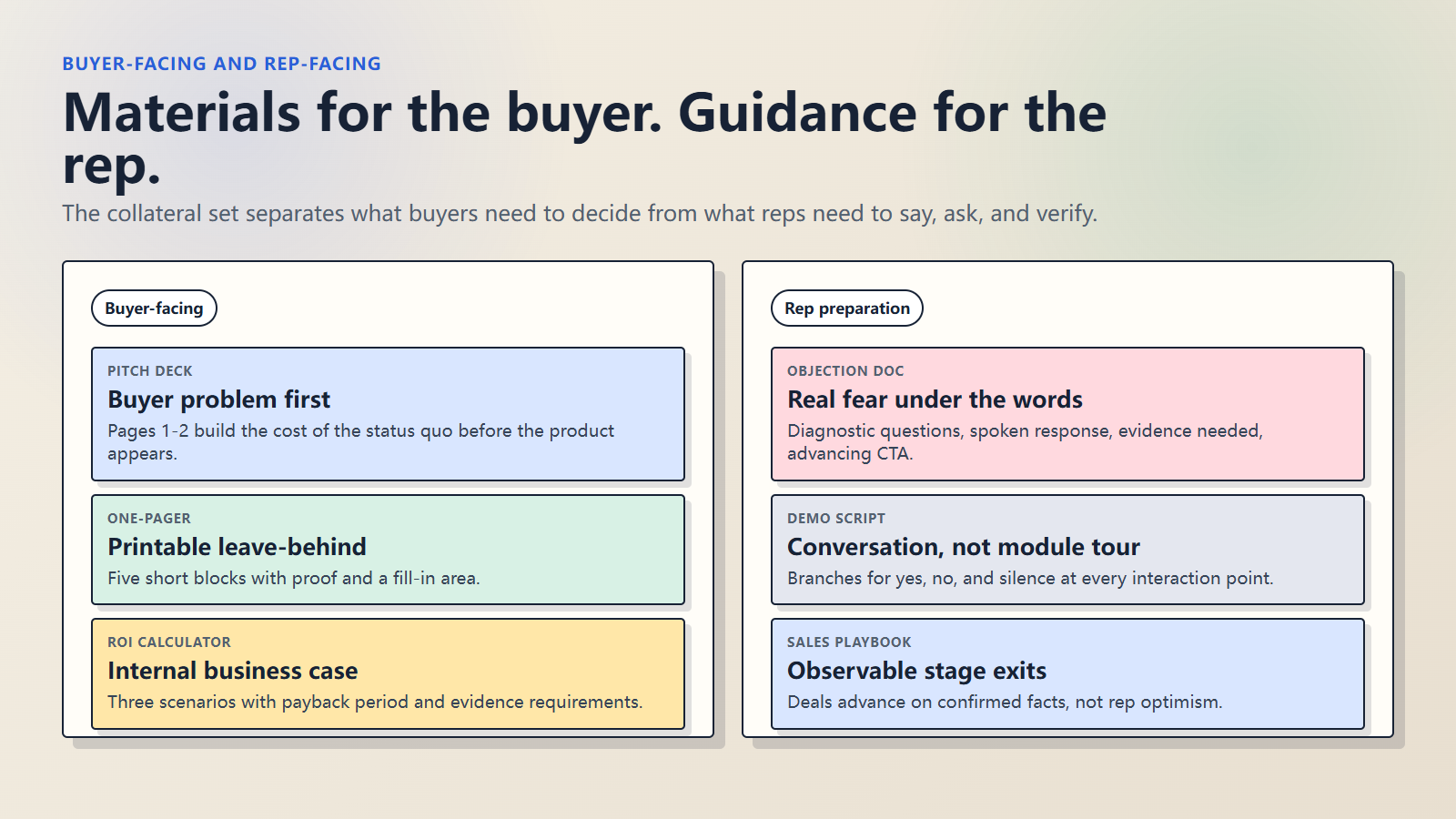
Buyer-facing material helps the customer make the case. Rep-facing material helps the seller know what to ask, say, show, and do next.
- Pitch deck template — opens on the buyer's problem, delays the product, proves the case, and ends with a binary CTA.
- One-pager — a printable leave-behind with five tight blocks, a proof slot, and a buyer fill-in area.
- ROI calculator — conservative, baseline, and optimistic scenarios with payback period.
- Objection handling training — real concern, diagnostic questions, spoken response, evidence needed, and advancing CTA.
- Demo script — a 30-minute conversation flow with branches for yes, no, and silence.
- Buyer persona card — seven dimensions, first-person objections, and named information sources.
- Sales playbook template — observable exit criteria from prospecting through post-sale.
Rep execution logic
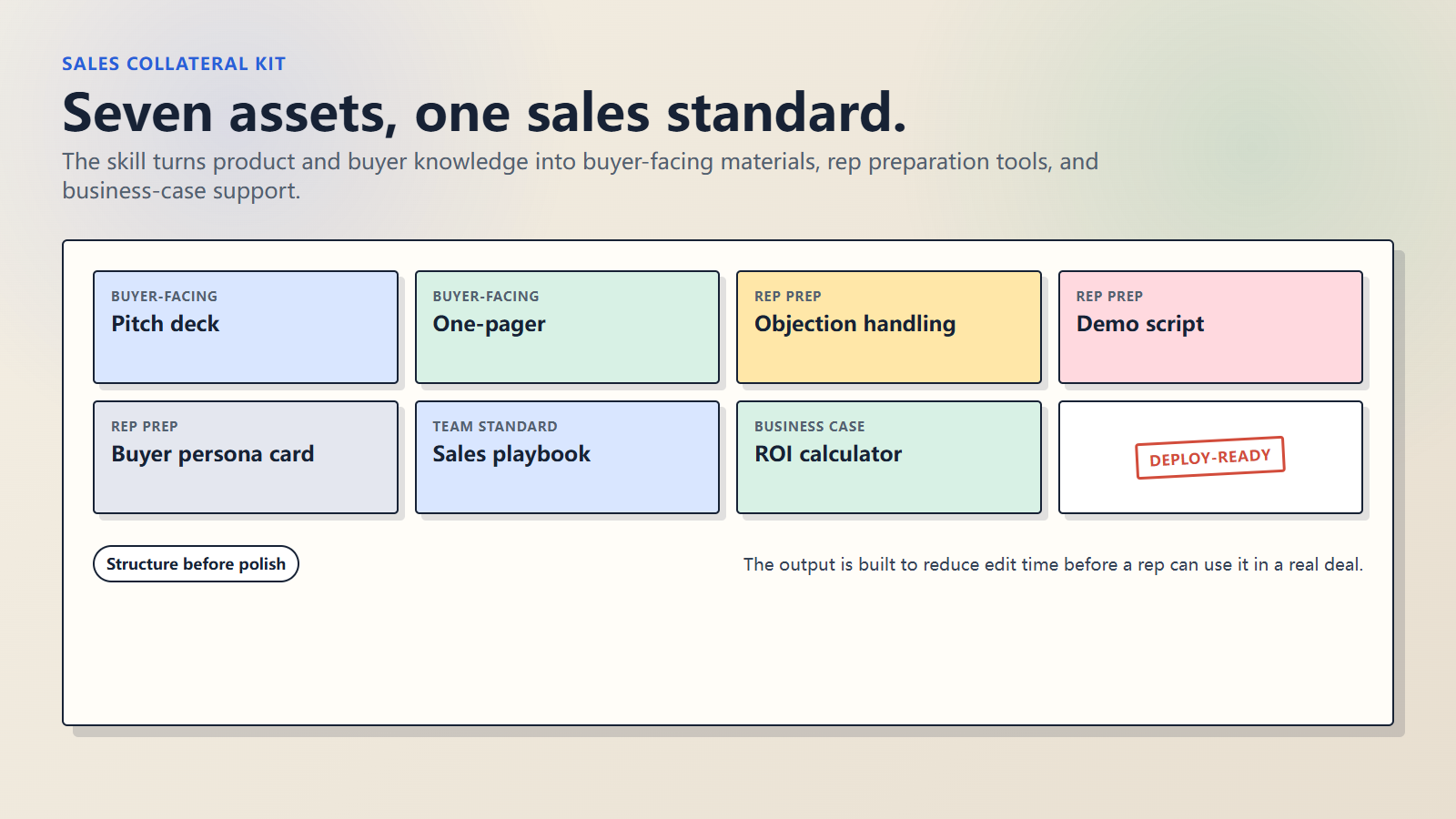
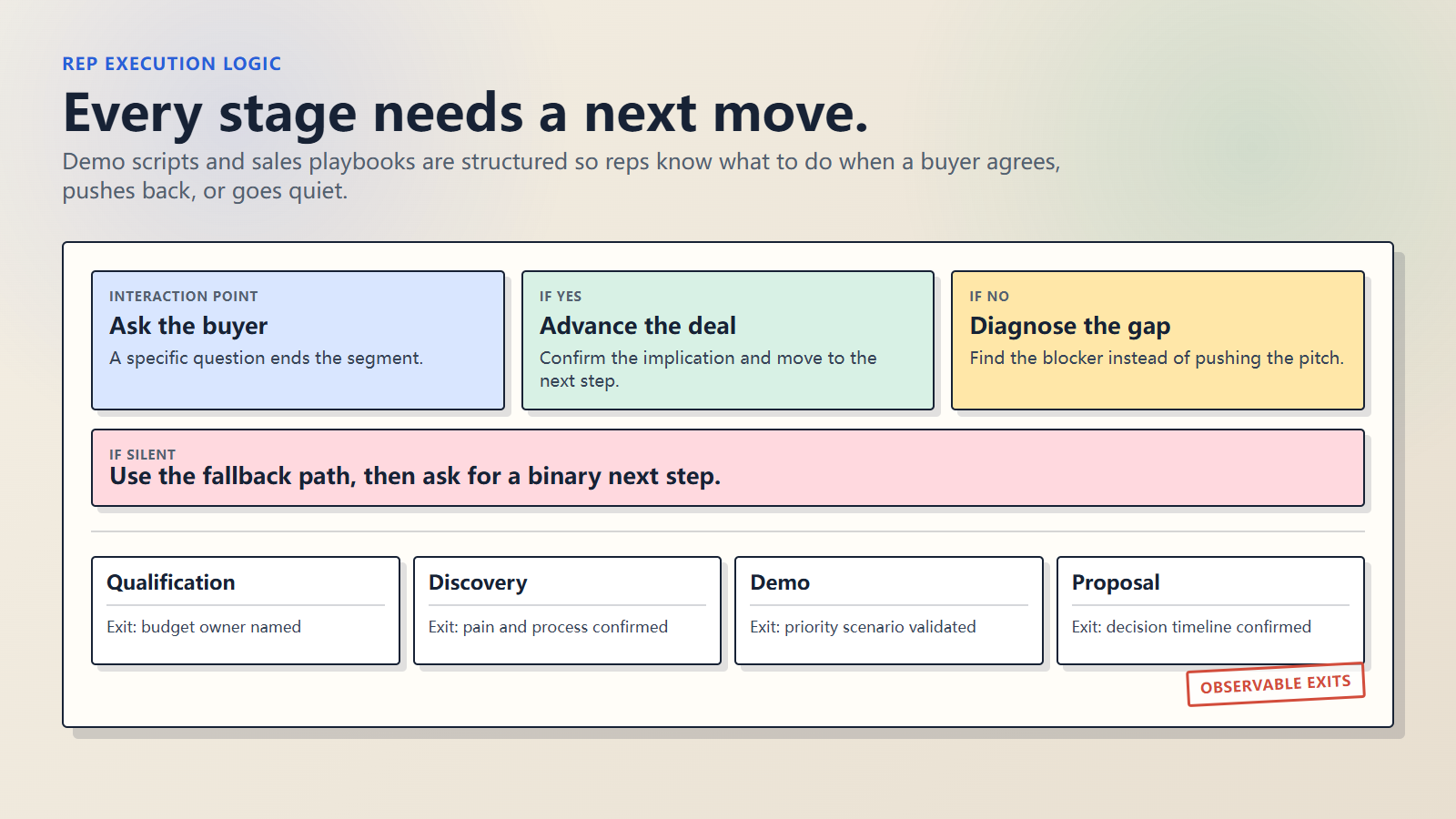
The best sales enablement asset is not the prettiest file. It is the one a rep can use when a buyer agrees, hesitates, objects, or goes quiet.
- Demo scripts behave like conversations — every interaction point includes what to do if the buyer says yes, says no, or says nothing.
- Playbook stages advance on facts — budget owner named, decision timeline confirmed, next meeting booked, success criteria agreed.
- Objection handling examples sound speakable — first-person buyer quotes and responses reps can rehearse out loud.
- Capability boundaries stay visible —
[CAP: unconfirmed]tags and evidence edit blocks keep unverified claims out of buyer-facing material.
What makes it different
- Buyer problem before product — pitch decks open on the buyer's reality, not your logo.
- Structure before polish — message order, talk tracks, branch logic, and exit criteria come before design language.
- Evidence gaps are named — every proof slot says what to fill in, what format to use, and why it matters.
- Filler gets stripped — no vague "synergy," "best-in-class," or empty "end-to-end" claims.
- Built to reduce edit time — the goal is deploy-ready sales collateral, not a draft your team has to rewrite from scratch.