
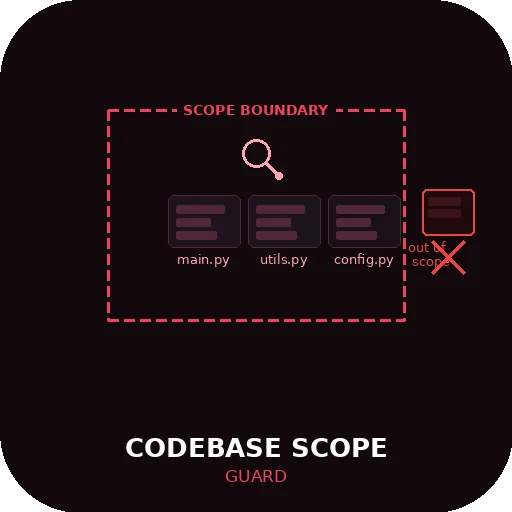
Forces AI coding agents to read exports, callers, and shared utilities before touching any file — then restricts every edit to the declared scope, flags conflicting patterns for human resolution, and reports any file touched outside the boundary.

Turn rough software ideas into bounded MVP scopes, practical architecture decisions, and coding-agent-ready implementation tasks without unnecessary complexity.

Turn vague product requirements into clear, implementation-ready specifications. When key information is missing, Agile ScopeGuard Pro identifies gaps and asks focused questions before generating relevant deliverables such as PRDs, User Stories, Functional Specifications, Acceptance Criteria, QA Test Cases, API Specifications, Workflows, Risk Analysis, and Implementation Checklists. Built to reduce ambiguity, prevent Scope Creep, and minimize costly rework.

This Skill is built on practical expertise in AI file-workflow governance, source authority classification, copy-first editing, prompt-injection resistance, private-to-external dataflow review, and publish/delete/send boundary checks. It helps AI agents decide what can be read, copied, edited, deleted, zipped, or sent while keeping originals protected and untrusted file, web, or tool content from becoming instructions.

I specialize in safe Codex skill onboarding. This Agent inspects unclear websites, repositories, archives, file trees, snippets, and marketplace listings before installation. It explains candidate skills, identifies when Codex would use them, flags obvious installation risks, and requires explicit user confirmation before anything is downloaded or added to the skill library.

Defensive application-security auditing: turns a repo, manifest, or code snippet into an actionable report—dependency vulnerabilities, leaked secrets, insecure code patterns, and config hardening—mapped to OWASP Top 10 and ranked by severity. Finds risk and the fix only, never attack content.

Write calm, professional English replies for difficult client messages, including extra-scope requests, rush delivery, repeated revisions, late payments, discounts, and unclear feedback. ScopeReply helps freelancers clarify scope, pricing, timelines, and next steps without sounding rude or defensive.

GSD is a spec-driven, context-engineering workflow for AI coding agents that prevents context rot & ships via the 5-step Discuss→Plan→Execute→Verify→Ship loop closed by /gsd-ship. Backed by a source-verified surface of 65 concrete commands across 6 namespace routers (/gsd-workflow, /gsd-project, /gsd-quality, /gsd-context, /gsd-manage, /gsd-ideate), with optional OpenGSD companions (gsd-pi, gsd-graph + MCP, gsd-loop, gsd-browser). & a `.planning/` directory that the agent reads across sessions.

This Skill encodes the current 2026 CSRD/ESRS framework - post-Omnibus scope and thresholds, the ESRS simplification, the 12 standards (ESRS 2 + E1-E5, S1-S4, G1) and the full double materiality method - as a structured workflow. It runs scoping, a double materiality assessment, disclosure mapping, gap analysis, and drafts the sustainability statement. It never invents data and flags where auditor limited assurance is required.