Quant Research Guide
Quant Research Guide: Data to Decision
Turn a trading idea into a go / no-go decision. This agent runs the full quant research workflow: it collects market data, cleans it, measures what matters, backtests with real costs, checks for overfitting, and writes a one-page report with numbers.
No API keys. No black boxes. Every formula and script is included and auditable.
What it does
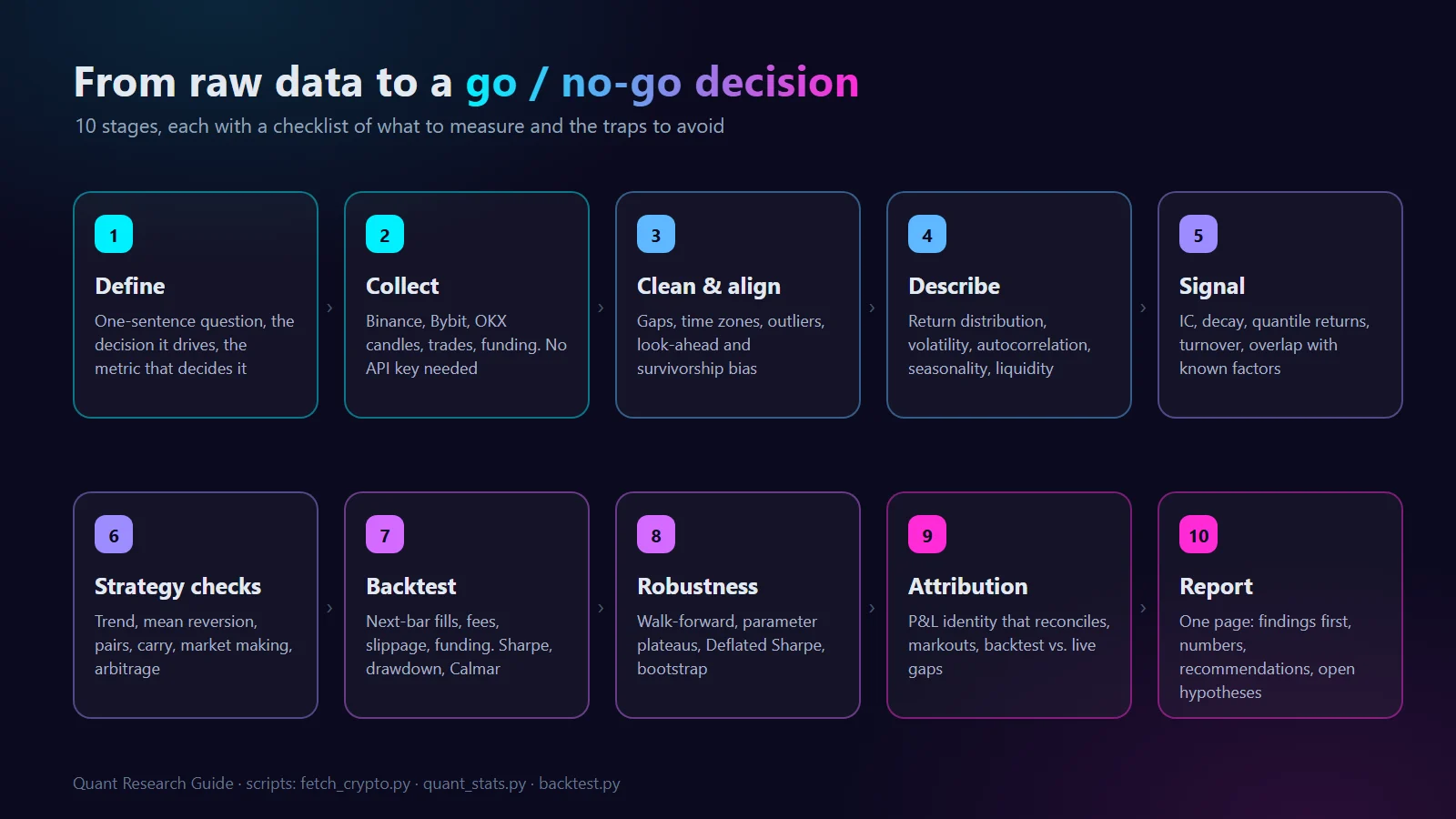
| Stage | What you get |
|---|---|
| 1. Define | A one-sentence research question, the decision it drives, and the metric that decides it |
| 2. Collect | Candles (1m–1d), mark and index prices, funding history, and tick trades from Binance, Bybit, and OKX, all via public endpoints |
| 3. Clean & align | Checks for gaps, duplicates, time zones, outliers, look-ahead bias, and survivorship bias |
| 4. Describe | Return distribution, fat tails, volatility, autocorrelation, variance ratio, Hurst, seasonality, beta |
| 5. Signal | IC and IC decay, quantile returns, turnover, coverage, and overlap with known factors |
| 6. Strategy checks | A measurement playbook for trend, mean reversion, pairs, funding/basis carry, market making, cross-exchange arbitrage, event-driven, and factor strategies |
| 7. Backtest | Next-bar fills, fees, slippage, and funding. Reports Sharpe, Sortino, max drawdown, Calmar, hit rate, profit factor, and cost share |
| 8. Robustness | Walk-forward, parameter plateaus, Deflated Sharpe Ratio, block bootstrap, and stress tests |
| 9. Attribution | A P&L identity breakdown that must reconcile, markouts, and backtest-vs-live gap analysis |
| 10. Report | A self-contained one-page HTML report: findings first, tables, charts, recommendations, open hypotheses |
Example
You ask:
Is a delta-neutral funding carry (long spot, short perp) worth running on BTC, ETH, and SOL? Use 6 months of Binance data and include trading costs. Also test only holding when funding is positive.
The agent: fetches spot and perp candles plus funding history for all three coins, measures funding persistence and basis risk, backtests both variants with costs, splits P&L into funding, basis, and fees, and delivers this report:
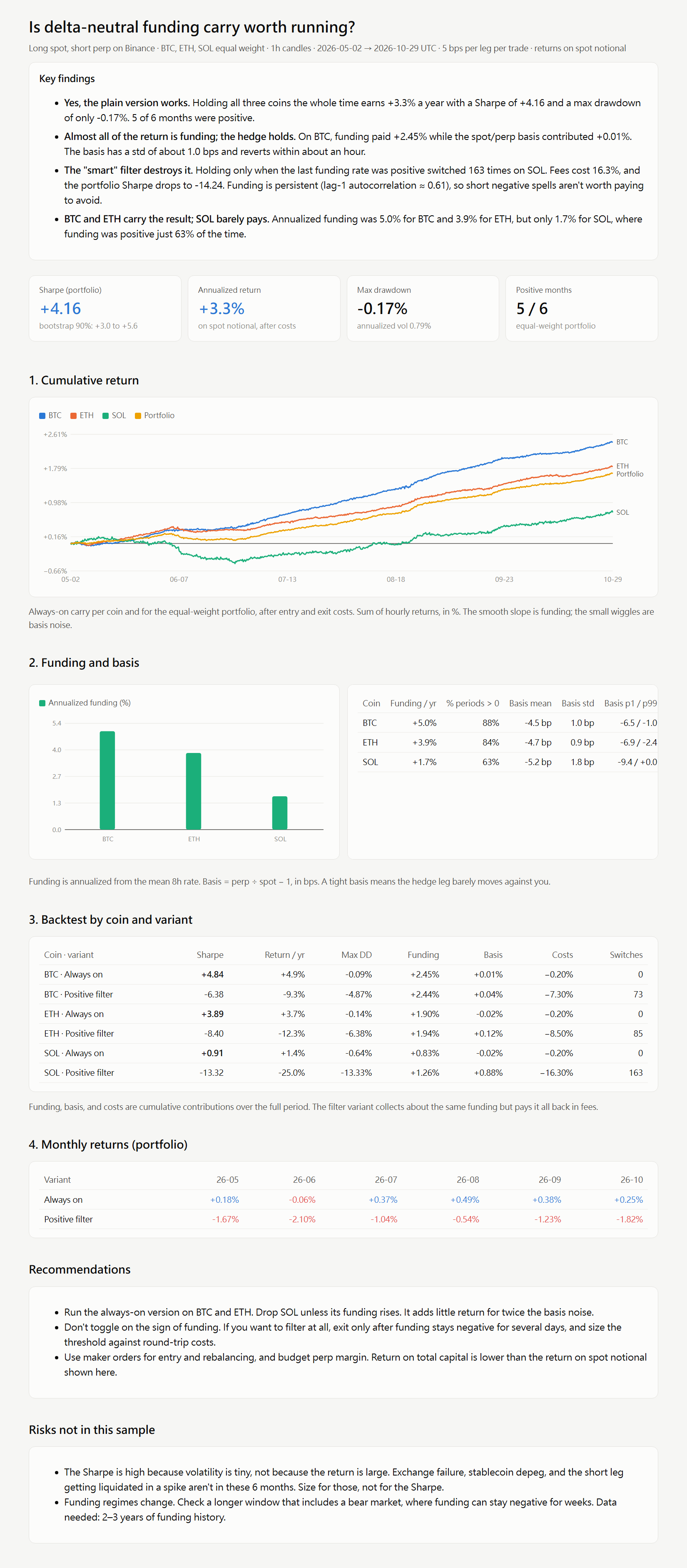
*Real output from real Binance data (2026-05-02 → 2026-10-29), with no parameter tuning. The always-on portfolio earned +3.3% a year with a Sharpe of +4.16 and a max drawdown of −0.17%, and 5 of 6 months were positive.*
The report also catches what doesn't work. The "smarter" variant, which holds only when funding is positive, switched up to 163 times and paid all of its funding back in fees. The report flags what the backtest can't see, too: exchange failure, depeg, and liquidation risk aren't in a 6-month sample, so it tells you to size for those instead of trusting the Sharpe.
Built for
- Crypto quant traders testing signals before risking capital
- Market makers analyzing markouts, adverse selection, and P&L leaks
- Carry and basis traders measuring funding persistence and basis risk
- Quant researchers and students who want a rigorous, repeatable process
Not for: trading signals, price predictions, or auto-trading bots. This agent researches; it never places orders.
What's inside
quant-research-guide/
├── SKILL.md                      # workflow, 10 core principles, report format
├── references/
│   ├── data-sources.md           # endpoints, archives, paid data, equities, macro, on-chain
│   ├── data-quality.md           # cleaning checklist, alignment, look-ahead & survivorship bias
│   ├── research-checklist.md     # what to measure: returns, liquidity, signals, backtest metrics
│   ├── strategy-types.md         # per-strategy measurements and traps (8 strategy types)
│   ├── execution-and-costs.md    # fees, slippage, impact, fill assumptions, capacity
│   ├── robustness.md             # walk-forward, multiple testing, Deflated Sharpe, bootstrap
│   └── pnl-attribution.md        # P&L identity, markouts, "who converges", replay
├── scripts/
│   ├── fetch_crypto.py           # Binance / Bybit / OKX candles, funding, aggTrades
│   ├── quant_stats.py            # 30+ stats: IC, decay, half-life, perf_summary, DSR, bootstrap
│   └── backtest.py               # vectorized backtest, parameter sweep, walk-forward splits
└── assets/
    └── report_template.html      # one-page report with light/dark themes and charts
Quick start (scripts on their own):
python scripts/fetch_crypto.py klines data 120 BTCUSDT ETHUSDT --interval 1h
python scripts/fetch_crypto.py funding data 120 BTCUSDT
python scripts/backtest.py data/binance_BTCUSDT_last_1h.csv 8760
Principles it follows
- Write the question and the decision first. Research ends in a decision, not a chart.
- Verify the data before using it. Gaps, time zones, splits, and delisted coins get checked first.
- Never see the future. Fills happen on the next bar, and standardization uses rolling windows.
- Estimate the ceiling with a formula before backtesting. If the math says no, skip the backtest.
- Charge full costs. A Sharpe ratio without costs means nothing.
- Only out-of-sample counts. Count every variant you try and deflate the Sharpe accordingly.
- P&L must reconcile. If the components don't sum to the total, the code is wrong.
- Report counterexamples. Don't let averages hide the cases that break the story.
FAQ
Do I need exchange API keys?
No. All market data comes from public endpoints. You only provide your own fill history if you want P&L attribution on live trading.
Which exchanges are supported?
Candles: Binance (spot and USDⓈ-M perps), Bybit, and OKX. Funding history: Binance and Bybit. Tick trades: Binance. The data-sources reference also covers Hyperliquid, Coinbase, archives, equities (yfinance, Polygon), macro (FRED), and on-chain sources.
Is it only for crypto?
The scripts fetch crypto data, but the workflow, statistics, backtester, and robustness checks work on any price series. Load your own csv with t, o, h, l, c, v columns.
What do I need installed?
Python 3.9+, pandas, and numpy.
Will it place trades?
No. It produces research, numbers, and recommendations. It never connects to your trading account.
Can I trust the results?
The methods are transparent and every script is readable. Fills are delayed one bar to avoid look-ahead, costs and funding are always charged, and unverified ideas are labeled as hypotheses. Past performance still doesn't guarantee future results, and this is not financial advice.
Built by a crypto quant trader who runs live market-making and hedging strategies. Every rule in this guide comes from a real loss or a real mistake.