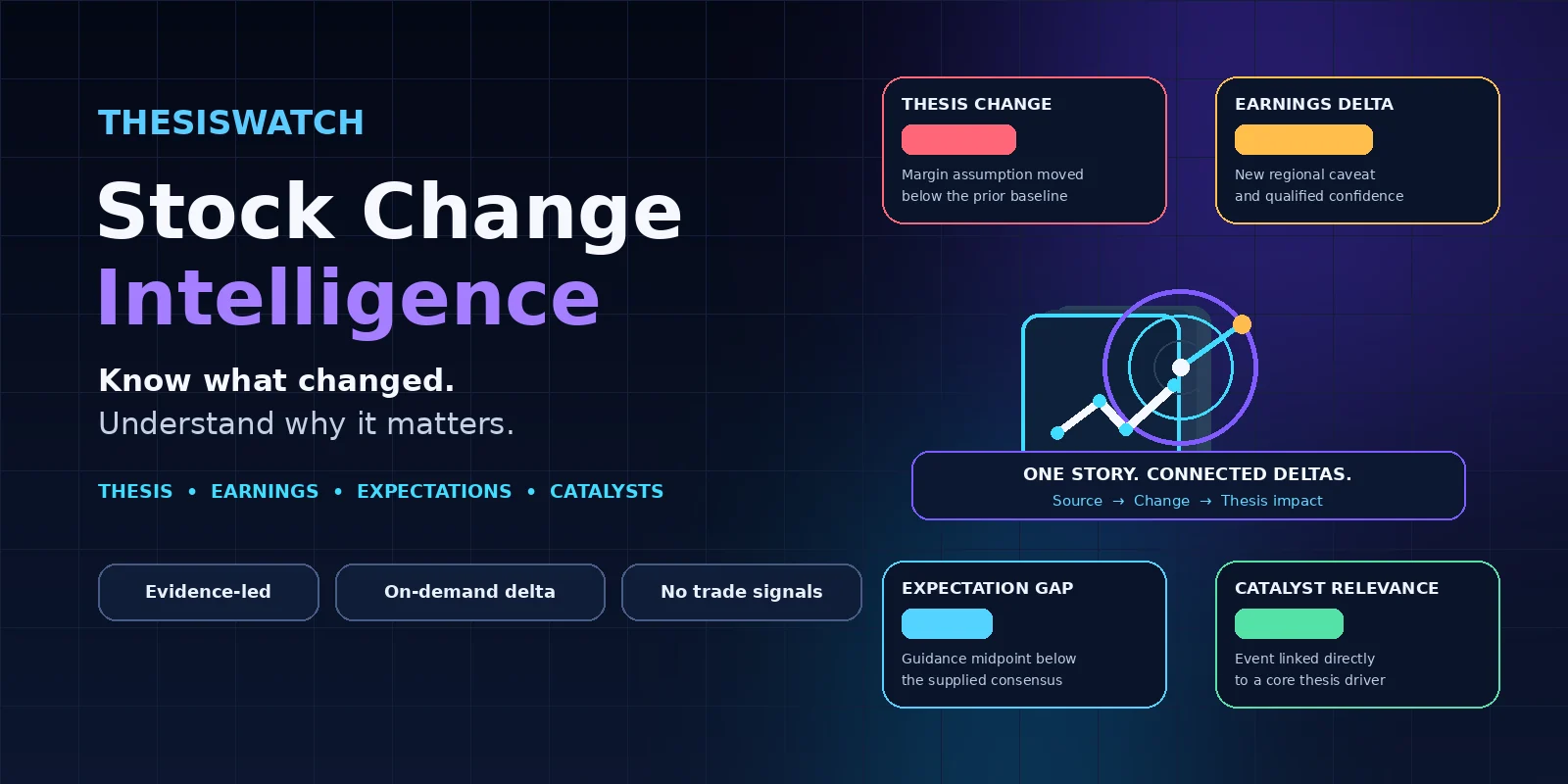
ThesisWatch: Stock Change Intelligence
ThesisWatch: Stock Change Intelligence
Know what changed. Understand why it matters.
ThesisWatch helps investors, analysts, and market watchers understand how a company's story changes over time.
Start with a ticker, a prior thesis, or a source pack. The Agent builds a structured thesis baseline, compares new disclosures against the original assumptions, detects material changes, analyzes shifts in management language, calculates guidance-versus-consensus gaps from attributed data, and connects catalysts to the specific drivers or risks they affect.
ThesisWatch explains changes in the research thesis. It does not predict returns or tell users what to trade.
Who It Helps
- individual investors conducting their own research;
- equity analysts;
- founders and operators tracking public competitors;
- finance professionals preparing internal research;
- portfolio and watchlist researchers;
- users following earnings and company disclosures.
The Core Job
Tell me when something important changes in the stock story I am following—and explain why it matters to the original thesis.
Rather than selling separate tools for earnings calls, catalysts, expectations, and thesis tracking, ThesisWatch connects them in one evidence-led workflow.
Core Capabilities
Thesis Baseline
Creates a reusable record of:
- growth drivers;
- key risks;
- assumptions;
- metrics;
- management commitments;
- known catalysts;
- disconfirming evidence;
- unresolved questions;
- sources and confidence.
Thesis Change Detection
Compares new evidence with the prior baseline and explains:
- what changed;
- previous versus current state;
- evidence;
- affected thesis components;
- thesis-change severity;
- confidence;
- why the change matters;
- what could confirm or reverse the interpretation.
Earnings Language Delta
Compares management commentary across periods by topic:
- demand;
- pricing;
- margins;
- supply;
- inventory;
- capex;
- competition;
- geography;
- regulation;
- customer concentration;
- execution;
- guidance confidence.
Expectation Gap
Calculates a source-attributed comparison between:
- company guidance;
- guidance midpoint;
- supplied consensus;
- absolute gap;
- percentage gap;
- historical guidance behavior when verified data is available.
The gap is descriptive. It is not a guaranteed beat/miss forecast.
Catalyst Relevance
Filters company, customer, competitor, supplier, regulatory, product, and industry events through the baseline.
An event becomes a thesis alert only when it affects a tracked driver, risk, metric, or assumption.
Watchlist Review
Produces an alert-style review across multiple companies:
- priority research alerts;
- material thesis changes;
- earnings language deltas;
- expectation gaps;
- relevant catalysts;
- no-material-change list;
- missing-data list.
Inputs
Provide any combination of:
- ticker or company name;
- prior thesis baseline;
- previous thesis update;
- company filing;
- earnings release;
- investor presentation;
- prepared remarks;
- authorized earnings-call transcript;
- guidance table;
- source-attributed consensus snapshot;
- company or industry announcement;
- watchlist.
Users must be authorized to upload any paywalled transcript, research, or consensus data.
Source Hierarchy
ThesisWatch prioritizes:
- regulator filings and exhibits;
- issuer investor-relations materials;
- company-prepared earnings materials;
- authorized transcripts or prepared remarks;
- source-attributed consensus supplied by the user;
- reputable public reporting for external catalysts;
- clearly labeled interpretation.
For U.S. issuers, SEC EDGAR and issuer disclosures are preferred primary sources.
Example Prompts
Create a baseline
Track NVIDIA.

Build a thesis baseline from the attached 10-K, latest 10-Q, earnings release, and investor presentation. Identify growth drivers, risks, assumptions, metrics, management commitments, catalysts, disconfirming evidence, and unresolved questions.
Update a thesis
Compare the attached new quarter with my previous thesis baseline. Show material changes, score their impact on the thesis, and explain what strengthened, weakened, or remained unchanged.
Earnings language delta
Compare management language in the current and prior earnings materials. Focus on demand, margins, supply, geography, competition, and guidance confidence. Use short evidence excerpts and source references.
Expectation gap
Company guidance is $11.6B–$12.2B. The source-attributed consensus snapshot is $12.4B as of 24 July 2026. Calculate the gap, explain comparability limits, and do not make a beat/miss prediction.
Watchlist review
Review my watchlist using the attached baselines and new source packs. Prioritize only confirmed material thesis changes and catalysts connected to each baseline.
Output Formats
- Markdown research report;
- thesis baseline JSON;
- thesis delta JSON;
- expectation-gap calculation;
- watchlist summary;
- CSV-ready tables when requested.
Evidence and Confidence
Every report includes:
- source cutoff;
- source coverage;
- primary versus secondary evidence;
- calculations;
- interpretation;
- confidence;
- missing data;
- conflicting evidence.
Thesis-change severity measures impact on the tracked thesis. It is not an investment rating.
Monitoring Model
Version 1.0.0 is on-demand.
It can create recurring value when the user returns with:
- the saved baseline;
- new filings;
- new earnings materials;
- new consensus data;
- a watchlist refresh request.
It does not:
- run continuously in the background;
- send push notifications;
- guarantee real-time coverage;
- guarantee that every event was captured.
Financial Disclaimer and Boundaries
This Agent does not constitute professional financial advice. Users should consult a licensed financial advisor before making financial decisions.
ThesisWatch does not provide:
- buy/sell/short/hold instructions;
- price targets;
- stop-loss levels;
- position sizing;
- trade execution;
- guaranteed returns;
- claims of predictive accuracy;
- claims that a historical guidance pattern guarantees the next result.
Privacy and Data Flow
This package does not hardcode an external market-data API, search provider, transcript provider, storage provider, analytics service, messaging service, or webhook.
Prompts and uploaded materials are processed through the Capafy runtime and its disclosed model path.
When platform browsing is available, the Agent may review public filings and issuer disclosures. If deployment later adds a direct external API or service that receives user-related data, the listing must be updated before publication.
Limitations
- Source availability and timeliness vary.
- Consensus must be attributed and timestamped.
- Paywalled research or transcripts require user authorization.
- Management tone is interpretive and context-dependent.
- Historical behavior does not guarantee future outcomes.
- A missing disclosure is not proof of deterioration.
- The Agent cannot guarantee complete market coverage.
- The user remains responsible for independent verification and decisions.
Version
1.0.0