Weekly Portfolio Health Check
Tells you what you actually hold — not what to do about it.
What it does
Give it your holdings — tickers, quantities, and ideally cost basis — and it runs a structural review of your portfolio:
Current allocation by asset class, sector, and geography
Top positions ranked by size, so concentration is visible at a glance
Concentration risk flags — single-stock, sector, geographic, and correlated-asset clustering, using commonly-cited reference thresholds
Target comparison and rebalancing math — if you give it a target allocation, it calculates the drift and what dollar amount would need to shift to close the gap
This is a downloaded skill, not a subscription service — there's no automated weekly run. You run it yourself, on whatever cadence works for you (weekly, monthly, before rebalancing decisions). The same consistent format each time makes a real check-in habit take minutes, not hours.
Why it's safe to use
Two things matter here: the numbers have to be real, and the skill has to stay on the right side of the line between describing your portfolio and advising you on it.
On the numbers:
Every price used in the analysis is either retrieved live or provided by you directly — never estimated from memory. Stock prices move daily; a stale or guessed figure would corrupt every percentage calculated from it.
If a price can't be retrieved for a holding, the skill says so explicitly rather than silently guessing.
On the boundary:
This skill will never tell you to buy, sell, or hold a specific security. It can tell you "your target calls for more in bonds" — it will not tell you "sell your Tesla" or "buy this ETF."
Rebalancing math is arithmetic performed on your own stated target — it never assigns you a target allocation you didn't ask for (no generic "age-based" defaults sprung on you).
Concentration flags are presented as facts plus commonly-cited reference points — never as a verdict. Some investors hold concentrated positions intentionally; the skill leaves that judgment to you.
Every output ends with a clear disclosure: this is a structural diagnostic, not financial advice, and a licensed financial advisor or tax professional is the right resource for decisions with tax or planning consequences.
Modes
Mode Best for What you get
Full Portfolio Health Check Your regular check-in Full allocation breakdown, top positions, risk flags, and (if you provide a target) drift + rebalancing math
Concentration Risk Deep-Dive "Am I too exposed to X?" Direct and indirect exposure to a specific stock, sector, or region — including exposure hidden inside funds/ETFs where that data is available
Rebalancing Scenario Modeling You already have a target and want the math Category-level shift amounts needed to move from current to target allocation
Example input → output
Input:
"I hold 100 shares of NVDA and 50 shares of VOO."

Output (excerpt):
| Holding | Value | % of Portfolio |
|---|---|---|
| NVDA | $21,700 | 38.2% |
| VOO | $35,050 | 61.8% |
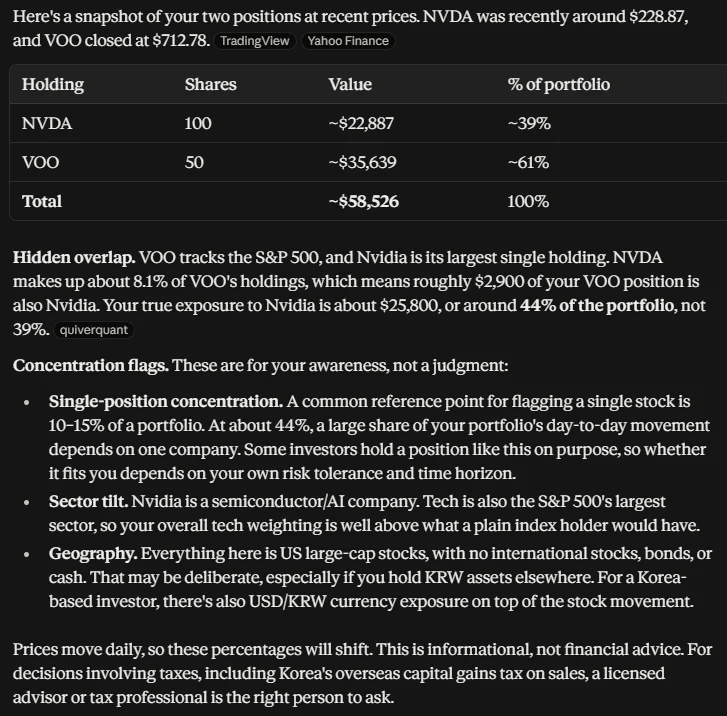
🔶 Single-position concentration: NVDA is 38.2% of your portfolio directly.
Indirect exposure: VOO itself holds ~7.5% NVDA, adding ~4.6% more.
Total NVDA exposure (direct + indirect): ~42.8%
FAQ
Does this give me buy/sell recommendations? No. It shows you the structure of what you already hold and flags things worth being aware of. Any decision about what to trade is yours (or your advisor's) to make.
How current are the prices used? As current as the skill can retrieve at the time you run it (via live search), or whatever values you provide directly. It will never use a memorized or estimated price.
Is this a subscription that runs automatically every week? No — it's a one-time download you run yourself. "Weekly" refers to the recommended habit, not an automated schedule. Run it as often as fits your routine.
Can it tell me if I'm "too concentrated"? It'll show you the percentage and note commonly-cited reference points (e.g., single positions over ~10-15% are often flagged), but whether that fits your personal risk tolerance is left to you — some investors hold concentrated positions on purpose.
Does it handle tax implications of rebalancing? It flags that tax consequences exist for trades in taxable accounts, but doesn't calculate actual tax liability — that's a conversation for a tax professional, since it depends on your full situation.
Is this financial advice? No. It's a structural diagnostic tool. Consider a licensed financial advisor for decisions about your specific goals, tax situation, and risk tolerance.