

SkillSmith ESG / CSRD Disclosure Assistant
The hard part of a first CSRD report isn't the prose — it's knowing which of the twelve ESRS standards apply to you, defending that scope with double materiality, and not inventing data you don't have. This wedge does exactly that, for a fraction of a Big-Four engagement.
What it does
CSRD/ESRS is the EU's high-stakes sustainability-disclosure regime, and the first report is where teams drown: twelve standards, a double-materiality test, hundreds of datapoints, and consultants quoting five or six figures. (Note: the 2026 Omnibus I directive raised the mandatory threshold to 1,000+ employees and €450M+ turnover, taking most smaller companies out of the mandatory scope — but value-chain customers still ask suppliers for ESG data, and voluntary VSME reporting is rising, so the "where do I even start" problem hasn't gone away.) Most tooling is built for large enterprises with a sustainability team already in place.
This skill is the pragmatic, affordable wedge. Give it a company profile, sector, size, target framework (CSRD/ESRS or GRI), and whatever data you can paste in — and it produces a structured disclosure work product: a scoping memo, a double-materiality scaffold, a disclosure-to-section mapping, a prioritized gap analysis, and section drafts of the sustainability statement. Plain text in, plain text out, runs in the sandbox, and your data never leaves your hands.
How it works
A five-stage workflow, each producing a fixed, hand-off-ready output:
| Stage | Output |
|---|---|
| 1. Scoping | Which ESRS topical standards (E1–E5, S1–S4, G1, +ESRS 2) plausibly apply — Likely / Possible / Unlikely with an activity-tied rationale. A hypothesis, confirmed by Stage 2. |
| 2. Double materiality | Per-topic impact + financial scaffold: severity (scale × scope × irremediability) and magnitude × likelihood rubrics, scored by you on your evidence — [DATA NEEDED] where there's none. |
| 3. Disclosure mapping | Each disclosure requirement → target report section → data source / status, grouped by the four ESRS building blocks. |
| 4. Gap analysis | What's missing to file, classified by type (policy / data / process / governance) + priority + a concrete next action. |
| 5. Section drafts | Sustainability-statement prose in ESRS 2 structure, every unsupplied figure left as a [DATA NEEDED] placeholder, with the disclaimer attached. |
⭐ Featured example — a generated first-filer work product
Input: "NordPack Oy — a ~180-employee recycled-cardboard packaging maker in Finland, EUR 28M turnover, one site, first-time CSRD/ESRS filer. Here's our sustainability policy. Help us scope and draft."
Output: the assistant scopes the twelve standards against the actual business — E1 Climate, E5 Resource use & circular economy, S1 Own workforce, G1 Business conduct as Likely, E2/E3/S2 as Possible pending facts — then builds the double-materiality scaffold without inventing a single score:
![Scoping table and double-materiality scaffold for an illustrative SME, with every unsupplied input flagged DATA NEEDED]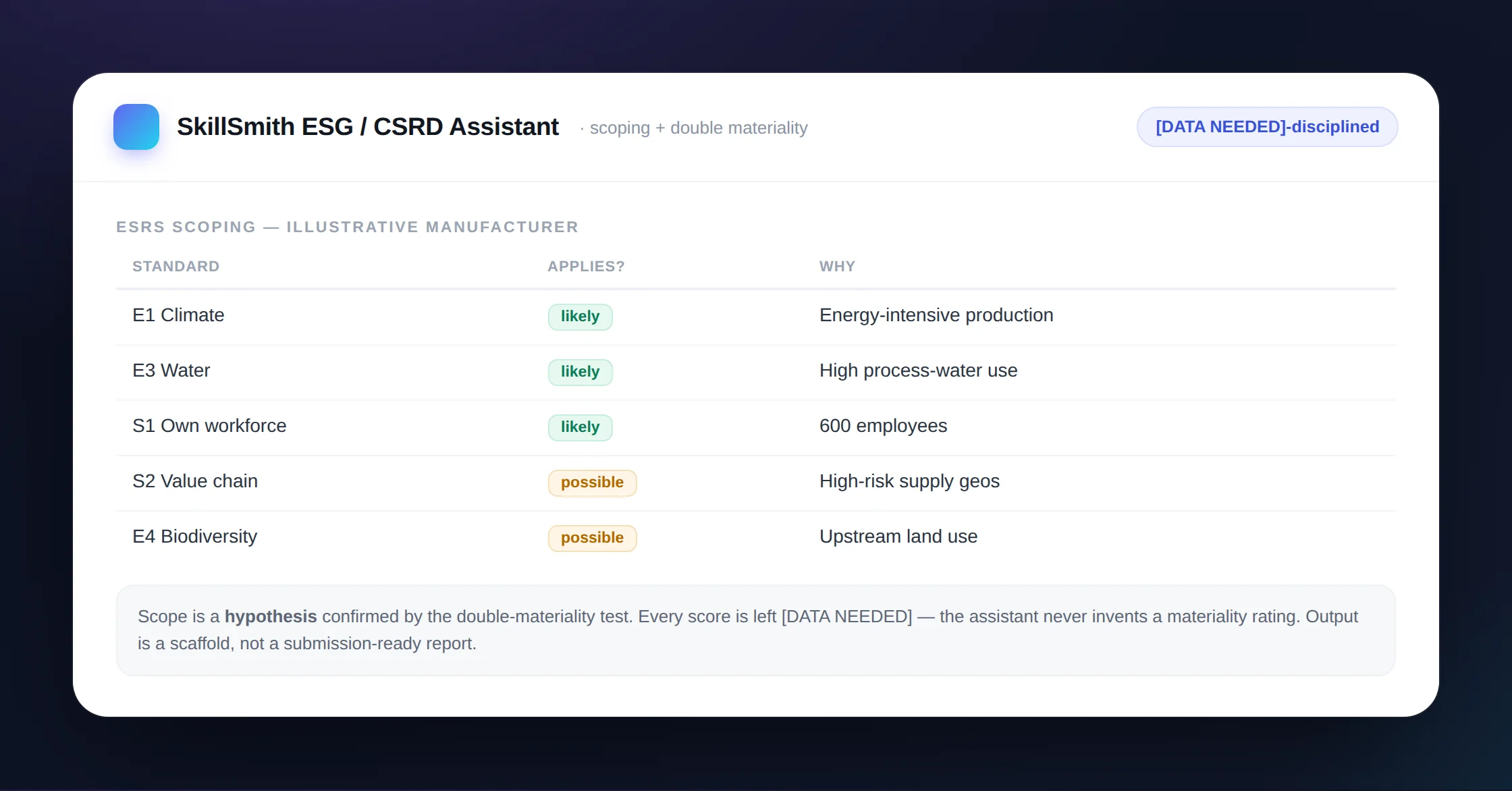
From there it maps each disclosure requirement to a section, turns the unsupplied rows into a prioritized gap analysis, and drafts the sustainability statement — leaving every emissions figure as an explicit [DATA NEEDED] placeholder rather than a fabricated number:
![Disclosure mapping, prioritized gap analysis, and a section draft with DATA NEEDED placeholders instead of invented emissions figures]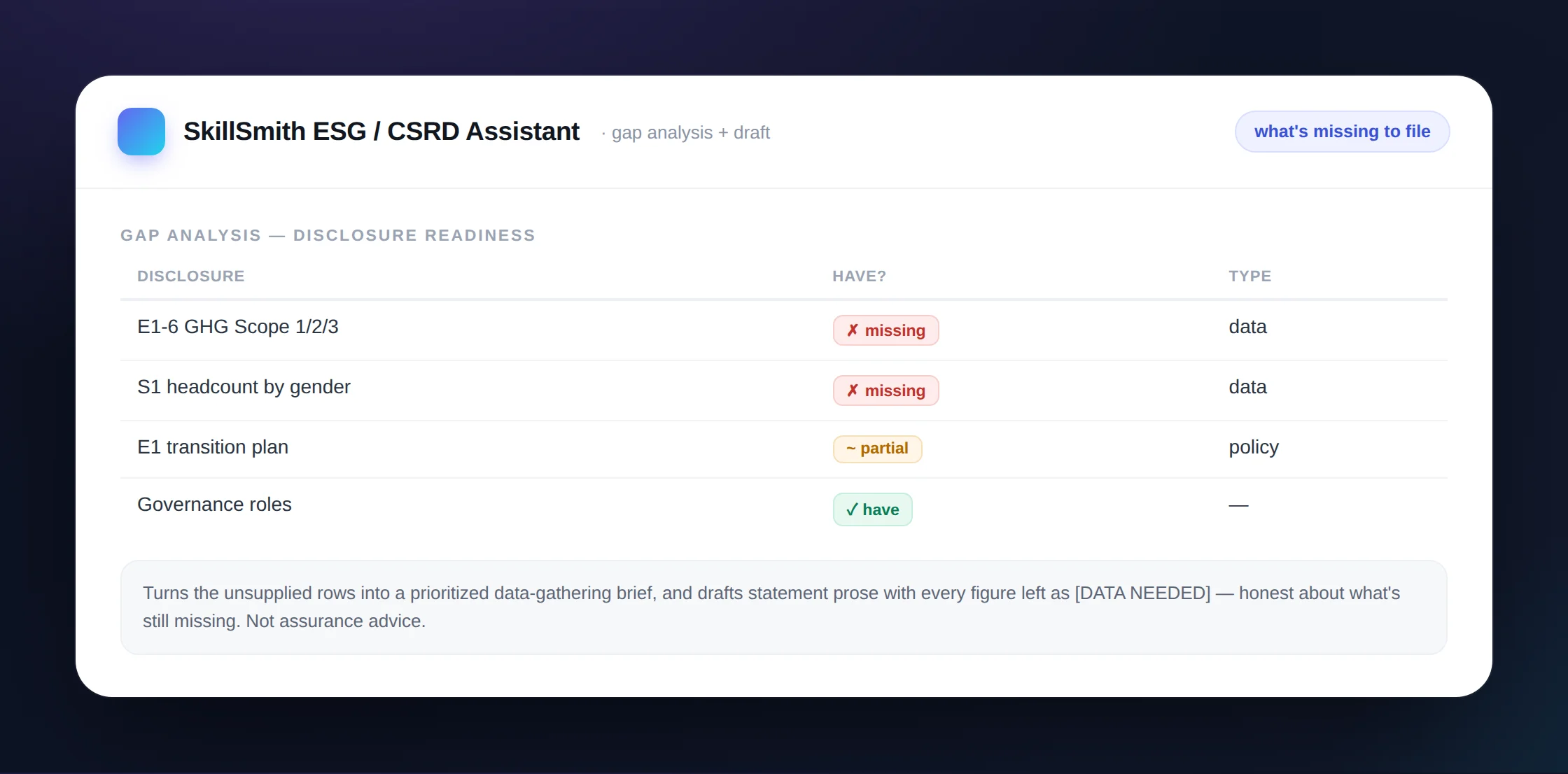
Generated on a real run of this skill against an illustrative SME. No emissions figures, scores, or compliance conclusions were fabricated; every missing input is flagged
[DATA NEEDED].
Why it's different
- An affordable wedge, not a Big-Four engagement. For an in-scope filer, a voluntary VSME reporter, or a supplier answering a customer's ESG questionnaire, it gives the same five-stage structure a practitioner would use — a scaffold plus a data-gathering brief — where the alternative is a five-figure consulting invoice. It gets you started and organized, not audit-ready.
- Materiality-first, the way ESRS actually works. Scope is a hypothesis until the double-materiality assessment confirms it — the skill refuses to map disclosures before the impact + financial test, exactly as the standard intends.
- It never fabricates. No invented emissions, metrics, scores, or "compliant" verdicts. Unknown is always
[DATA NEEDED]with a precise description of what to insert — so a draft is honest about what's still missing. - Self-contained and private. Pure text in/out, your data only, no paid databases — runs entirely in the sandbox.
- Framework-aware references. Bundled guides for the twelve ESRS standards, the double-materiality method, disclosure mapping, gap analysis, and safe non-advisory phrasing — a verified starting point you confirm against current official text.
Disclaimer / Scope
This skill is an AI-assisted drafting and organization aid — it is not professional compliance, legal, accounting, audit, or assurance advice, and not a substitute for review by qualified sustainability practitioners and an independent auditor. CSRD/ESRS rules (including phase-in dates, the EU Omnibus changes, and sector standards) evolve — confirm all requirements against the latest official EFRAG / EU sources before relying on them. All figures, metrics, and topic conclusions must be verified by the company; [DATA NEEDED] placeholders mark information the company must supply and must never be filled with estimated values.


