AI-Generated Content Fact-Check Assistant
An editor's second pair of eyes for the sentences that sound a little too certain.
What it does
Paste in a draft — an article, blog post, marketing page, script, or anything an AI helped write — and this skill reads it the way a careful editor would before it goes to print. It doesn't just skim for typos. It hunts for the specific pattern that makes AI-assisted content risky to publish: claims that sound authoritative but were never actually checked.

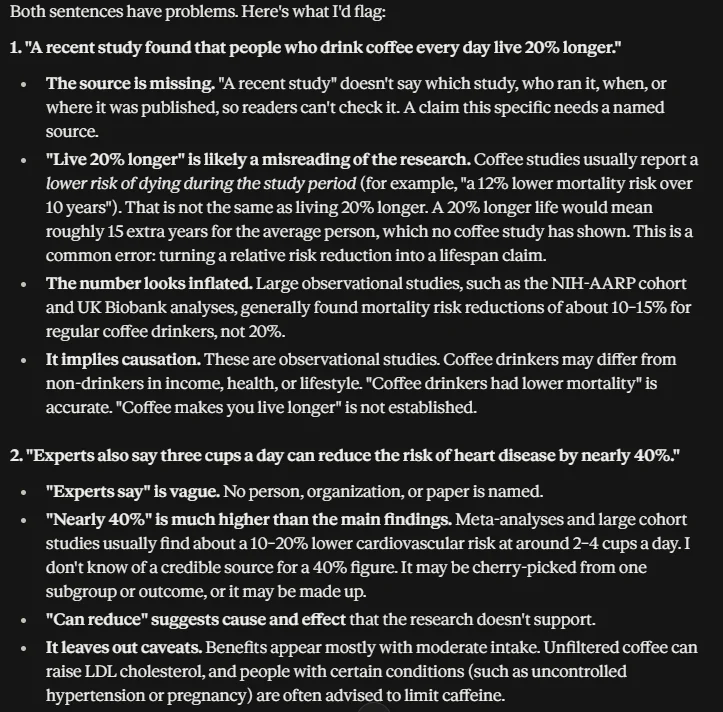
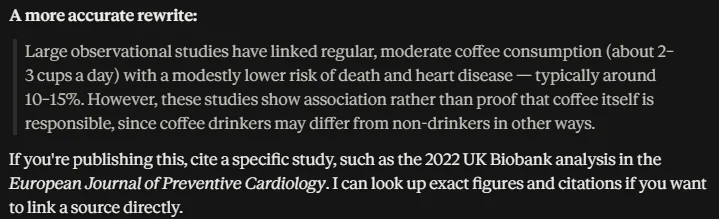
Specifically, it looks for:
- Specific-sounding statistics with no source ("73% of teams now...")
- "Studies show" or "experts agree" with no study or expert actually named
- Quotes attributed to nobody in particular
- Inflated social proof (follower counts, review counts, "trusted by 10,000+ companies") with nothing backing the number
- Predictions stated as settled fact rather than forecast
Every flagged claim gets a risk level (🔴 High / 🟡 Medium / 🟢 Low) and a plain-language explanation of what's missing, so you know exactly what to fix — not just that "something feels off."
Why it's safe to use
The skill is built around one non-negotiable rule: it will never manufacture the verification it's supposed to be checking for.
That means:
- It will never invent a URL, study name, author, date, or statistic to make a claim look sourced.
- It will never upgrade a claim from "unverified" to "confirmed" just because the claim sounds plausible. Plausible is not the same as verified.
- It will never generate placeholder review counts, ratings, or follower numbers and present them as real, even as an "example."
- If asked to add a source and none exists, it names the type of source that would help ("a peer-reviewed study on X") instead of fabricating a specific one.
- If live web search is used to double-check a claim, the output says plainly whether a matching source was actually found — it doesn't quietly assume a claim is fine just because nothing contradicted it.
In short: the skill would rather tell you "I can't verify this" than hand you a confident-sounding answer that turns out to be another hallucination layered on top of the first one.
Modes
| Mode | Best for | What you get |
|---|---|---|
| Quick Scan | "Can I post this right now?" | A fast, scannable list of flagged claims with one-line reasons and next steps |
| Detailed Fact-Check Report | Formal publication, journalism, official company copy | A numbered, claim-by-claim breakdown with category, status, and a suggested fix for each |
| Rewrite Suggestions | You want the fixes, not just the flags | Each risky claim rewritten into honest, hedged language — with multiple options depending on whether you can add a real source |
Example input → output
Input (excerpt):
"According to a recent study, 87% of marketers now rely on AI-generated content daily, and industry experts agree this will double by next year. Our platform is trusted by over 50,000 businesses."
Output (Quick Scan, excerpt):
🔴 "87% of marketers... daily" — specific stat, no source given
🔴 "trusted by over 50,000 businesses" — social proof number, no source
🟡 "industry experts agree" — unnamed authority, nothing specific to check

Before you publish:
- Add a real, named source for the 87% figure or remove the number
- Confirm the 50,000 figure against actual internal data before publishing
- Name the specific experts/publications, or soften to "some in the industry believe"
FAQ
Does this skill fact-check against the live internet?
Only if you have web search enabled and ask for it. By default, it checks whether a claim is properly sourced within your own text — which is usually the faster and more useful first pass, since most AI-hallucinated content fails at that step before you even get to live verification.
Will it slow down my publishing workflow?
Quick Scan is designed to be read in under a minute. Save the Detailed Report mode for content that actually needs the extra scrutiny (press releases, official statements, anything with legal exposure).
What if my content is genuinely well-sourced already?
It says so. The skill doesn't manufacture risk to seem thorough — a clean draft gets a short, clean result.
Can it rewrite my content for me?
Yes, in Rewrite Suggestions mode — but it will never fill a rewritten sentence with a fabricated statistic or source just to make it read more smoothly. If a claim can't be honestly rewritten, it will tell you to cut it instead.
Is this a substitute for a professional fact-checker or legal review?
No. It's a strong first pass that catches the most common AI-content failure mode before human review — not a replacement for editorial or legal sign-off on high-stakes content.