DCA Rewind | DCA vs Lump-Sum Backtest Report
DCA Rewind | DCA vs Lump-Sum Backtest Report
Past data calculation, not investment advice.
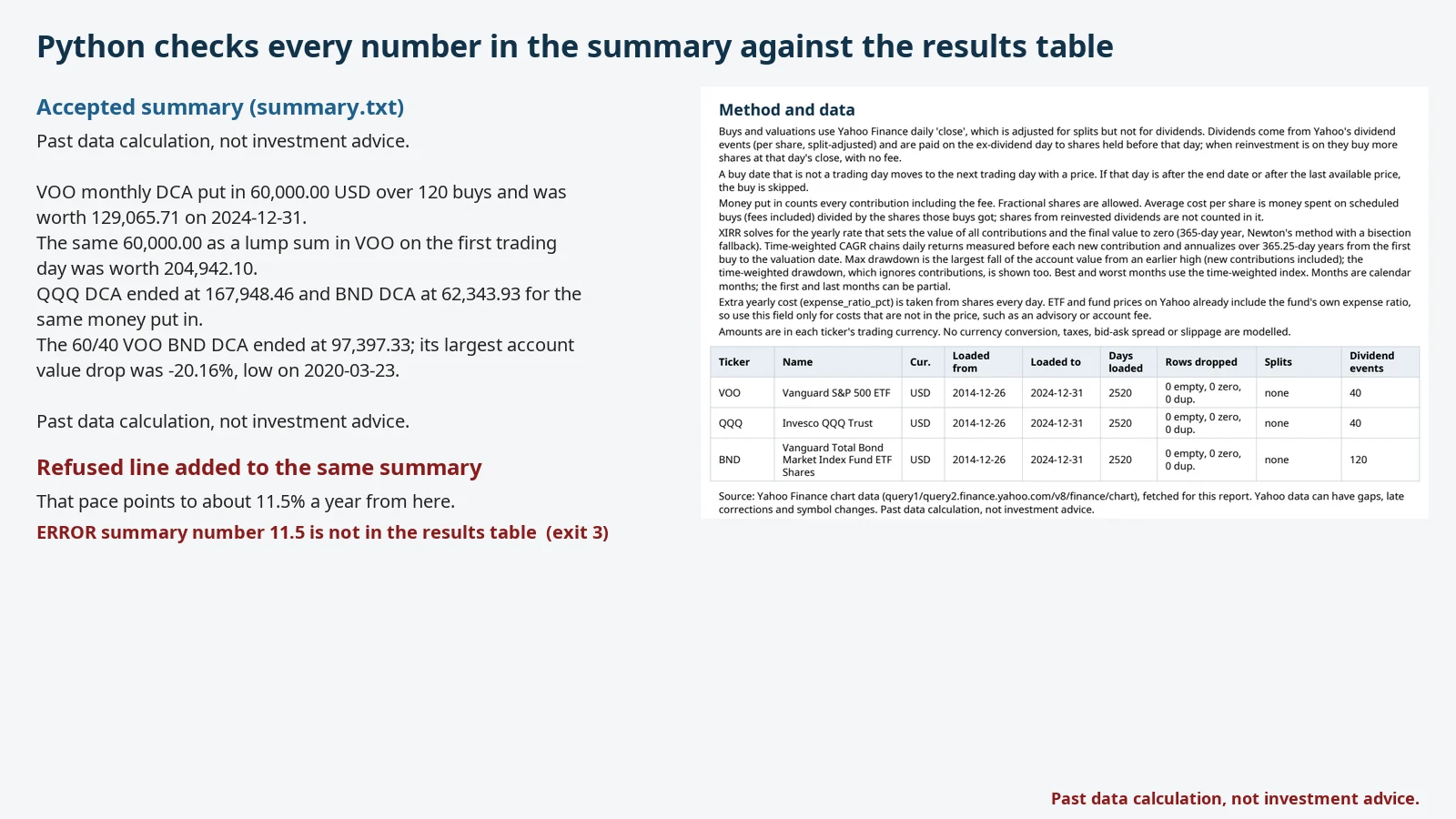
Tell DCA Rewind which tickers you want to look back on, how much you would have put in each time and how often. It replays those buys on Yahoo Finance daily prices and puts them next to a lump sum of the same total invested on day one. Python does every calculation. The assistant only fills in your plan and writes a short summary, and Python checks that every number in that summary appears in the results table.
It looks at the past only. It does not tell you what to buy or sell and does not forecast prices or returns.
What you send
- Up to 5 tickers as Yahoo Finance symbols: stocks, ETFs, funds and crypto (for example VOO, QQQ, AAPL, BND, BTC-USD, 7203.T). A company or fund name also works; the symbol found is shown to you.
- Amount per buy, and how often: weekly, every two weeks (on a weekday you pick) or monthly (on a day of the month you pick).
- Start and end dates.
- Optional: a lump-sum amount (default: the same total as the DCA plan), a flat fee per buy, an extra yearly cost such as an advisor fee, dividends reinvested or kept as cash, and one mixed portfolio such as 60% VOO / 40% BND with no, monthly, quarterly or yearly rebalancing.
What you get
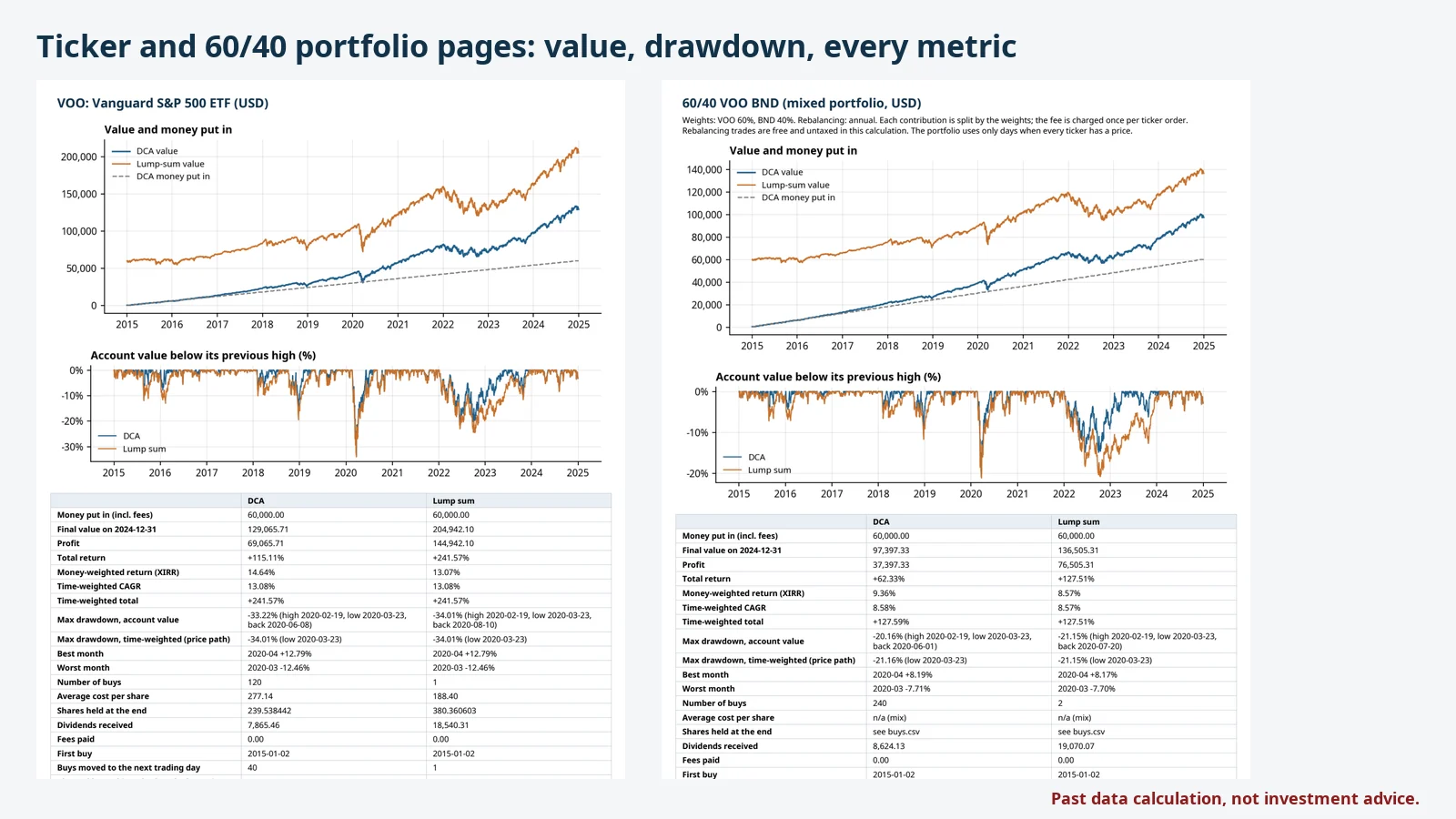
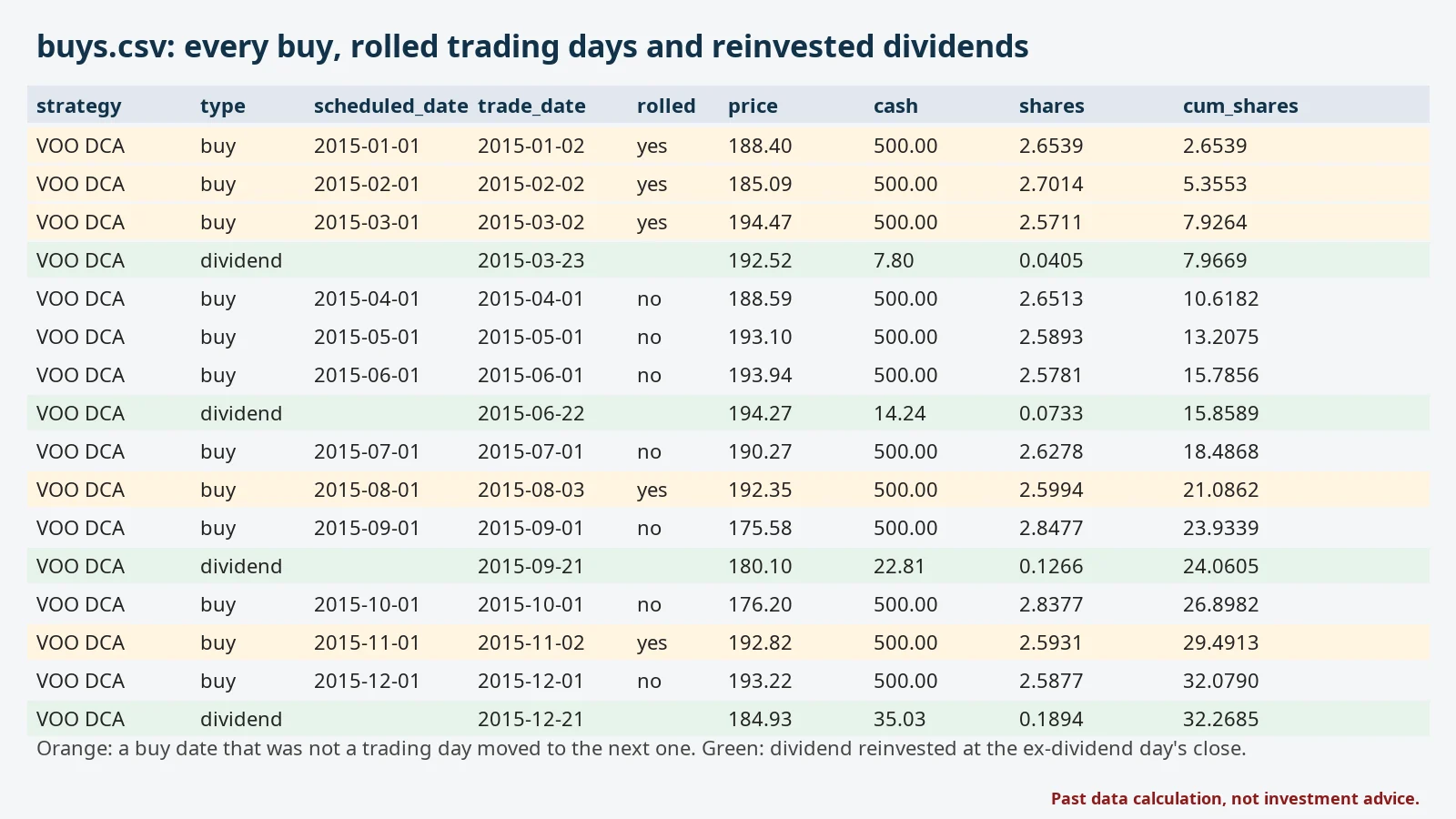
dca_rewind_report.pdf: a summary, a comparison table for every strategy, a chart of DCA value per unit of money put in, and one page per ticker and for the mix with value and money-put-in lines, an account drawdown chart and the full metrics table, then a method and data page.buys.csv: every buy with the planned date, the actual trading date, whether it moved, price, cash, fee, shares and running totals, plus each reinvested dividend and rebalancing trade.comparison.csvandresults.json: every number in the report, and the daily value series.summary_card.png: a 1080x1350 card with money put in, DCA and lump-sum final values, XIRR and max drawdown for each ticker.summary.txt: the checked 3 to 5 line summary.
Every file starts and ends with "Past data calculation, not investment advice."
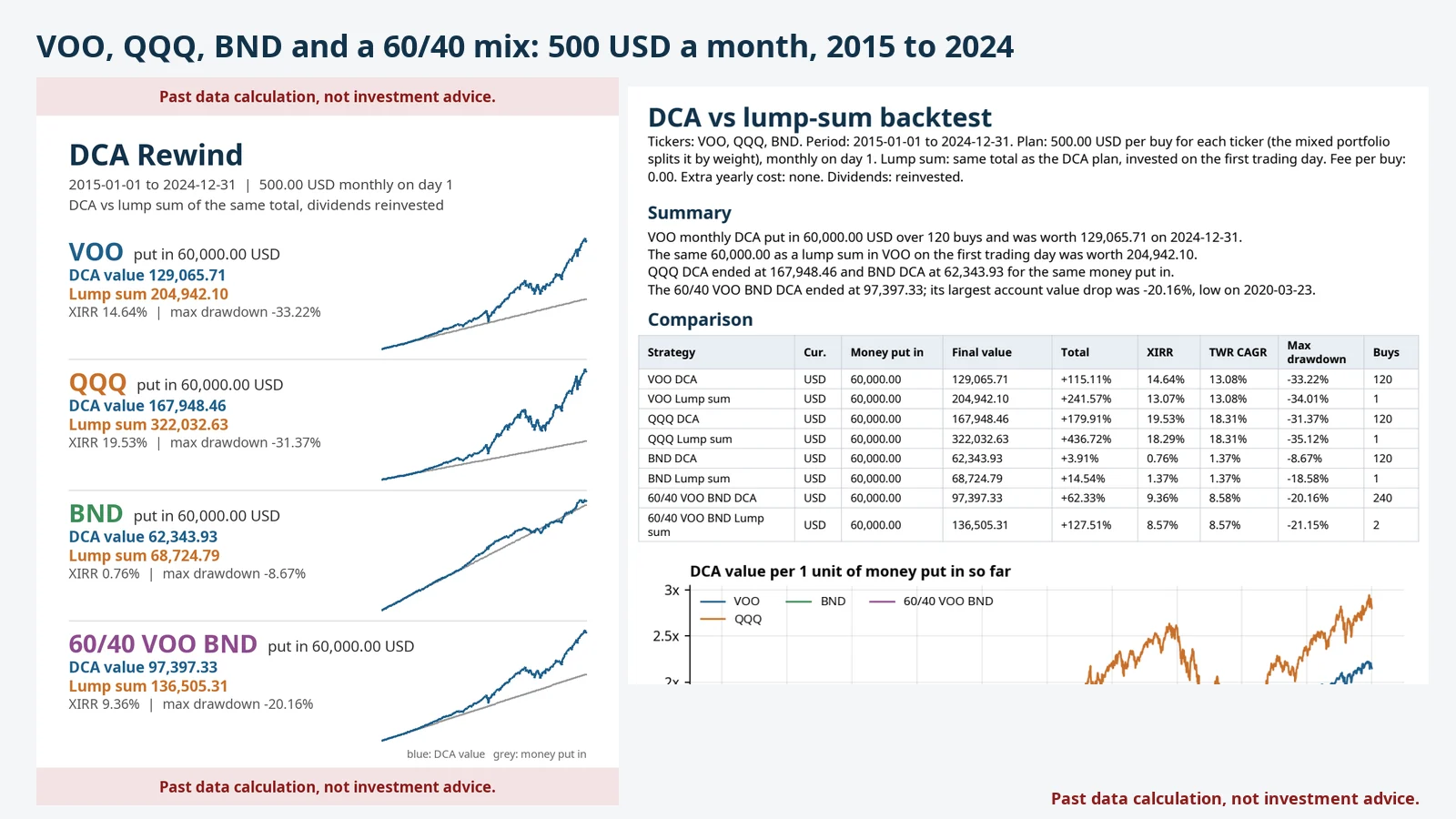
The numbers in the table
Money put in (fees included), final value, profit, total return, money-weighted return (XIRR), time-weighted CAGR, max drawdown of the account value with its high, low and recovery dates, the time-weighted drawdown, best and worst calendar month, number of buys, average cost per share, shares held, dividends received, fees paid, buys moved to the next trading day and buys skipped.
How prices and dates are handled
- Buys and values use Yahoo's daily close, which is adjusted for splits but not for dividends. Dividends come from Yahoo's dividend events and are paid on the ex-dividend day to shares held before that day. With reinvestment on, they buy more shares at that day's close, with no fee.
- A buy that falls on a weekend or holiday moves to the next trading day with a price. A buy that would land after the end date or the last price is skipped and counted. Crypto trades every day, so weekend buys stay on the weekend.
- If a ticker's prices start after your start date, its buys start at the first price instead of piling up on one day, and the report says so.
- The mixed portfolio splits each contribution by weight, charges the fee once per ticker order, uses only days when every ticker has a price, and rebalances on the first such day of each period. Tickers in a mix must trade in the same currency.
- Amounts are in each ticker's own currency. Taxes, currency conversion, spreads and slippage are not modelled. Yahoo ETF prices already include the fund's own expense ratio, so the extra yearly cost field is only for costs outside the price.
Checks we ran
- XIRR and CAGR: 30 cash-flow cases with known answers (rates from -90% to +350% a year, 1 to 260 contributions, three with a withdrawal) and 30 CAGR cases. DCA Rewind and a separately written implementation both matched the known answers to better than 1e-6 (largest error 4.4e-14). Newton's method solved 25 cases; the bisection fallback solved the other 5. On 10 synthetic price paths growing at a fixed rate, XIRR and CAGR came out at that rate.
- Dates and data: 16 cases pass, including weekend and holiday moves, day 31 in February, empty, zero and duplicate price rows, a split that Yahoo had not adjusted, a dividend on a missing day, a buy on the ex-dividend day, prices that start late, buys after the last price, crypto weekends, Tokyo and Sydney time stamps, and mixed-currency and fee errors.
- Independent recompute: a second backtest written from the raw Yahoo responses gave the same final value, shares and money put in for all 18 single-ticker strategies in two test plans (difference 0). Lump-sum growth with dividends reinvested was within 0.071% of Yahoo's own adjusted-close growth for VOO, QQQ, AAPL and BND over 2015 to 2024.
- Live run on 2026-11-19 with VOO, QQQ, AAPL, BTC-USD and BND: 10 of 10 final values equal shares held times the last close in the same response, and the independent recompute matched exactly.
- Summary check: invented numbers and words such as should, will, expect, forecast and sell are refused; in our test set, 7 of 7 bad summaries were refused and 3 of 3 good ones accepted.
These are our own tests, not an audit of Yahoo's data.
Plans
| Plan | Price | Requests |
|---|---|---|
| Daily | $2.99 | 5 per day |
| Weekly | $7.99 | 10 per week |
| Monthly | $19.99 | 30 per month |
The weekly plan has a 1-day trial with 2 free requests. One message is one backtest of up to 5 tickers.
Limits
- Data comes from Yahoo Finance's public chart endpoint without a key. It can be delayed, revised, rate limited or missing for some symbols; if a ticker cannot be loaded, the run stops and says which one instead of guessing.
- Daily closes only, no intraday prices. If the end date is today, the last price may be an intraday quote; the report marks it.
- Past results do not show what will happen next. Past data calculation, not investment advice.
API externes
Yahoo Finance chart API (query1.finance.yahoo.com) · Yahoo Finance chart and search API (query2.finance.yahoo.com) · PyPI (pypi.org) · Python Package Files (files.pythonhosted.org)