Due Diligence Intelligence
Due Diligence Intelligence
Investigate before you commit.
Evidence-driven company investigation for acquisitions, investments, vendors, partnerships, competitors, and strategic business decisions.
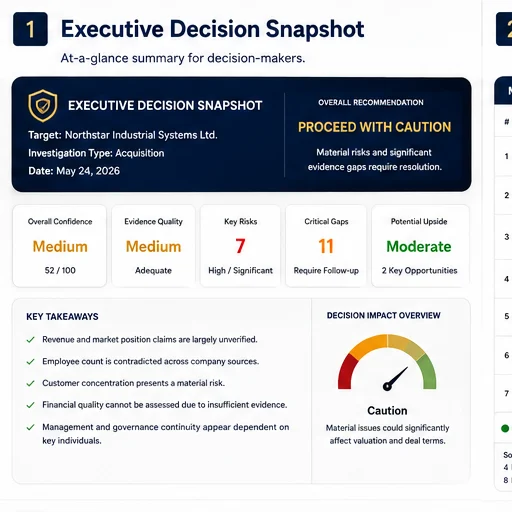
Image 1. Executive Decision Snapshot:
What It Does
Due Diligence Intelligence transforms business information and supporting documents into structured, evidence-aware decision analysis.
It answers a question ordinary research tools often leave unresolved:
What does the available evidence actually mean for my decision, and what should I verify before proceeding?
The Agent:
- Extracts and classifies material claims.
- Separates supported facts from company claims, third-party claims, analyst inference, and unverified signals.
- Evaluates evidence quality, source independence, recency, specificity, corroboration, and completeness.
- Tests important claims against available evidence.
- Identifies contradictions and distinguishes genuine conflicts from differences caused by dates, definitions, scope, geography, or accounting treatment.
- Identifies material risks and opportunities.
- Assesses potential decision impact.
- Identifies missing evidence and prioritizes evidence requests.
- Generates targeted management questions tied to specific findings.
- Explains what evidence could change major conclusions.
- Produces a structured Diligence Decision Map.
- Performs scenario analysis when the available evidence supports it.
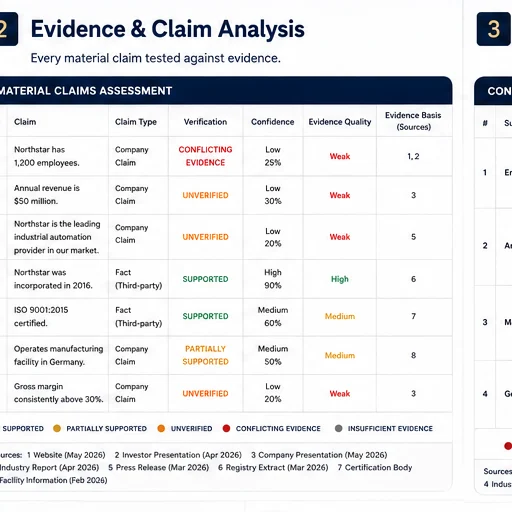
Image 2: Evidence & Claim Analysis:
The Core Intelligence Chain
Every material finding is connected through:
Finding → Evidence → Verification → Confidence → Risk / Opportunity → Decision Impact → Evidence Needed → Management Question
This makes the analysis traceable from source material to business decision.
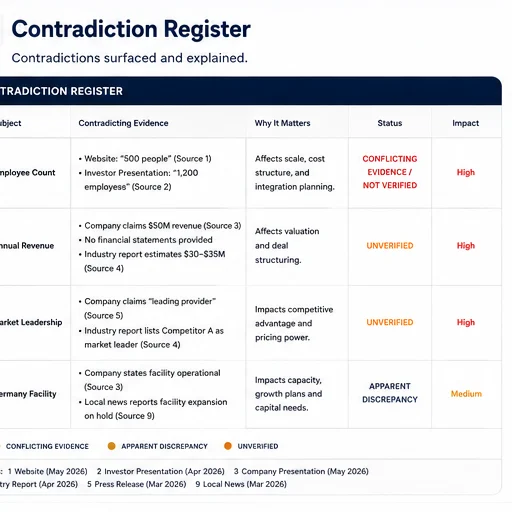
Image 3: Contradiction Register"
Evidence Discipline
The Agent does not treat repeated company statements as independent corroboration.
Material findings can be classified as:
- SUPPORTED
- PARTIALLY SUPPORTED
- UNVERIFIED
- CONFLICTING EVIDENCE
- APPARENT DISCREPANCY
- INSUFFICIENT EVIDENCE
- ANALYST INFERENCE
The Agent preserves uncertainty rather than converting weak evidence into artificial certainty.
Evidence-Calibrated Assessment
Assessment
- STRONG
- ADEQUATE
- MIXED
- WEAK
- INSUFFICIENT EVIDENCE
- NOT ASSESSED
Confidence
- HIGH
- MEDIUM
- LOW
Evidence uncertainty is not automatically treated as high risk.
Numerical scores are used only when the underlying evidence and methodology support a reproducible calculation.
Contradiction Analysis
When sources disagree, the Agent first considers:
- Date
- Definition
- Scope
- Geography
- Accounting treatment
- Source timing
- Source reliability
- Independence
This helps distinguish genuine contradictions from information reported using different definitions or periods.
Diligence Decision Map
The Agent converts important findings into decision-oriented actions:
Finding → Evidence → Verification → Confidence → Decision Impact → Evidence Needed → Management Question
Images 4: Diligence Decision Map:
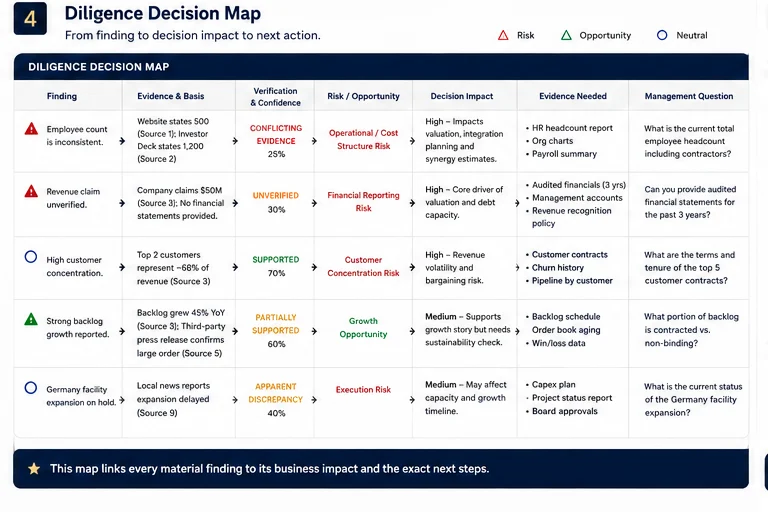
The result is not simply a research report. It is a structured investigation of what should happen next.
What the Output Can Contain
Executive Decision Snapshot
A concise view of the most material findings, uncertainties, risks, opportunities, and decision implications.
Evidence & Claim Analysis
A structured examination of important company and third-party claims.
Contradiction Register
Material conflicts, their sources, possible explanations, and what must be reconciled.
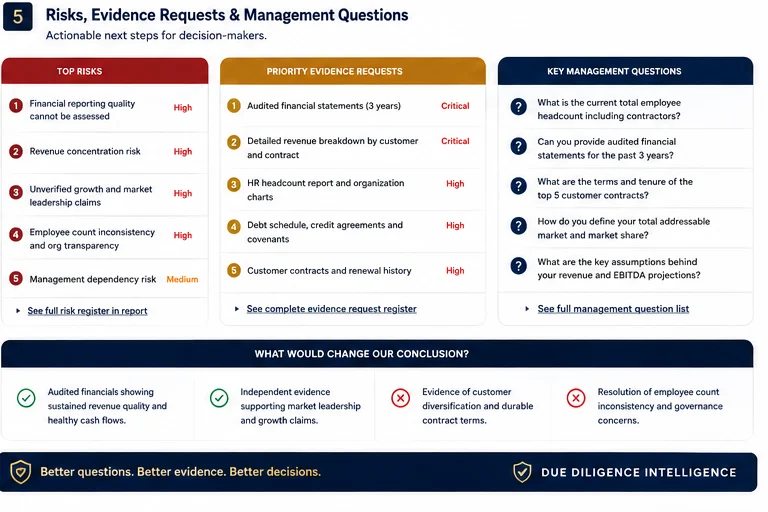
Risk Register
Material risks with severity, confidence, evidence basis, potential impact, and required follow-up.
Opportunity Register
Potential strategic or commercial opportunities supported by the available evidence.
Evidence Request Register
A prioritized list of documents, records, schedules, confirmations, or other evidence needed to resolve important uncertainties.
Management Questions
Specific questions tied to identified claims, risks, contradictions, and evidence gaps.
Image 5: Risks, Evidence Requests & Management Questions:
Scenario Analysis
Where sufficient evidence exists, analysis of how different assumptions or outcomes could affect the decision.
What Would Change the Conclusion?
A clear statement of the evidence or development that could materially change a major finding.
Example Use Cases
Acquisition Due Diligence
"I'm considering acquiring this company. Analyze the supplied documents and identify the most important risks, contradictions, missing evidence, and questions I should ask management."
The Agent can examine ownership, financial evidence, revenue claims, customer concentration, liabilities, debt, intellectual property, management dependency, regulatory exposure, operational resilience, and transaction implications when relevant evidence is available.
Investment Research
"Test the company's growth, revenue, market-position, and business-quality claims against the evidence provided."
The Agent separates company claims from verified evidence and identifies what remains unresolved.
Vendor / Supplier Due Diligence
"We're considering this company as a critical supplier. Assess its financial, operational, concentration, regulatory, and continuity risks."
Partnership Due Diligence
"Evaluate this potential partner's capabilities, strategic fit, reputation, dependencies, execution capacity, and potential conflicts based on the available evidence."
Competitor Intelligence
"Assess this competitor's market claims, positioning, products, strengths, weaknesses, and strategic implications. Separate verified evidence from marketing claims."
Claim Verification
"Here are five claims from the company's presentation. Test each claim and tell me what evidence would be required to verify it."
A Typical Investigation
- Define the decision — acquisition, investment, supplier, partnership, competitor, or another business decision.
- Provide the available evidence — reports, presentations, claims, financial information, contracts, or other supplied material.
- Extract material claims.
- Classify evidence and source quality.
- Test claims and identify contradictions.
- Assess confidence, risks, opportunities, and decision impact.
- Identify evidence gaps.
- Generate prioritized evidence requests and management questions.
- Map findings to the decision.
- State what could change the conclusions.
Designed for Imperfect Information
Real-world diligence rarely starts with complete information.
Instead of inventing an answer when evidence is missing, the Agent can state:
INSUFFICIENT EVIDENCE
and explain:
- what cannot currently be established;
- why the evidence is insufficient;
- what evidence is needed;
- what management should be asked;
- and how resolving the gap could affect the decision.
Best Results
For the strongest analysis, provide:
- The decision you are considering.
- The company or entity being investigated.
- Relevant source documents.
- Specific claims you want tested.
- Any known concerns or red flags.
- The time period or transaction context.
- The level of diligence you require.
The more decision context and primary evidence available, the more precise and useful the analysis can be.
Important Limitation
Due Diligence Intelligence provides AI-generated informational analysis and decision support.
It is not legal, financial, investment, accounting, tax, regulatory, or other professional advice.
Conclusions depend on the quality, completeness, accuracy, and recency of the evidence available to the Agent. Users should obtain appropriate professional advice before making material legal, financial, investment, tax, regulatory, or transaction decisions.
Due Diligence Intelligence
Investigate before you commit.