

Market Research - Online Skill
Market Research
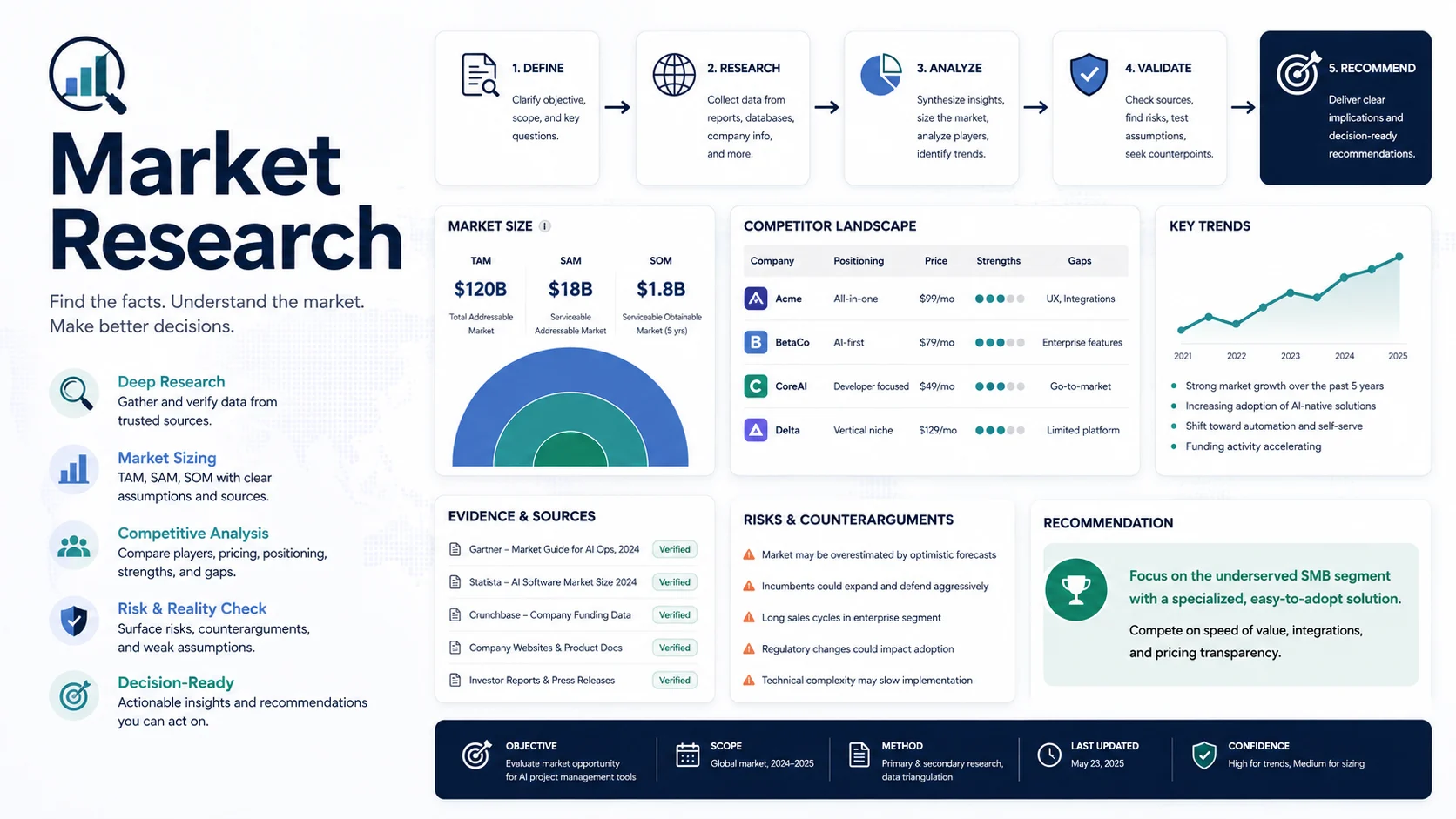
Market Research helps you investigate markets, competitors, investors, companies, and technology trends with one goal: make better business decisions.
Instead of producing a long research report filled with disconnected facts, this skill focuses on evidence, trade-offs, risks, and what the findings actually mean for the decision you are trying to make.
Use it for market sizing, competitive analysis, investor due diligence, technology research, or pressure-testing a business thesis before you build, fund, buy, or enter a market.
Research a market
Use the skill when you need to understand a market or category before making a move.
It can help answer questions such as:
- How large is this market?
- Is the category growing?
- Who are the major players?
- Where are the gaps?
- How crowded is the space?
- What assumptions would need to be true for this opportunity to work?
- What evidence supports or weakens the opportunity?
The research is organized around the decision you need to make, rather than collecting information simply because it is available.
Estimate TAM, SAM, and SOM
Market sizing can be approached from more than one direction.
The skill can combine:
- Top-down estimates from reports and public datasets
- Bottom-up estimates based on realistic customer assumptions
- Pricing assumptions
- Customer counts
- Adoption rates
- Geographic or segment constraints
- Comparable market data
Important assumptions are made explicit instead of being hidden inside the final number.
When reliable data is unavailable, estimates are labeled as estimates rather than presented as facts.
Analyze competitors
Competitive research focuses on what competitors actually offer, not just what their marketing pages claim.
It can investigate:
- Product capabilities
- Target customers
- Pricing
- Positioning
- Distribution
- Funding history
- Investors
- Public traction signals
- Strengths
- Weaknesses
- Product gaps
- Positioning gaps
This makes it useful both for understanding direct competitors and for finding adjacent products that could become competitors later.
For example:
Compare the five main AI meeting assistants for small businesses. Look at product capabilities, pricing, positioning, distribution, and obvious gaps in the market.
Research investors and funds
Market Research can also be used before investor outreach.
For a fund or investor, it can investigate:
- Fund size
- Investment stage
- Typical check size
- Relevant portfolio companies
- Public investment thesis
- Recent activity
- Sector focus
- Reasons they may be a good fit
- Reasons they may not be a good fit
- Obvious conflicts or red flags
Instead of producing a generic investor profile, the research should help answer a practical question:
Is this investor actually worth contacting?
Example:
Research these 10 venture funds for our seed round. We are building developer infrastructure for AI agents. Rank them by fit and explain why.
Research technologies and vendors
Use the skill when choosing between technologies, platforms, APIs, or vendors.
Research can cover:
- How the technology works
- Key capabilities
- Trade-offs
- Adoption signals
- Integration complexity
- Vendor lock-in
- Security considerations
- Compliance issues
- Operational risks
- Migration difficulty
This is useful when a technical decision has business consequences and a simple feature comparison is not enough.
For example:
Compare three vector databases for a production AI application. Include performance trade-offs, integration complexity, lock-in risk, pricing considerations, and adoption signals.
Pressure-test a business thesis
Research should not only look for evidence that supports an idea.
This skill deliberately looks for evidence that could prove the thesis wrong.
It can surface:
- Contrarian evidence
- Weak assumptions
- Market constraints
- Competitive threats
- Adoption barriers
- Pricing risks
- Distribution challenges
- Regulatory concerns
- Missing evidence
For example:
We believe small accounting firms will pay $200/month for an AI workflow automation product. Pressure-test this thesis and identify the assumptions most likely to fail.
The goal is not to defend the original idea. It is to understand whether the evidence supports it.
Keep claims tied to sources
Important factual claims should have supporting sources.
The skill is designed to:
- Attribute important claims
- Prefer recent information
- Flag stale data
- Label estimates clearly
- Distinguish facts from inference
- Separate recommendations from evidence
Numbers should either be sourced or clearly identified as estimates.
If available information is old or incomplete, that limitation should be visible in the report rather than hidden.
Include risks and counterarguments
A useful market report should not read like a pitch deck.
Alongside supporting evidence, the skill looks for:
- Downside cases
- Conflicting evidence
- Weak signals
- Missing information
- Alternative explanations
- Reasons a strategy might fail
This helps prevent a research report from becoming confirmation bias with citations.
Separate fact, inference, and recommendation
The skill distinguishes between three different things:
Fact
Company A raised $25M in its latest publicly reported funding round.
Inference
The funding and recent hiring suggest the company may be investing heavily in enterprise expansion.
Recommendation
Avoid competing directly on enterprise workflow breadth and focus on the underserved SMB segment instead.
Keeping these separate makes it easier to understand how the final recommendation was reached.
Turn research into a decision
The final output is designed to answer:
So what should we do?
A typical report is structured as:
- Executive summary
- Key findings
- Implications
- Risks and caveats
- Recommendation
- Sources
The recommendation should follow from the evidence rather than being added as a generic conclusion at the end.
Use it for
Market Research is useful when you want to:
- Research a market or industry
- Estimate TAM, SAM, and SOM
- Compare competitors
- Find positioning gaps
- Research a company
- Research investors or venture funds
- Prepare for investor outreach
- Compare technologies or vendors
- Investigate a technology trend
- Evaluate market-entry opportunities
- Pressure-test a startup idea
- Validate a business thesis
- Identify risks and counterarguments
- Build a source-backed business recommendation
Example requests
Estimate the TAM, SAM, and SOM for AI customer-support software for US ecommerce brands. Show your assumptions and use both top-down and bottom-up approaches.
Compare the leading AI coding assistants by product, pricing, distribution, target customer, funding, and positioning. Identify gaps a new entrant could exploit.
Research this venture fund before I contact them. Look at fund size, stage, check size, relevant portfolio companies, recent investments, and whether they are a good fit for our company.
Compare these three API providers. Focus on integration difficulty, pricing, lock-in, security, adoption, and operational risk.
Pressure-test our plan to launch an AI bookkeeping product for small businesses. Find evidence both for and against the opportunity.
Research the current market for AI agent marketplaces and recommend whether a new entrant should compete broadly or focus on a specific vertical.
What you get
Depending on the research task, the result can include:
- Executive summary
- Market overview
- TAM / SAM / SOM estimates
- Competitor comparison
- Competitive positioning
- Investor dossier
- Technology comparison
- Vendor analysis
- Key findings
- Business implications
- Risks and caveats
- Contrarian evidence
- Decision-oriented recommendation
- Source list
Before delivering the research, the skill checks that important numbers are sourced or labeled as estimates, stale data is identified, risks and counterarguments are included, and the final recommendation follows from the evidence.
The goal is not more research.
It is a clearer decision.
Source
Market Research comes from affaan-m's ECC project.
Source:
https://github.com/affaan-m/ECC/tree/main/.agents/skills/market-research


