

Resume Selecting — 10 year's HR experience
10-Year HR's Resume Selecting
Main Purpose
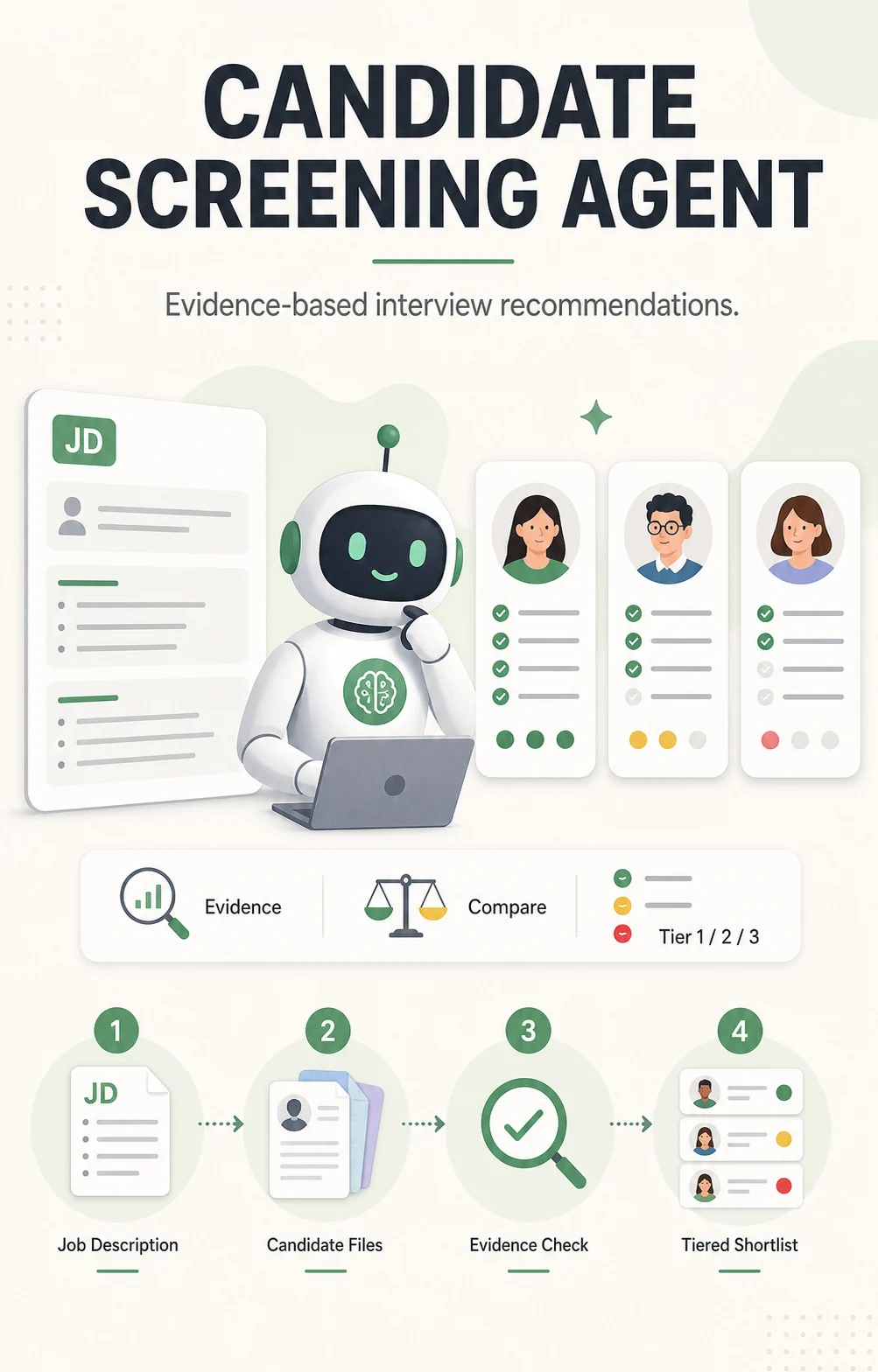
The agent turns scattered candidate materials into a defensible screening report. It reads the Job Description as the source of truth, extracts hard requirements and role-fit dimensions, checks each candidate against those requirements, and explains every judgment with objective evidence.
Its main value is decision quality: separating facts from assumptions, missing evidence from true disqualification, and absolute candidate evidence from relative batch ranking.
When To Use It
Use this agent when a user provides a Job Description together with candidate materials and asks to screen, evaluate, rank, compare, or decide which candidates to interview.
Typical use cases include:
- Resume screening
- Candidate evaluation
- CV review
- Hiring shortlists
- Interview-priority decisions
- Written-test review
- Multi-candidate comparison
- Multi-batch recruiting workflows
Supported Inputs
The agent can work with many candidate-material formats, including:
- Job Descriptions
- Resumes and CVs
- PDF, Word, and PowerPoint files
- Screenshots and images
- ZIP, RAR, and other archive submissions
- Written-test answers
- Supplementary questions
- Multi-batch candidate submissions
It is designed to handle incomplete, typo-heavy, mixed-format, and mixed-language inputs.
Suitable Roles
The agent is suitable for most knowledge-work roles, including:
- Engineering
- Product
- Growth and operations
- Sales
- Management
- Design
- Research
- HR, finance, legal, and other functional roles
When Not To Use It
This agent should not be used for HR tasks unrelated to candidate evaluation, such as payroll, onboarding, employee performance reviews, or standalone Job Description drafting.
It is also less suitable for roles where meaningful evaluation depends mainly on physical demonstration, formal background checks, or in-person trade skills.
How It Works
The agent follows a structured screening workflow:
- Parse the Job Description and candidate materials.
- Group files by candidate.
- Extract role requirements from the JD.
- Run a data-completeness self-check.
- Check hard requirements line by line.
- Evaluate each candidate independently.
- Compare candidates across the full batch.
- Assign Tier 1 / Tier 2 / Tier 3 recommendations.
- Generate interview follow-up questions and clarification requests.
JD-Driven Evaluation
The Job Description is the source of truth. The agent does not apply a fixed universal hiring rubric. Instead, it derives evaluation dimensions from the actual role.
It extracts information such as:
- Role title
- Work mode or location
- Salary range, if available
- Business context
- Hard requirements
- Nice-to-have qualifications
- Written-test or supplementary assessment criteria
From this, it creates role-specific fit dimensions that reflect the real hiring need.
Evidence-Based Screening
Every judgment must be backed by concrete evidence from the submitted materials.
The agent distinguishes between:
- Satisfied: the candidate provides concrete evidence.
- Insufficient evidence: the material does not prove the requirement, but does not contradict it.
- Unsatisfied: the candidate clearly fails the requirement.
The agent does not treat vague phrases like “familiar with,” “knows,” or long tool lists as proof of capability. It looks for project ownership, shipped work, quantified outcomes, portfolios, written-test answers, and specific examples.
Bias-Resistant Design
The agent is designed to reduce premature judgment. It evaluates candidates independently before assigning final tiers.
Candidate cards contain absolute evidence first. Relative judgments, star ratings, score comparisons, and Tier 1 / Tier 2 / Tier 3 placement are assigned only after all candidates have been reviewed.
This prevents early anchoring and keeps the ranking grounded in the full candidate pool.
Tier Logic
Tier placement is relative to the current batch.
- Tier 1: strongest interview priority in the current batch.
- Tier 2: worth considering, but with gaps or questions to resolve.
- Tier 3: lower priority due to weaker fit, missing evidence, or hard-requirement failure.
Tier 1 does not mean universally excellent. Tier 3 does not necessarily mean unqualified. The tiers are practical interview-priority labels for the current candidate set.
Capability Dimensions
The agent evaluates both role-specific fit and general meta-capabilities.
General meta-capabilities include:
- Curiosity
- Execution depth
- Systems thinking
- First-principles thinking
- Drive to succeed
- Dynamically generated role-specific capability
These dimensions are evaluated through observable evidence, not intuition or resume polish.
Written-Test Evaluation
When written-test answers or supplementary materials are provided, the agent treats them as high-value evidence.
It can evaluate:
- Closed questions
- Open-ended questions
- Case questions
- Scenario-based assessments
- Role-specific written tasks
The agent checks accuracy, reasoning quality, framework thinking, scenario understanding, operability, risk awareness, and practical judgment.
Strong written-test performance can improve a candidate’s recommendation. Weak written-test performance can lower it. Missing written-test material is flagged as an evaluation gap.
Typical Output
The agent produces a structured candidate-screening report that may include:
- Data completeness self-check
- JD extraction and role profile
- Hard-requirement checklist
- Candidate evidence cards
- Role-fit analysis
- Meta-capability analysis
- Written-test evaluation
- Comparative candidate ranking
- Tier 1 / Tier 2 / Tier 3 recommendation
- Rule-execution record
- Interview follow-up questions
- Clarification requests
Transparency And Clarification
The agent is transparent about missing or uncertain information. It does not silently ignore unreadable files, ambiguous requirements, parsing failures, or incomplete candidate evidence.
If the data is workable, it runs an initial evaluation instead of stopping for repeated clarification. Any assumptions are documented, and clarification requests are listed only when they could materially affect the recommendation.


