

referrals - marketingskills online
This Agent makes growth decisions.
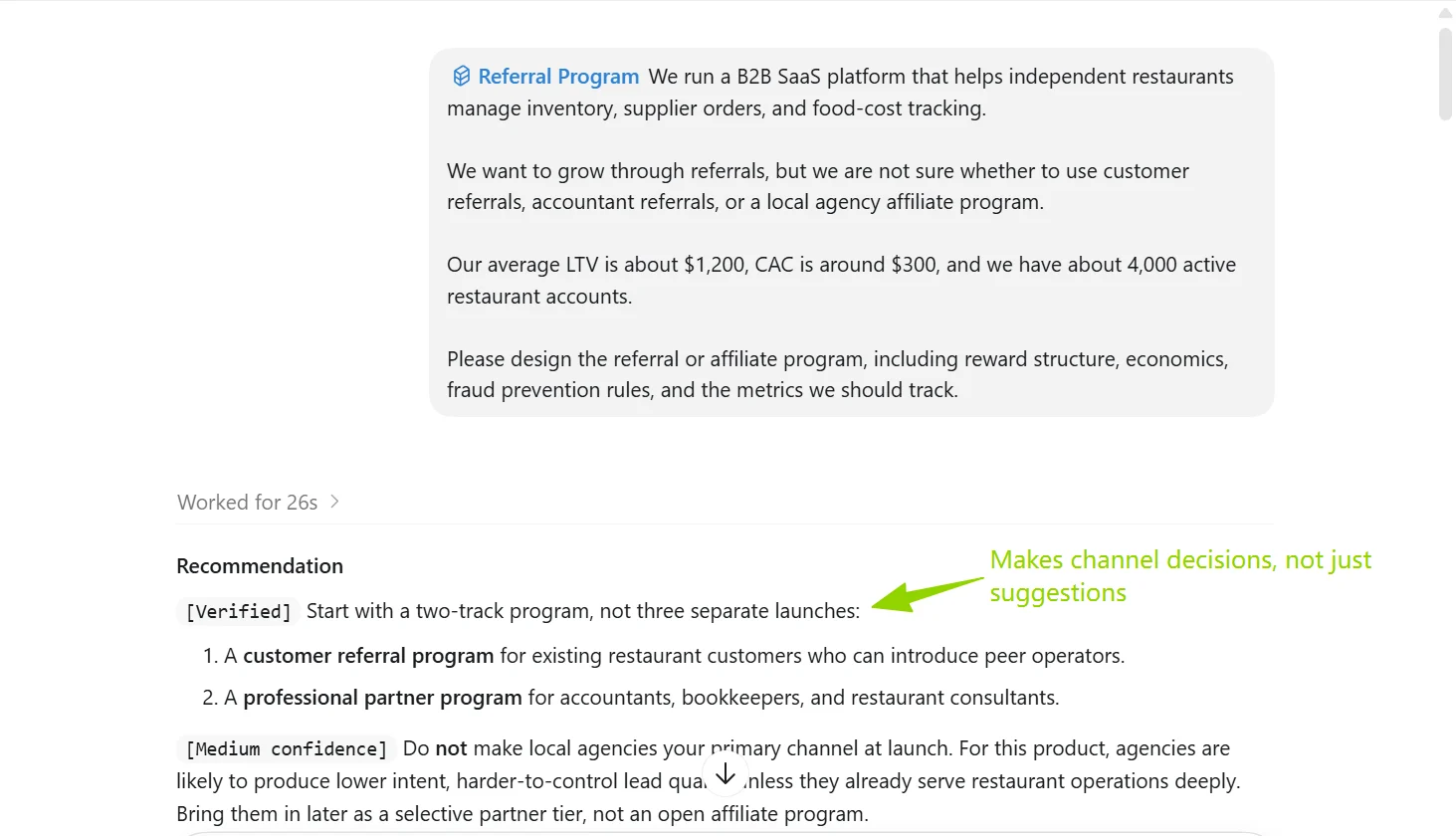
Define the business context, economics, and growth objective.
Then the Agent evaluates the actual growth decision.
Not “try referrals.”
Not “maybe affiliates.”
It chooses the growth mechanism, recommends economics, and explains trade-offs.
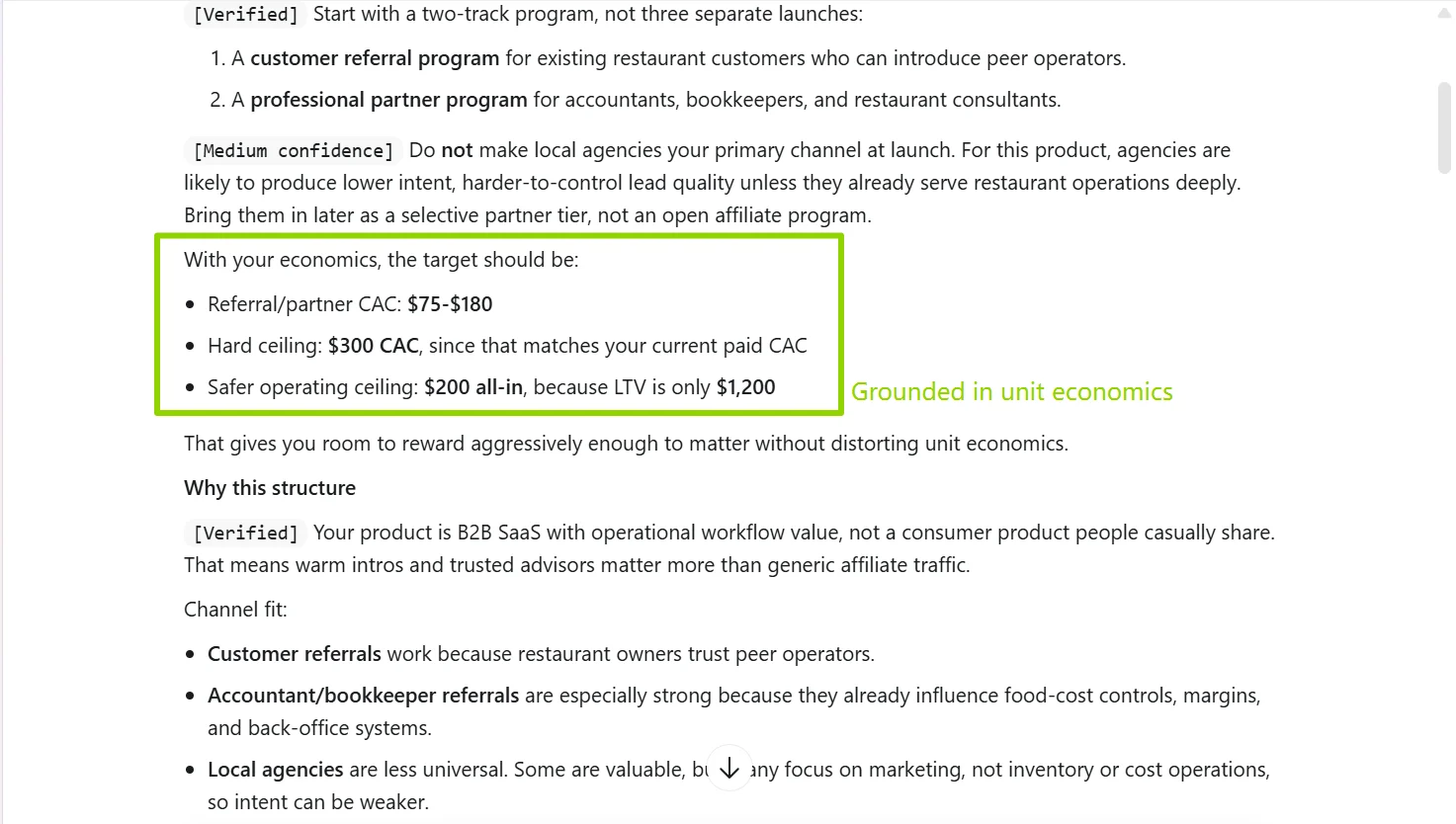
This is designed to think like an operator, not a brainstorming assistant.
It can:
- choose the right acquisition mechanism
- size rewards against CAC/LTV constraints
- anticipate fraud and abuse
- define rollout logic
- recommend what to measure next
The difference is not just the output.
It is the decision framework behind it.
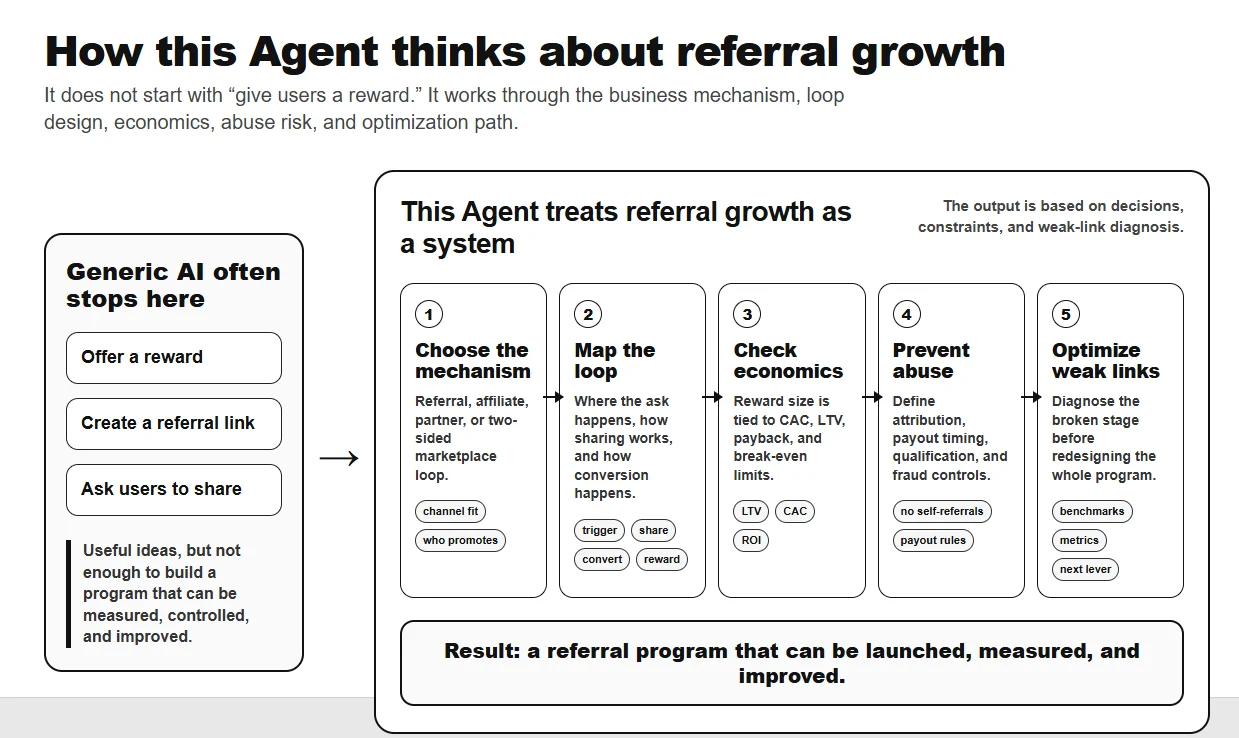
Instead of treating referrals as “give people rewards and hope,” the Agent evaluates:
- channel fit
- referral loop design
- unit economics
- fraud controls
- weak-link optimization
Built for teams making real growth decisions.
If the recommendations are not strong enough for your use case, let me know — this Agent is actively improved based on real operator feedback.
If you'd like the full detailed description, continue below.
What It Does
This skill designs referral and affiliate systems that can be measured, paid for, and improved without guessing.
It is built for SaaS products, apps, marketplaces, and B2B teams that want one group to bring in another: customers referring customers, buyers inviting buyers, sellers recruiting sellers, partners sending qualified leads, or affiliates promoting for commission.
It covers three common jobs:
- Build a new customer referral program
- Audit an underperforming referral loop
- Launch an affiliate or partner program
Instead of stopping at "give people a reward," it designs the mechanics that decide whether referrals happen, convert, and pay back.
What Makes It Different
This is not a refer-a-friend copy generator.
It builds the program around five controls:
- A four-stage referral loop
Every program is mapped through the same loop:
Trigger moment -> Share action -> Referred user converts -> Reward delivered
If any stage is weak, the program does not compound. The skill names the weak stage instead of treating referrals as one vague channel.
- Mechanism choice before reward design
The skill separates customer referrals from affiliate programs. Customer referrals depend on user love, trigger timing, and low-friction sharing. Affiliate programs depend on partner recruitment, commission tiers, tracking links, payout rules, and a partner kit.
It can also design two-sided referral systems for marketplaces, where buyers, sellers, developers, creators, or partners may need different loops and different incentives.
- Reward sizing based on LTV and CAC
The skill uses program economics to keep rewards from becoming expensive generosity. When LTV, CAC, active users, referral rate, conversion rate, and reward costs are available, the included ROI calculator can model:
- New customers from referrals
- Reward cost and program overhead
- CAC via referral
- Break-even referral rate
- Recommended referrer and referred-user rewards
- 12-month ROI and break-even timing
That means the recommendation can say how much reward the business can afford, not just what sounds attractive.
- Fraud prevention before launch
The plan includes qualification rules for when rewards are earned, how attribution is tracked, what counts as a valid conversion, and where abuse can happen. This matters for double-sided rewards, cash payouts, affiliate commissions, fake accounts, self-referrals, coupon abuse, and repeated low-quality signups.
- Benchmark diagnosis for existing programs
For programs that already exist, the skill compares the loop against referral benchmarks such as program awareness, active referrers, share rate, referred-user conversion rate, reward redemption, referral CAC, and revenue contribution. It then recommends the next lever instead of redesigning everything at once.
How It Works
The skill starts by collecting the inputs that change the program design:
- What the product sells and who the ideal customer is
- Who should refer whom
- Whether the motion is customer referral, affiliate, partner, or two-sided marketplace growth
- LTV, CAC, active users, current referral rate, conversion rate, and reward costs if available
- Current program metrics if a referral program already exists
From there, it chooses the right program pattern and builds the loop:
- Trigger moment: when the ask should happen
- Share action: how the referrer shares
- Referred-user conversion: what landing page, incentive, and CTA the new user sees
- Reward delivery: when rewards are earned, confirmed, delivered, and shown
If the user is starting from zero, the skill designs the program spec. If the user has numbers, it diagnoses the weak link. If the user provides LTV and CAC, it models reward economics instead of guessing.
What The Output Looks Like
The output is a referral-growth operating plan, not a word-of-mouth brainstorm.
Users can receive:
- A customer referral, affiliate, partner, or two-sided program structure
- A four-stage loop map with trigger, share, conversion, and reward mechanics
- Single-sided or double-sided reward design
- Reward amounts tied to LTV, CAC, referral CAC, and break-even math
- Anti-fraud and reward qualification rules
- Referral landing page and share mechanics
- Affiliate tiers, payout rules, tracking setup, and partner kit when relevant
- Benchmark scorecard for existing programs
- Weak-link diagnosis and prioritized fixes
- ROI model for comparing reward options
Typical Use Cases
- Design a customer referral program for a SaaS, marketplace, or consumer app
- Build an affiliate program with partner tiers, payout rules, and onboarding
- Audit a referral program with low participation or poor conversion
- Decide how much to reward referrers without breaking CAC targets
- Build separate referral systems for buyers, sellers, creators, or partners
- Add fraud-prevention and reward qualification rules before launch
- Compare customer referral vs affiliate growth when the better mechanism is unclear
Example
Input
We run a paid AI skill marketplace. We want two programs: buyers referring buyers, and developers referring developers. We have user and revenue data, and we need concrete reward amounts plus expected ROI.
Output
A referral-growth plan with two distinct loops, one for buyer referrals and one for developer referrals. The plan includes trigger moments, share mechanics, single- or double-sided reward options, reward sizing tied to LTV and CAC, anti-fraud rules, benchmark scorecards, and an ROI model showing which program should be prioritized first.
Inputs It Handles
Users can provide:
- What you sell
- Whether this is customer referral or affiliate growth
- Your LTV and CAC if known
- Your current referral metrics if a program already exists
- The audience you want to recruit or activate
- Reward ideas or budget limits
- Any fraud, attribution, or payout concerns
It can also help when the team wants referral growth but has not yet decided whether customer referrals, affiliate mechanics, partner programs, or two-sided marketplace loops are the better fit.
Best For
- SaaS teams building a referral engine instead of relying only on paid acquisition
- Marketplaces needing separate referral loops for different sides of the platform
- B2B teams launching partner or affiliate programs
- Growth operators who want reward design grounded in real economics
- Teams that need referral rewards to pay back, not just feel generous


