
Timed Shorts Scripts: Fit 15/30/45/60 Seconds
Three scripts that fit the clock on the first recording
A script that looks like 30 seconds on paper often records at 36, and the edit cuts the ending - usually the payoff. Timed Shorts Scripts times every line from the pace of speech, not from how long the text looks (about 2.5 English words or 6 Japanese characters per second by default; send your own voice's pace to change it). A script that runs over, or too short, is rewritten before you see it: each one lands a little under the target, never over.
What it looks like
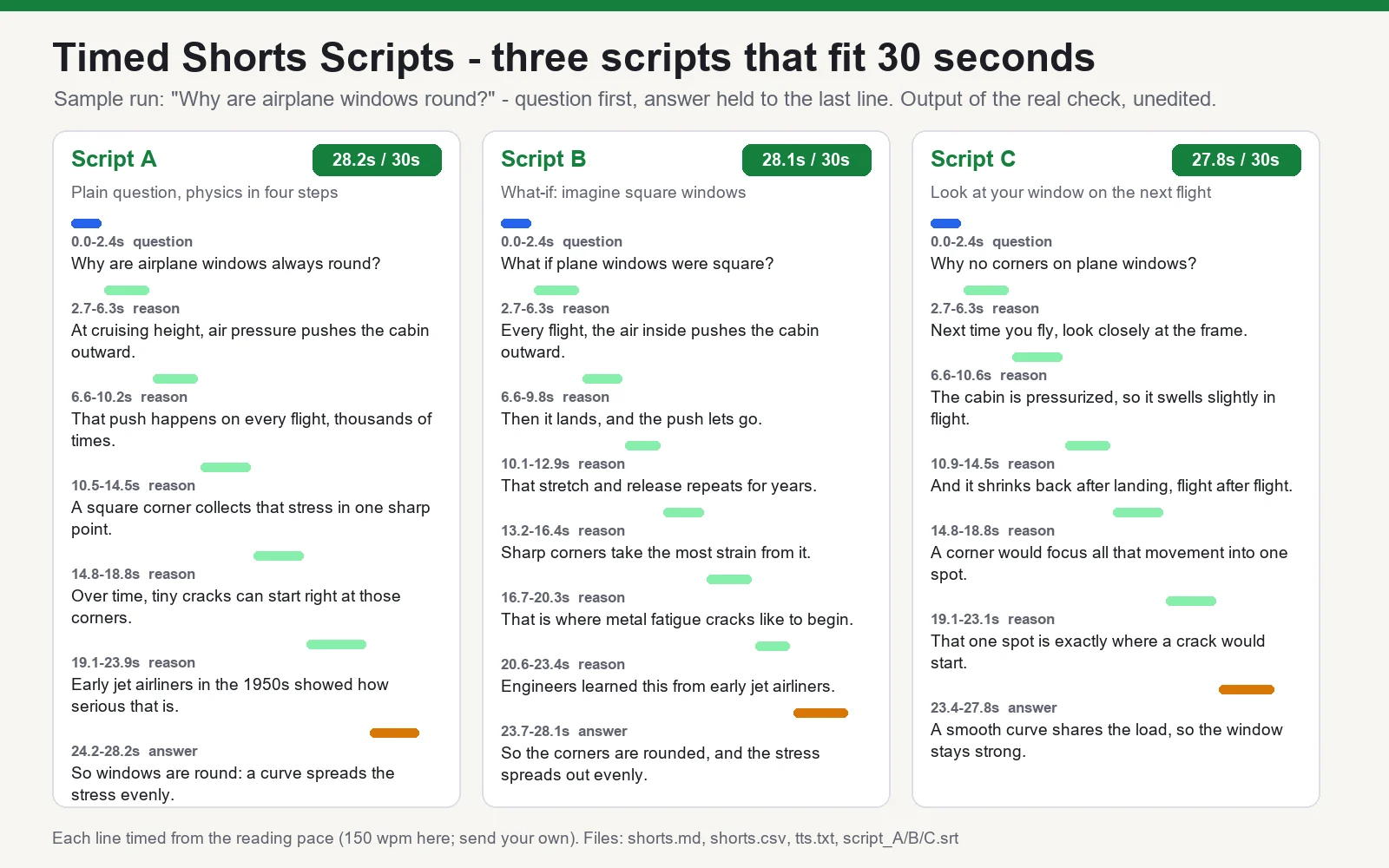
A real run for "Why are airplane windows round?" at 30 seconds, question first: three angles, each line timed, the answer held to the last line, every script inside the 27.6-30 second window.
What you send
- A topic, and the length: 15, 30, 45 or 60 seconds
- (optional) question first (default) or standard hook-body-payoff; language; your pace; platform; facts to use
What you get
- Three scripts with different angles and different first lines
- Line-by-line timing; the first line under 2.6 seconds, no greetings
- In question-first scripts, the answer stays hidden until the last line - checked by the script
- On-screen text and a stock-footage search term (with a fallback) for every line
- A title, caption and tags for each script
script_A.srt,script_B.srt,script_C.srt,shorts.csv,tts.txt,shorts.md
How it differs from Shorts Autopilot
Shorts Autopilot builds a full production plan around one topic (hooks, shot list, captions for each platform, retention review). Timed Shorts Scripts does one thing: three scripts that fit your chosen length, with captions timed to match.
What it does not do
- It records no voice, edits no video, fetches no footage and posts nothing.
- It does not predict views and does not write clickbait the script does not answer.