

Decide whether to buy, wait, or skip before you spend — with regret-risk scoring, future-self checks, and a 7-day purchase test.

Daily arXiv reading across NLP, computer vision, RL, and LLM systems through ICML, NeurIPS, and ICLR cycles. This skill forces a judgment — contributions, results vs. prior SOTA, honest limitations, and reproduction difficulty — so you decide read/skip/implement in under 5 minutes. Covers LLM architecture, MoE scaling, efficient attention, RLHF, and vision-language models.

Hands-on prompt engineering and LLM evaluation. Built around a diagnose-then-ship loop: forensic transcript critique ▎ that names the exact failure mode, paired with a fixer that produces complete, deployment-ready rewrites — not ▎ vague advice.

Challenge your thinking before you commit. The riskiest decisions are the ones that feel obvious too early. Council runs your plan past independent advisers who surface objections and hidden risks — before you commit.
Compare pasted decision records and meeting notes to identify conflicting choices, missing context, and unresolved questions while retaining a traceable source ledger.

Not every tradition treats the same wound: attention training is superb against rumination and useless against moral injury. REGULA identifies which of seven problems you're actually in, selects the tradition historically built for it, and writes you a Rule of Life: three daily anchors attached to moments already in your day, a weekly practice, a 30-day progression, a minimum that survives your worst week, and a printable card. No divine voice, no promises about outcomes.
Fixed-template DOCX batches from explicit mappings and XLSX or UTF-8 CSV: preview first, approve the exact hash, then generate 1–100 documents with a ZIP, index, exception report and receipt. Arbitrary Word layout redesign is outside the supported profile.
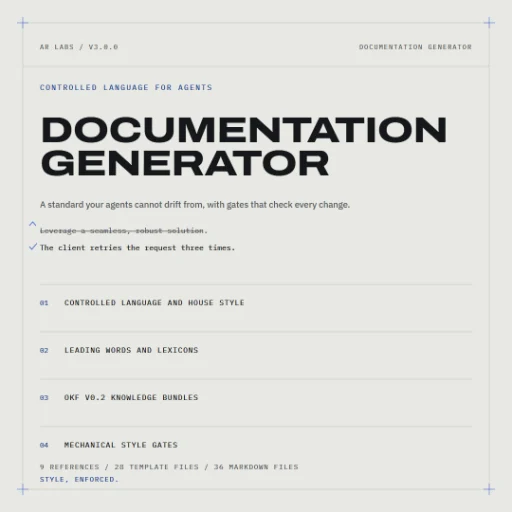
Generate, audit, co-author, and maintain software documentation under a style your agent cannot drift from. Version 3.0.0 adds controlled language (STE-derived), a distilled house style enforced by mechanical gates (vale, markdownlint, cspell), canonical vocabulary that steers agents, OKF v0.2 knowledge bundles with a working attester, and the 2026 spec-driven development landscape with 11 tool-neutral templates. Works across software, hardware, firmware, and embedded projects in any runtime.

Structure project docs as modular memory + reasoning files so AI agents load only what they need — cutting token usage by 70–96% per query. Grounded in Anthropic, LangChain, and Crawl4AI's production llm.txt research. Implements write/select/compress/isolate context engineering strategies.