Amazon Shadow Demand Lab
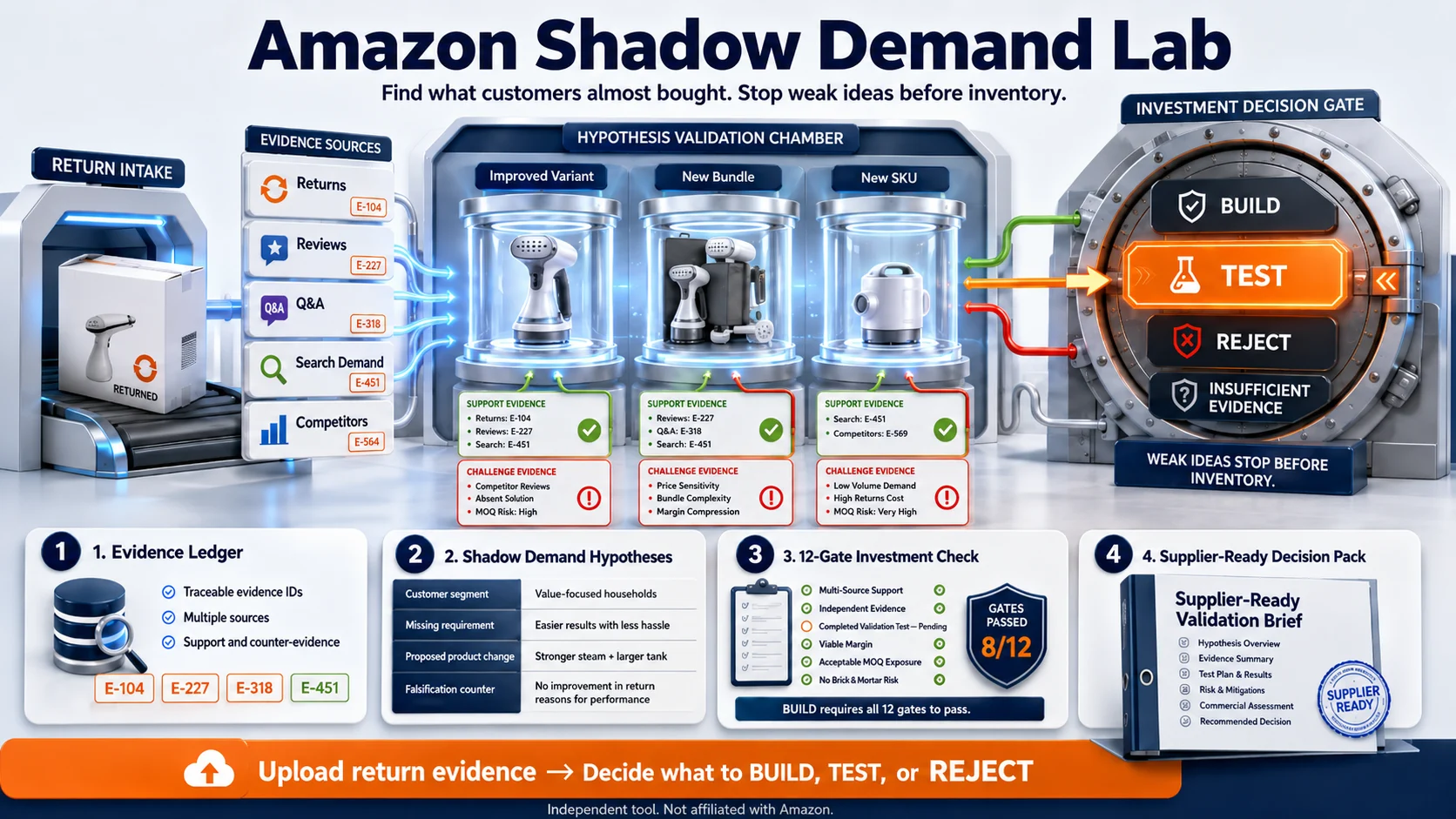
Find the Products Customers Almost Bought
Amazon returns usually explain what went wrong with the current product.
Amazon Shadow Demand Lab asks a harder question:
What were those customers actually trying to buy, and does that opportunity deserve an inventory investment?
The Agent converts return signals into falsifiable product hypotheses, actively searches for reasons each idea may fail, calculates inventory exposure, and issues one guarded decision:
- BUILD — Evidence supports a controlled inventory commitment
- TEST — Run a small decision-changing validation test first
- REJECT — Stop the idea before it becomes inventory
- INSUFFICIENT EVIDENCE — Acquire one specific missing evidence source
Why Shadow Demand Matters
A customer who returned a product had enough purchase intent to buy it.
But a return comment is not proof of demand.
Shadow Demand Lab separates genuine product opportunities from:
- Product defects that should be repaired
- Listing or image confusion that should be clarified
- Fulfillment issues and return-policy noise
- Feature requests customers may not pay for
- Product ideas too weak to justify MOQ exposure
The most valuable output may be a REJECT.
What You Can Provide
- Amazon Customer Returns reports
- Return comments and dispositions
- Reviews, Q&A, support tickets, and warranty claims
- Competitor reviews, variants, listings, and prices
- Search Query Performance or keyword reports
- Current product specifications and listing content
- Supplier quotes, MOQ, tooling, unit cost, and lead time
- Planned selling price, Amazon fees, shipping, and variable costs
- Previous Amazon Agent reports
Incomplete data is accepted. The Agent will identify the single next-best evidence source instead of inventing certainty.
What the Agent Produces
1. Shadow Demand Map
Every signal is classified as:
- Repair Current SKU
- Clarify Current SKU
- Shadow Demand Candidate
- Non-Product Signal
This prevents listing problems from being incorrectly turned into new-product recommendations.
2. Evidence Ledger
Every important claim is connected to a traceable evidence ID, exact excerpt, or observed metric.
Evidence strength is checked by a deterministic engine. Unsupported confidence claims are automatically downgraded.
Repeated comments without a known denominator remain Weak evidence, regardless of occurrence count.
3. Competing-Hypothesis Challenge
The Agent actively searches for evidence that could invalidate the opportunity:
- Listing confusion instead of product demand
- Segment too small for the required MOQ
- Price ceiling or competitor saturation
- Supplier, compliance, lead-time, or cannibalization risk
- Customers requesting a feature but refusing its required price
4. Inventory Exposure and Payback
The deterministic engine calculates:
- Contribution per unit
- Contribution margin
- Setup and tooling cost
- MOQ cash exposure
- Break-even units
- Contribution after setup at MOQ
- Small-test cash exposure
It does not invent future sales.
5. Supplier-Ready Decision Artifact
Depending on the verdict, the Agent produces:
- BUILD: Supplier-Ready Build Brief
- TEST: Supplier-Ready Validation Brief
- REJECT: Kill Memo with reversal conditions
- INSUFFICIENT EVIDENCE: Evidence Acquisition Brief
BUILD Is Intentionally Difficult
BUILD is issued only when every deterministic gate passes, including:
- Traceable own-return support
- Multiple source classes
- Multiple independent evidence groups
- External demand support
- A completed validation test
- Positive unit contribution
- Target margin and payback requirements
- No blocking constraint
- No unresolved high-severity risk
- No Strong counter-evidence
A persuasive story cannot bypass a failed gate.
Best For
- Amazon private-label brands deciding what to launch next
- Sellers considering a new size, material, bundle, or variation
- Teams trying to avoid weak MOQ commitments
- Agencies preparing evidence-backed product recommendations
- Brands converting customer feedback into a product roadmap
Important Limits
Amazon Shadow Demand Lab is a decision-support Agent.
It does not guarantee demand, sales, conversion, return reduction, profitability, supplier performance, safety, or legal compliance.
All verdicts are bounded by the evidence and economics supplied by the user.
Independent tool. Not affiliated with Amazon.