Auditx — CRO Audit, Boost Conversions
🔍 Stop Guessing Why Visitors Leave — Diagnose and Fix Any Marketing Page
Audit marketing pages that get traffic but aren't converting — across 7 dimensions, with prioritized fixes you can ship.
✨ What this audits
This skill audits marketing pages that get traffic but are not converting enough visitors.
It analyzes homepage, landing page, pricing page, feature page, blog post, and other conversion-focused pages across seven diagnostic dimensions, then turns the findings into prioritized recommendations.
Built for marketers, founders, and growth teams who want to understand why visitors leave, what to fix first, and which changes are worth testing.
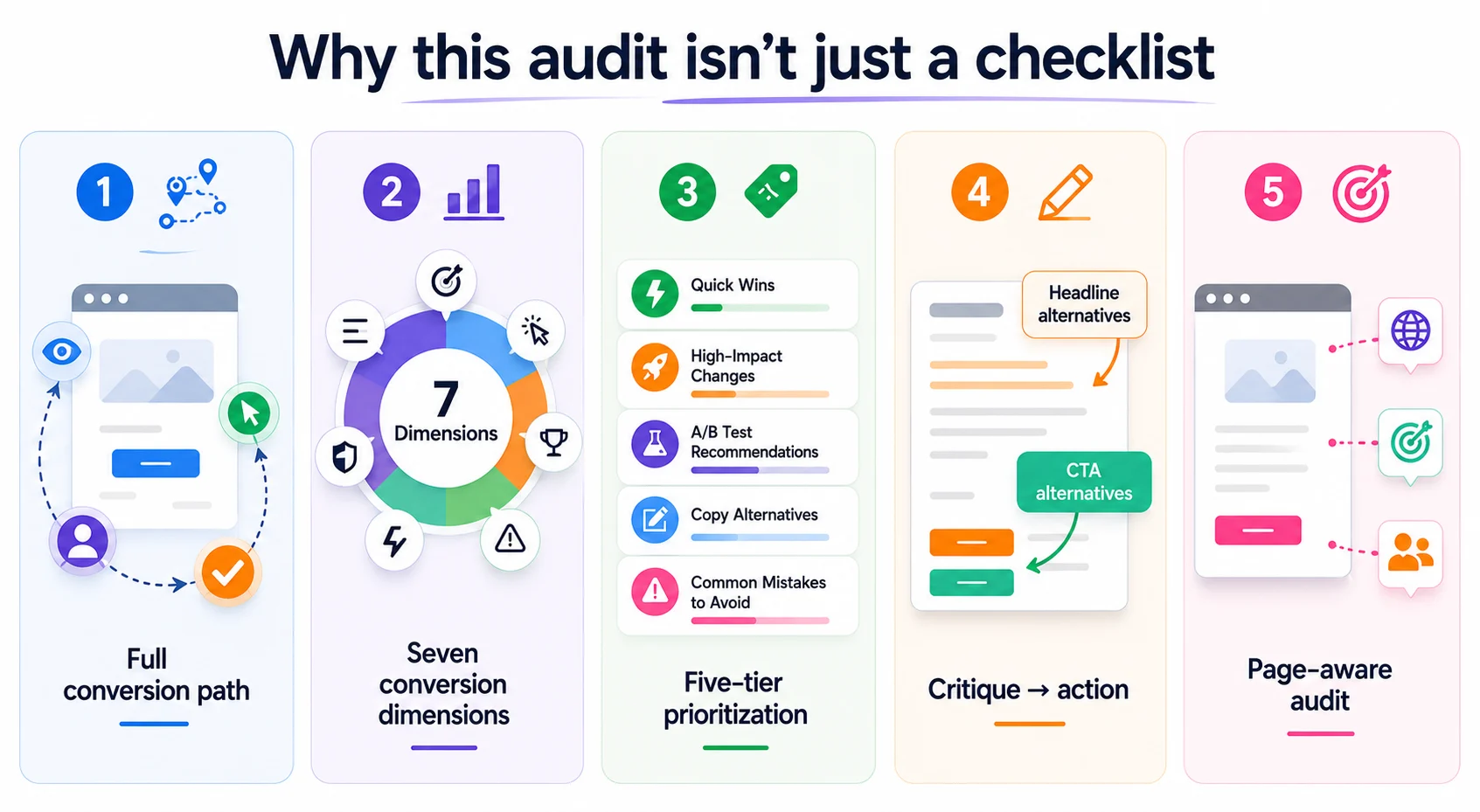
🔄 Inside a single audit
Establish the conversion context
Identifies the page type, primary conversion goal, and main traffic source.
💡 A homepage, landing page, pricing page, feature page, and blog post each convert differently. A page built for Google Ads is judged differently from one receiving organic, email, or social traffic.
Run a seven-dimension CRO diagnostic
Reviews the page across:
| # | Dimension | What it checks |
|---|---|---|
| 1 | 🎯 Value proposition & headline | Can visitors quickly grasp what the page offers and why it matters? |
| 2 | 🔘 CTA buttons | Clear primary action, strong button copy, logical hierarchy? |
| 3 | 👁️ Visual hierarchy & scannability | Is the main message easy to grasp at a scan? |
| 4 | 🏆 Trust signals & social proof | Is proof present, specific, and near decision points? |
| 5 | 🛡️ Objection handling | Does the page address price, fit, setup, risk, and outcome? |
| 6 | 🚧 Friction points | Do forms, navigation, or unclear next steps create resistance? |
| 7 | ⚡ Performance & mobile | Are loading speed, Core Web Vitals, and mobile usability hurting conversion? |
🎯 Goal: identify the real conversion blockers, not surface-level design feedback.
Prioritize what to fix
Organizes recommendations into five tiers:
| Tier | What it means |
|---|---|
| ⚡ Quick Wins | Small, easy changes likely to improve results fast |
| 🚀 High-Impact Changes | Larger work, but meaningful conversion lift |
| 🧪 A/B Test Recommendations | Promising hypotheses that should be validated first |
| 🔠 Copy Alternatives | 2–3 headline and CTA options with reasoning |
| ⚠️ Common Mistakes to Avoid | Page-type-specific traps that hurt conversions |
📌 This structure helps teams avoid treating every issue as equally urgent.
Adapt recommendations by page type
Recommendations adjust to the page being audited:
- 🎯 Landing page → tighter message match and fewer distractions
- 💳 Pricing page → clearer plan comparison and stronger decision support
- ⚙️ Feature page → better feature-to-benefit framing
- 📝 Blog post → contextual CTAs instead of generic banners
Turn findings into usable next steps
Each recommendation explains what is wrong, why it matters, and what to change. When relevant, includes expected impact, implementation difficulty, test hypothesis, target metric, or replacement copy.
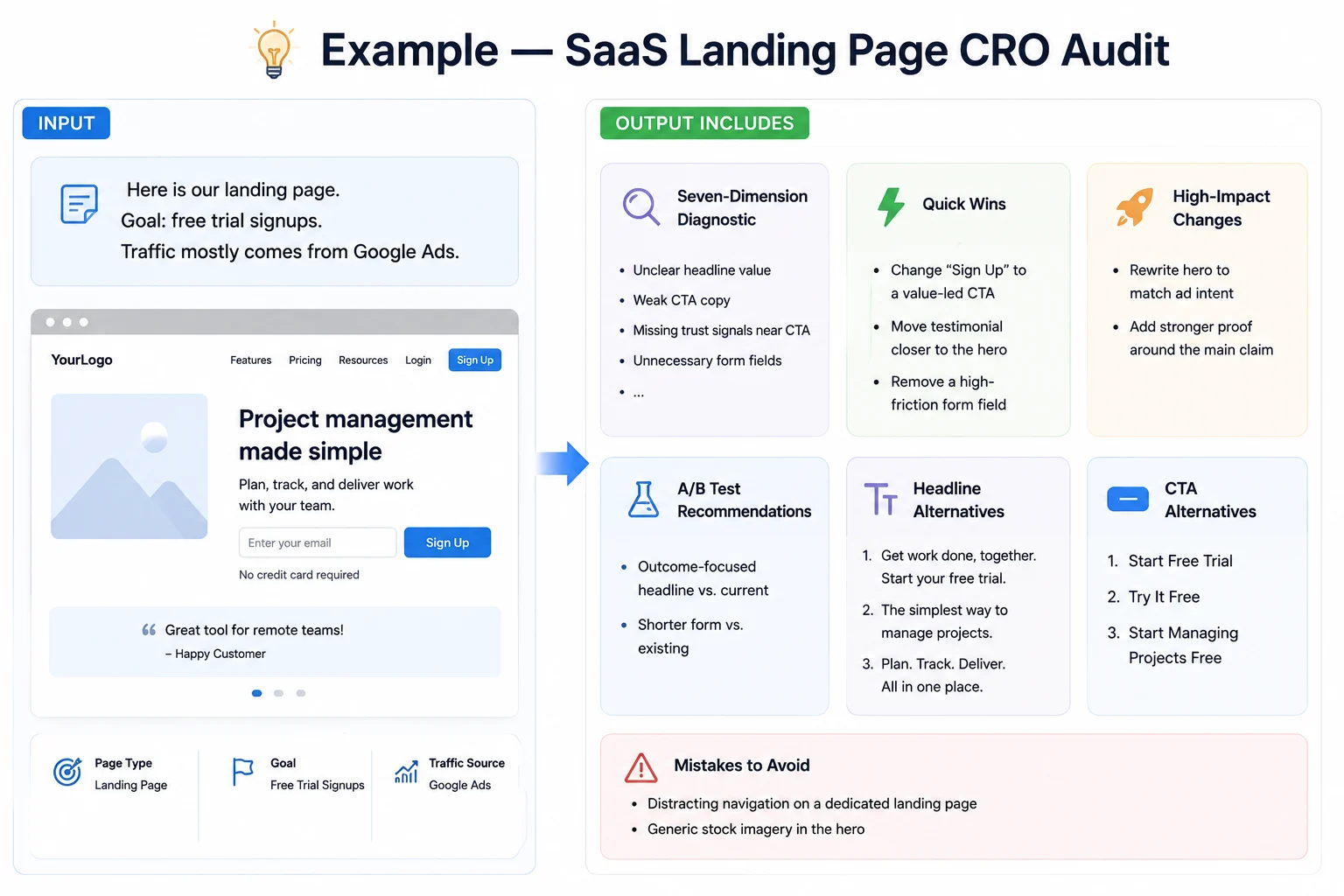
📥 What to provide
You can provide:
- 🔗 The page itself — URL, screenshot, pasted copy, or a natural-language description of the page and current problem
- 🎯 Page context — page type (homepage, landing, pricing, feature, blog, about), conversion goal (signup, demo, purchase, subscription, download, contact sales), and traffic source (organic, paid ads, email, social)
- 📊 Performance data (optional) — current and target conversion rate, heatmaps, session recordings, user research, or past optimization attempts
💡 The more context you provide, the more targeted the diagnosis. If some data is missing, the skill still produces a structured audit and flags where more evidence would sharpen the recommendation.
📦 What you get back
- 🔬 A structured CRO audit across seven conversion dimensions
- 🏷️ Prioritized recommendations grouped into five tiers
- ⚡ Quick wins you can implement immediately
- 🚀 High-impact changes worth prioritizing
- 🧪 A/B test hypotheses with target metrics
- 🔠 Ready-to-use headline and CTA alternatives
- ⚠️ Page-type-specific mistakes to avoid