Industrial Research — Make Reports, Move Decisions
"# AI Research
Multi-source research, citation-tracked on every sentence, delivered as a structured
report you can share, present, and defend. Built for questions where the answer matters
enough to verify.
When to Use / Best For
- The question requires evidence, not confidence: technology evaluations, competitive
landscape analysis, market entry intelligence, state-of-the-art reviews — when you
need a sourced case you can stand behind, not a well-reasoned guess. - The output will be presented or shared: board briefings, investor materials, client
deliverables, internal strategy documents — when the report needs to survive scrutiny
from people who will push back on sources, methodology, and conclusions. - The topic spans multiple conflicting sources: the skill triangulates across
independent evidence before synthesizing — contradictions are flagged, not papered
over. When sources disagree, the report says so and explains why. - You've been burned by AI-generated research before: confident summaries of things
that don't exist, invented citations, circular references — the evidence pipeline
here catches unsupported claims before they reach the final report, not after someone
checks the bibliography.
How It Works
Four depth modes matched to what's at stake:
| Mode | Phases | Right for |
|---|---|---|
| Quick scan | 3 | Fast orientation — is this worth a deeper look? |
| Standard | 6 | Default — analytical questions with a defined scope |
| Deep | 8 | High-stakes decisions, conflicting evidence, nuanced topics |
| UltraDeep | 8+ | Exhaustive literature reviews, systematic multi-angle analysis |
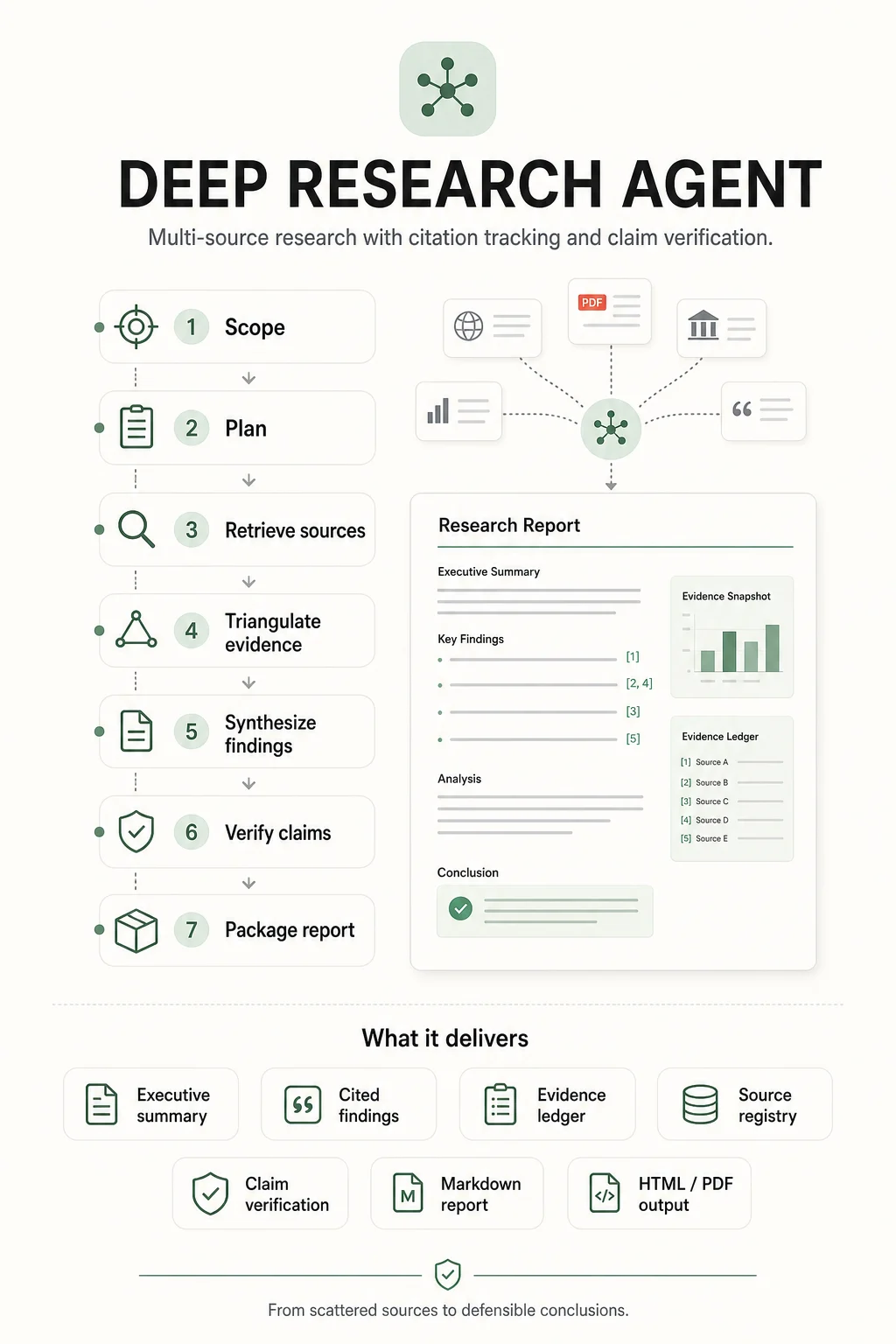
The pipeline — research before writing, verification before delivery:
Sources are retrieved and registered before a single sentence of the report is written.
Evidence is stored against each source. Claims are drafted section by section, then
verified against stored quotes — only claims with supporting evidence ship. The sequence
matters: writing from retrieved sources (not from memory) is what separates citation-
tracked output from confident-sounding fabrication.
Evidence persistence — three files written to disk throughout the run:
sources.jsonl— every source gets a stable canonical ID at retrieval timeevidence.jsonl— supporting quotes stored with locators as evidence accumulatesclaims.jsonl— atomic claim ledger; each claim's support status verified before
the report is finalized
The research is auditable after delivery. Any sentence in the final report can be traced
back to the exact quote and source that supported it.
Phases in depth (Standard / Deep):
- SCOPE — frames the research question, surfaces sub-questions, flags key
assumptions before any searching begins - PLAN — designs the search strategy; what to look for and in what order
- RETRIEVE — pulls sources in batches; each source assigned a stable ID
- TRIANGULATE — cross-checks claims across independent sources; contradictions
flagged rather than resolved by picking the most convenient answer - OUTLINE REFINEMENT — restructures the report based on what the evidence actually
supports, not the original outline hypothesis - SYNTHESIZE — drafts section by section, writing findings to disk as completed;
each factual sentence carries[N]inline - CRITIQUE — independent pass on weak claims, overclaims, and missing coverage
- PACKAGE — final report assembled, citations verified, HTML and PDF rendered
Output that scales past context: reports exceeding ~18,000 words are assembled
section-by-section using a continuation protocol — final report length is not constrained
by context window size.
Delivered as: a structured report (Executive Summary, 4–8 developed findings at
600–2,000 words each, Synthesis, Limitations, Recommendations, complete Bibliography,
Methodology Appendix) rendered as McKinsey-style HTML and print-quality PDF, both
auto-opened on delivery.
Why This Skill / What Makes It Different
vs. ChatGPT / Gemini research mode: both synthesize from training data and append
citations afterward — the citation is selected to match the claim, not the other way
around. This pipeline retrieves sources first, stores evidence before writing, and
verifies claims against stored quotes. When a claim can't be supported, it doesn't
ship. The failure mode is different: this returns fewer confident claims, all of them
traceable.
vs. Perplexity: Perplexity returns annotated answers to questions. This returns a
research report — scoped, structured, multi-finding, with a methodology appendix and
a complete bibliography. Built for documents and presentations, not Q&A threads.
vs. commissioning research externally: the same structural elements a research firm
produces — defined scope, evidence-backed findings, conflicting-source treatment,
limitations section, recommendations with caveats — in the same session as the request,
without the three-week timeline or the engagement cost.
Depth modes that match the actual stakes: not every question needs an 8-phase
pipeline. A quick scan answers ""is this worth investigating further"" in minutes. An
ultradeep run handles exhaustive systematic reviews. The mode is matched to what's
being decided — rigor where it matters, speed where it doesn't.
The report travels with its evidence: sources.jsonl, evidence.jsonl, and
claims.jsonl are written alongside the report and stay on disk. Six months later,
anyone can open those files and verify exactly which source supported any claim in
the report. That's what makes it research-grade rather than a well-formatted response."