

Research Paper Writing - Online Skill
Research Paper Writing
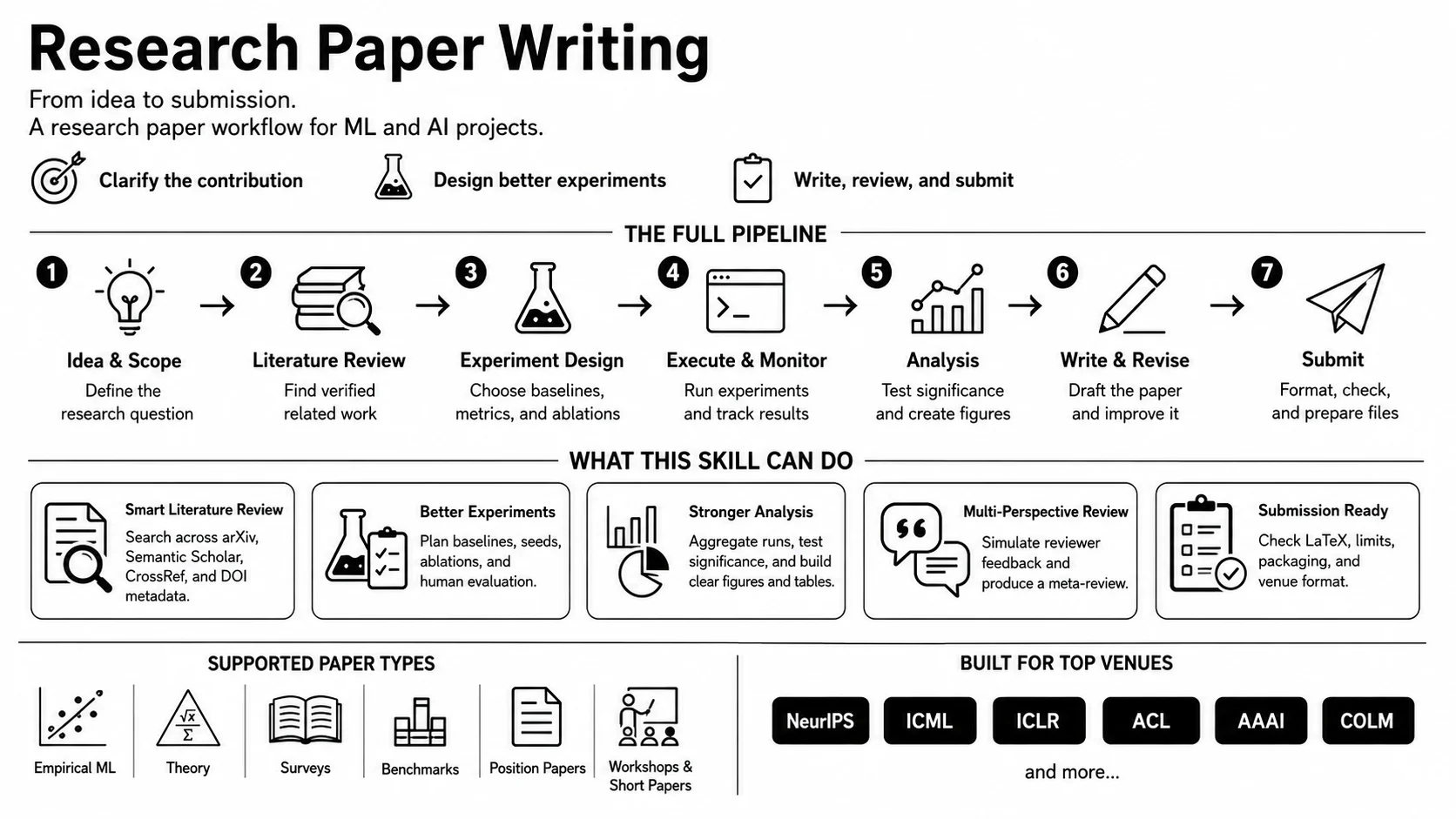
Writing the paper is usually not the hard part.
The hard part is figuring out what the paper is actually claiming, whether the experiments prove it, what prior work you need to compare against, and what still needs to be fixed before reviewers see it.
Research Paper Writing handles that whole process.
Give it a research idea, an existing codebase, experiment results, or a half-finished draft. It can work from there, moving between literature review, experiment design, analysis, writing, revision, and submission instead of treating each step as a separate task.
Start with the contribution
Before filling pages with text, the skill tries to pin down the paper's main contribution.
What are you actually claiming?
What evidence would make that claim believable?
Why would someone in the field care?
That framing stays connected to the rest of the work. Experiments are designed around specific claims rather than added because they look useful, and results can send the process back to experiment design when the evidence is not strong enough yet.
This is especially useful when you already have a working project but are not sure how to turn it into a coherent paper.
Literature review without made-up references
The skill can search for related work, trace papers through arXiv, Semantic Scholar, CrossRef, and DOI metadata, and build the bibliography around papers it can actually verify.
It does not rely on citations recalled from model memory.
If a reference cannot be verified, it should be marked for checking rather than quietly invented.
It also organizes related work by the ideas and methods that matter to your paper, instead of producing a paragraph-by-paragraph list of "X et al. did this, Y et al. did that."
Design experiments that answer something
A paper can have a lot of experiments and still leave the main question unanswered.
This skill maps claims to evidence before running the work. That includes choosing baselines, defining metrics, planning ablations, deciding how many runs or seeds are needed, and setting up statistical tests.
For research that depends on human judgment, it also covers human evaluation design, including annotator selection, pairwise or rating-based evaluation, agreement metrics, and quality control.
Long-running experiments can be launched and monitored from the same workflow, with failures and completed runs kept track of instead of disappearing into a folder of random outputs.
Turn results into a paper
Once results are available, the skill helps work out what they actually say.
It can aggregate runs, test statistical significance, make figures and tables, compare the findings with the original hypothesis, and decide whether the evidence is ready to write up or whether another experiment is still needed.
Negative or unexpected results are not automatically hidden. If they change the story, the paper should change with them.
From there, it can draft and revise the usual sections:
- Abstract
- Introduction
- Related work
- Method
- Experiments
- Results
- Limitations
- Appendix
The aim is to keep one argument running through the whole paper instead of producing individually polished sections that do not quite fit together.
Review it before reviewers do
The first complete draft is not treated as finished.
The skill can run several independent review passes from different reviewer perspectives, then combine the feedback into a meta-review. Claims can be checked against the actual results, citations checked again, and weak parts of the paper revised before submission.
It can also help with rebuttals when reviewer feedback arrives.
This is useful for catching the kinds of problems that are easy to miss after working on the same paper for weeks: a baseline that should have been included, a claim that goes further than the evidence, inconsistent terminology, or a figure that makes sense only if you already know the result.
Built around real conference submissions
The workflow includes LaTeX templates and submission checks for major ML and AI venues, including:
- NeurIPS
- ICML
- ICLR
- ACL
- AAAI
- COLM
It can help with page limits, anonymization, citation and LaTeX checks, conference format conversion, camera-ready preparation, and packaging research code for release.
The skill also covers workshop and short papers, plus research that does not fit the standard empirical ML format.
Theory papers, surveys, benchmarks, and position papers each get a different structure instead of being forced into the same "method + experiments" template.
Use it for
Use Research Paper Writing when you have:
- A research idea that needs to become a paper
- An existing ML/AI project with results but no clear writeup
- Experiments that still need stronger baselines or analysis
- A paper draft that needs serious revision
- Reviewer feedback that requires a rebuttal or new experiments
- A paper that needs to be converted for another venue
- A submission that needs a final technical and formatting pass
You do not need to start at the beginning. If the experiments are already done, start with the results. If you already have a draft, start with the draft.
The pipeline can pick up where the research actually is.
Source
Research Paper Writing is included in the NousResearch Hermes Agent skill collection.
Source:
https://github.com/NousResearch/hermes-agent/tree/main/skills/research/research-paper-writing


