
Should I Build This? — Startup Idea Stress Test
Should I Build This? — Startup Idea Stress Test
Find out if your startup idea survives the real market before you spend months building it.
💡 What it does
You describe your startup, app or online-business idea. The agent treats it the way a co-founder putting in their own money would. It hunts for what would kill the idea, and it works just as hard to find the version that would work.
Everything is researched live, not from memory. Competitor prices, free tiers, platform rules and regulations change every few weeks. An answer from training data is out of date the day you get it.
⚙️ How a run works
1. You describe the idea. A paragraph is enough, in any language.
2. A few quick questions. Your budget, your time, your skills, how you'll reach customers, what revenue would make it worth it, and what finding would make you walk away. The walk-away bar is set before any research, so the evidence can't quietly move the goalposts.
3. It shows you the plan. A list of what it will check for your idea and why, plus what it's leaving out. You can add anything.
4. Live research, usually about 30 minutes.
5. A verdict card first, then the full report.
🔍 What it checks
Every idea gets its own checklist. These are the areas that most often decide the answer:
• Competitors & price — who already sells this, at what price, and whether a free option already covers your buyer at your price
• Their worst reviews — what paying customers of those competitors complain about, and what that says you could build differently
• Platform & API access — whether the platform your idea depends on will actually let you in, and on what terms
• Regulation — rules that apply to the idea itself or to what it promises customers
• Unit economics — whether your price covers what each customer costs you to serve
• Market size vs your goal — how many paying customers your revenue goal needs, compared with how many exist
• Distribution — whether the channel you plan to use can actually reach those customers
• Demand — whether anyone besides you is asking for this: forum threads, workarounds, feature requests
• …and more: trust, retention, build difficulty, ongoing workload, gatekeepers, payments
📦 What you get
• A score out of 10, set by the worst problem it found, never averaged. A great market doesn't hide a blocker. The card names the finding that set the score.
• Every claim labelled by its source: read directly from the source, confirmed by several sources, or from a single source. Anything it couldn't confirm is said plainly.
• Your walk-away bar, checked: met, cleared or unresolved, and what that does and doesn't rule out.
• Charts of the price landscape and cost structure, whenever the numbers exist.
• The version worth building if your idea as described doesn't hold up, in the business shape you asked for where one exists.
• One concrete next step with a pass/fail line set in advance, plus a list of findings to re-check before you commit.
🧪 Real output: a sample run
Idea tested: "A $9/month Shopify app for small makers that combines back-in-stock alerts and pre-orders, with a simple 'made to order — ships in 3 weeks' option." Researched on 21 September 2026. Prices and review counts change over time.
The verdict card
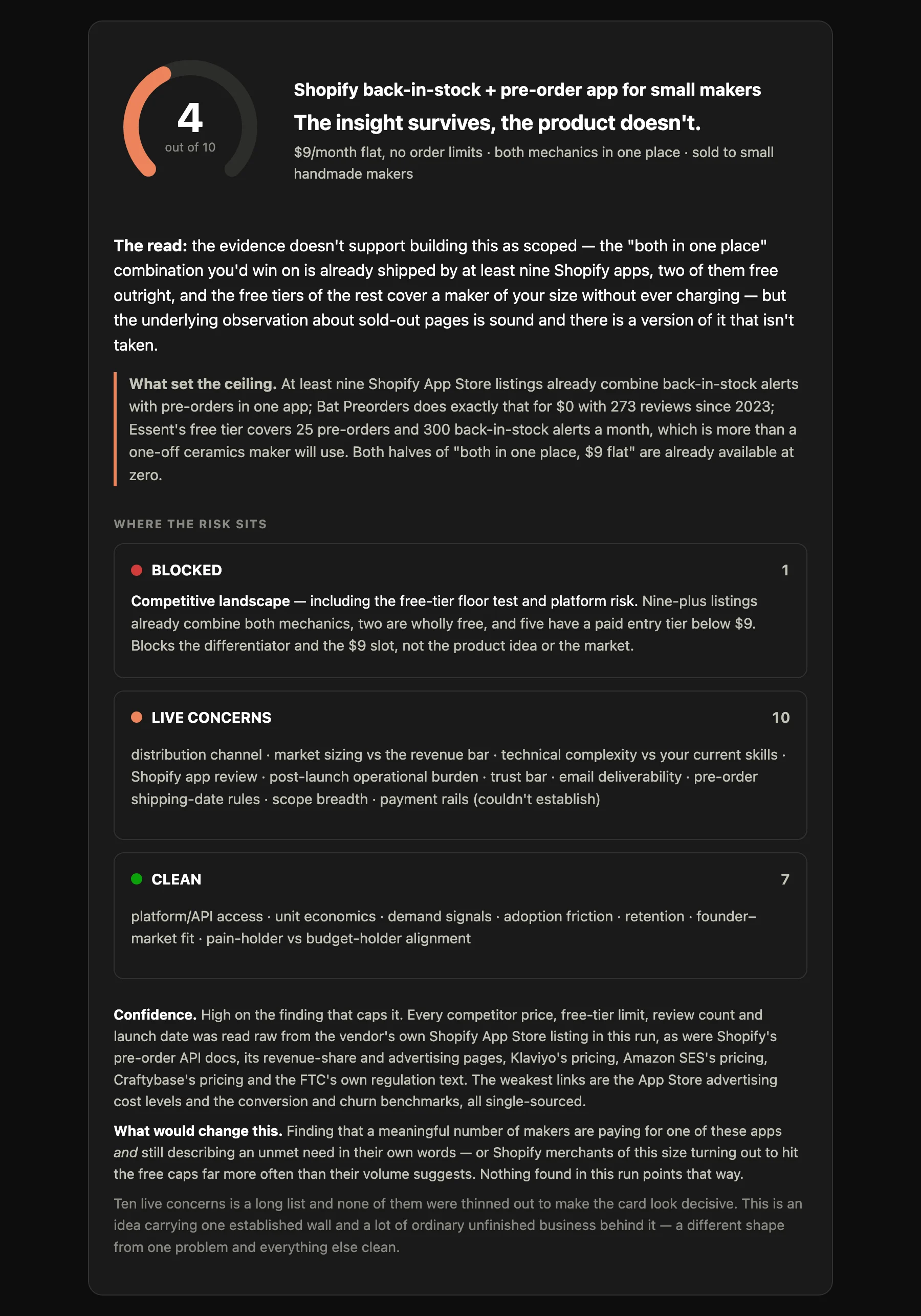
The idea scored 4/10. Nine Shopify apps already combine both features, two of them for free. But the report didn't stop at "no"; it went on to find the version worth building (below).
The price landscape
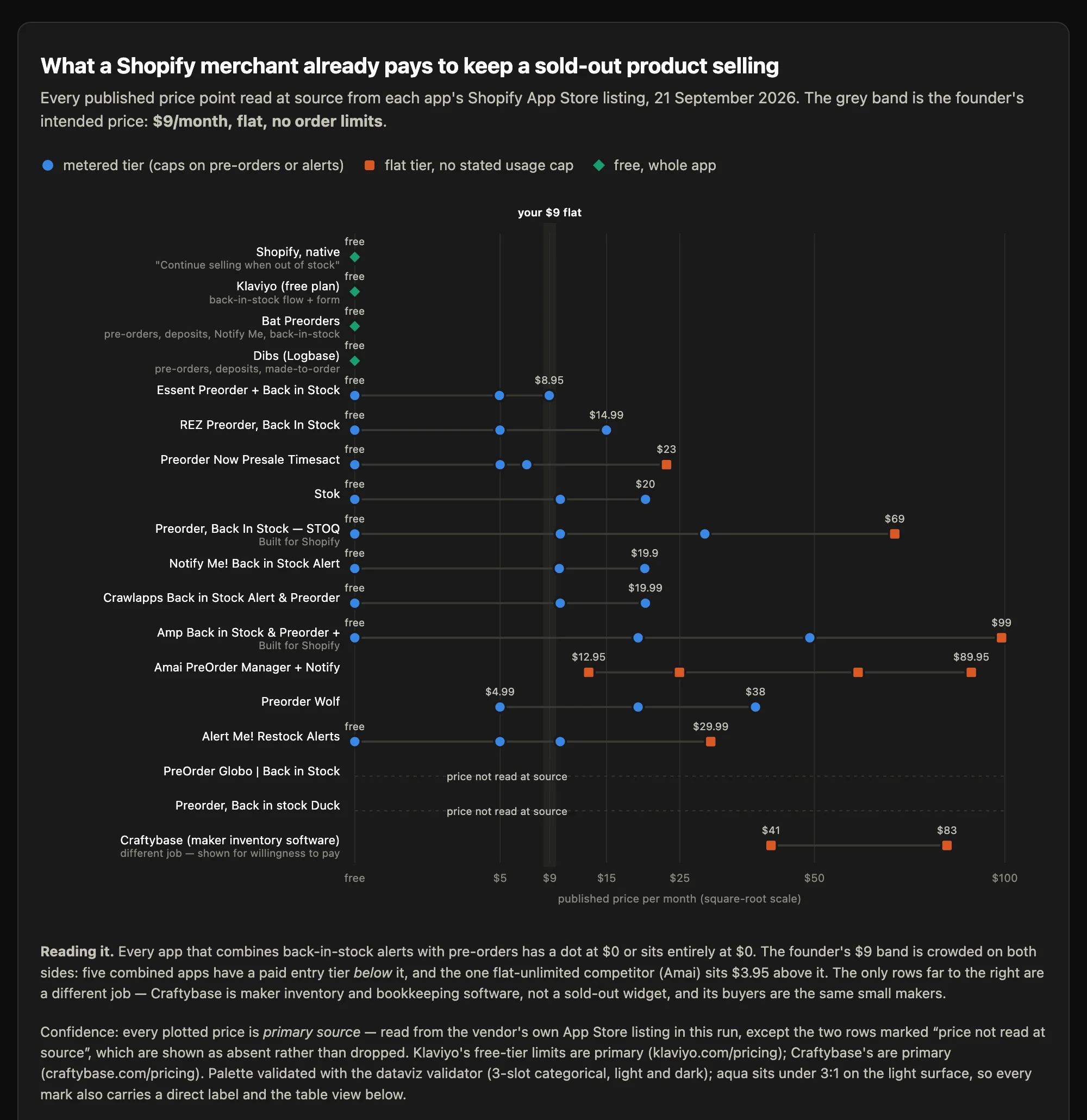
Every competitor price was read directly from its Shopify App Store listing. The grey band is the founder's intended price.
What competitors' customers complain about (excerpt)
It read every one-star review of the closest competitors and summarised the worst of them, marking which complaints are real openings and which aren't:
• ★1: a plan change without notice made a merchant oversell, and they had to cancel orders one by one.
• ★1: a pre-order cap cut a merchant off in the middle of a successful sale.
• ★1: a made-to-order seller's customers were charged a balance with no warning or notification.
• ★2: free-plan alert emails land in spam unless you upgrade.
• ★1: nearly $2,000 stuck after a balance-collection error. (Discarded as an opening: it traces to a known Shopify admin bug, so it's the category's problem, not something a new app would fix.)
Does the price cover the cost?
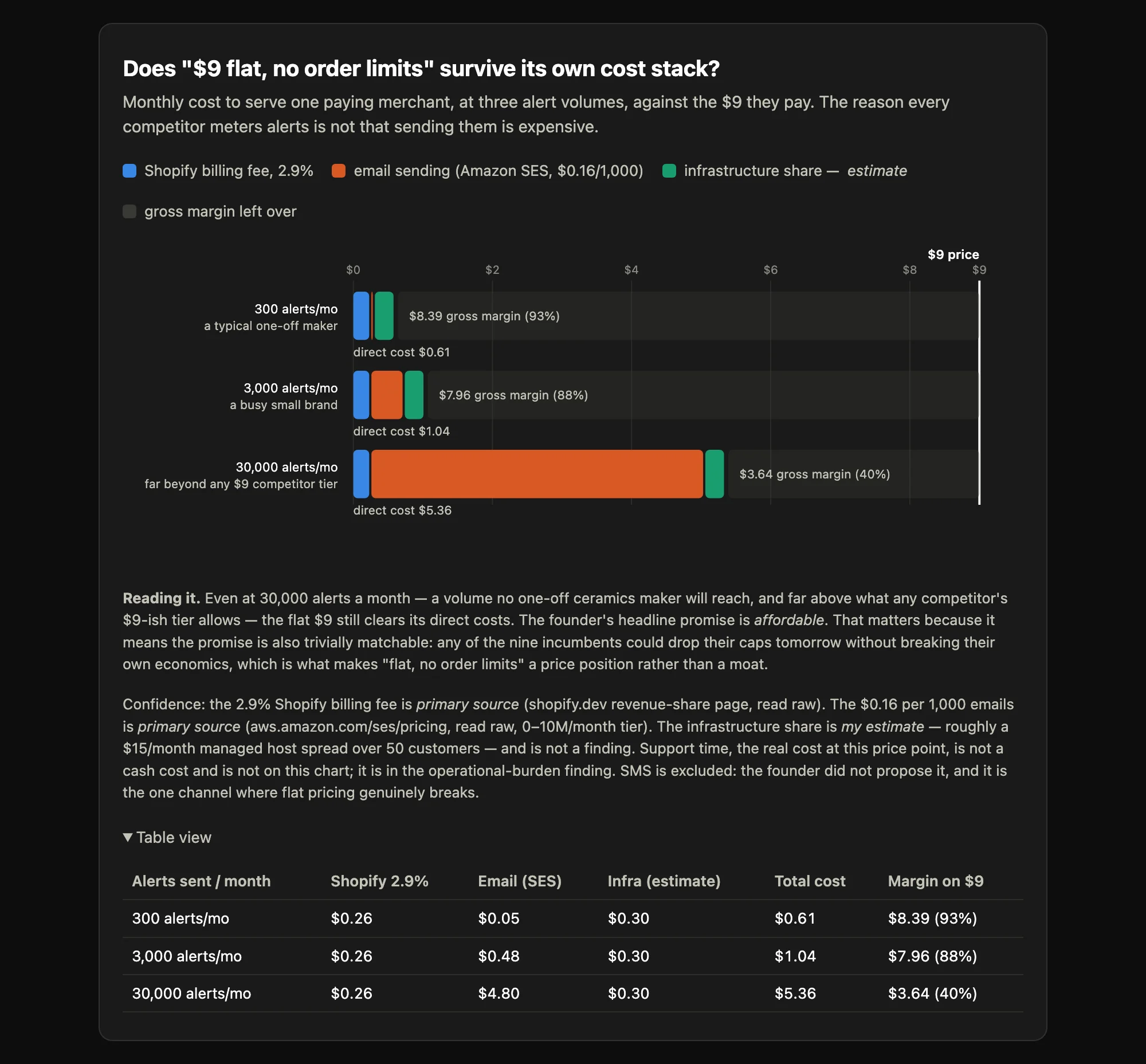
$9 flat covers its costs easily. That also means any competitor could match it tomorrow, so it's a price position, not something competitors can't copy.
The version worth building
Instead of another pre-order button, it pointed to made-to-order ship dates driven by the maker's own production queue. Shopify staff have confirmed Shopify's delivery estimates can't do this. The makers' own reviews ask for delay notifications. And the handful of apps in that space launched only months ago. The report also stated the honest cost: it's a bigger build than the original idea.
🤖 Why not just ask a chatbot?
A general assistant will give you a thoughtful opinion. This agent gives you a decision you can check:
• It sets your walk-away point before the research, not after.
• It reads the sources itself (pricing pages, app listings, regulations, reviews) and tells you which claims rest on what.
• It scores against the worst finding instead of balancing pros and cons into "it depends".
• It separates problems in the idea from problems in your budget, and names the budget that would change the answer.
• It looks for the version that works with the same effort it spends looking for flaws.
✍️ Try it with
"I want to build an app for independent dog groomers: online booking, SMS reminders, before/after photos. £25 a month. Worth doing?"
"Tear apart my idea: AI that writes Etsy listings from a product photo, $12/mo."
"I've got $2k and 3 months of evenings. Which of these two should I build: …"
ℹ️ Good to know
• A run takes about 30 minutes of live research.
• It answers in your language.
• It's an evidence-based assessment, not a business plan, legal advice or a guarantee. The decision is always yours.
• Market facts change. The report lists which findings to re-check before you commit.
Externe API’s
Web search · Public websites (competitor sites, app stores, forums) · Domain registries (RDAP/WHOIS)


