

AI Open Source Intelligence
Evidence-backed open-source AI research
AI Open Source Intelligence helps developers, technical leads, and research teams discover and evaluate open-source AI projects without collapsing evidence, recommendations, and unknowns into one answer.
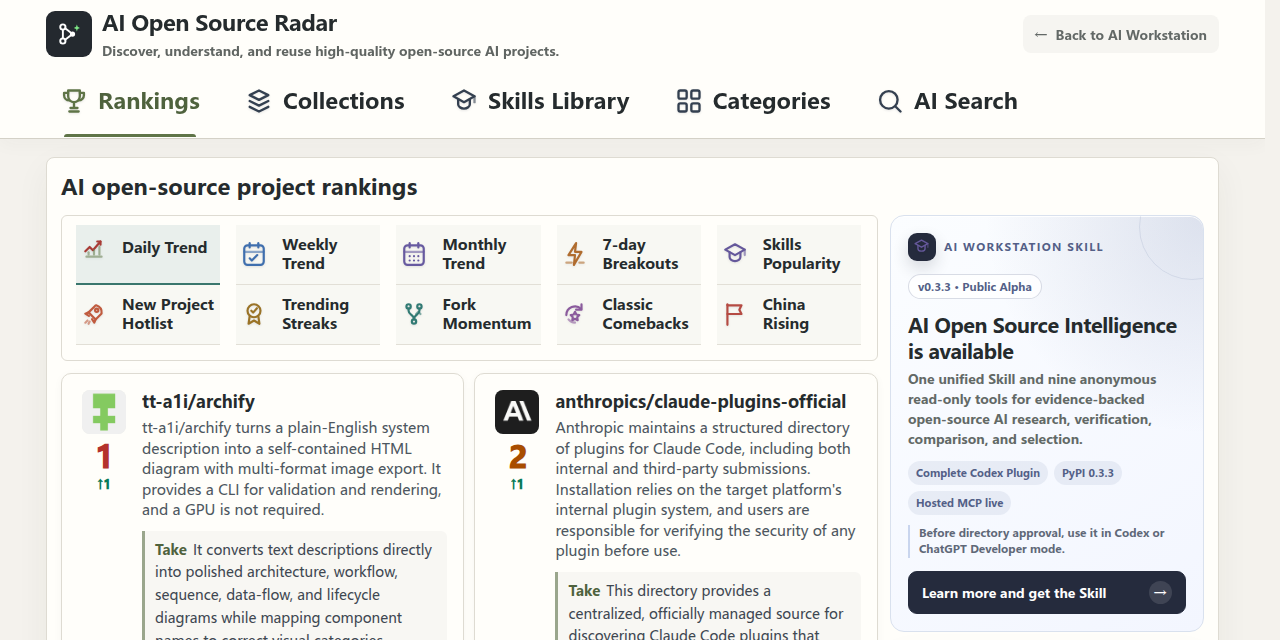
It combines one unified Agent Skill with nine read-only live tools backed by AI Workstation Open Source Radar. The Agent can browse current Radar collections, find projects from explicit requirements, verify project facts, inspect license evidence, compare candidates, find alternatives, and plan a candidate AI stack.
What you can ask
- Find open-source AI projects that satisfy hard requirements such as self-hosting, Docker, language, license, or recent activity.
- Verify one project before adoption and identify which important conditions remain unknown.
- Compare two to five projects for a concrete use case.
- Find alternatives when a candidate conflicts with a hard requirement.
- Plan a candidate stack for RAG, Agents, knowledge bases, inference, evaluation, or observability.
- Browse current Radar rankings, collections, projects, and the Radar Skills library.
What you receive
- a short evidence-backed candidate set or an honest no-match result;
- verified facts with source and observation-time context;
- recommendations separated from facts;
- explicit unknowns, conflicts, and adoption risks;
- license evidence presented as technical evidence, not legal advice;
- next verification steps and high-risk integration tests.
Constraint-aware selection
Requirements remain typed as required, preferred, or excluded. The Agent does not silently weaken a hard requirement to manufacture a result. Formal matches stay separate from near matches and their blockers.
Live, read-only data boundary
The nine standard tools read current public Radar evidence over HTTPS. They do not execute or install third-party repository code, modify repositories, access private code, or run an AI Workstation model. Natural-language reasoning is performed by the Capafy host model; AI Workstation supplies data and evidence only.
Do not submit credentials, private-repository content, customer documents, or personal data. Public tool requests can include project queries, project identifiers, typed constraints, locale, and Radar filters. See the privacy policy for operational details.
Important limits
- Version 0.3.3 is a public pre-release, not a stable-GA claim.
- License detection is evidence, not legal advice or permission to use a project.
- Popularity and Radar position do not prove production suitability.
- Cross-project compatibility remains unknown until supported by direct evidence or a controlled test.
- Security, maintenance continuity, and deployment fit must be reviewed before adoption.
Example request
Find three open-source AI projects for a local RAG stack. Hard constraints: Apache-2.0 or MIT, active in the last 90 days, and no mandatory hosted service. Separate verified facts, recommendations, unknowns, and risks. Do not silently relax constraints.
Prefer local installation? The Apache-2.0 Codex Plugin, standalone Skill, Python package, Hosted MCP endpoint, documentation, and source are available in the public GitHub repository.
- Product overview: https://useaistation.com/ai-open-source-intelligence/
- Browse the Radar: https://useaistation.com/githubai/
- GitHub and release: https://github.com/zxhwolfe-dev/aiworkstation-open-source-intelligence
- Support: [email protected]
APIs externas
mcp.aiworkstation.cn


