pSEO — Page Planner for Long Tail Organic Traffic
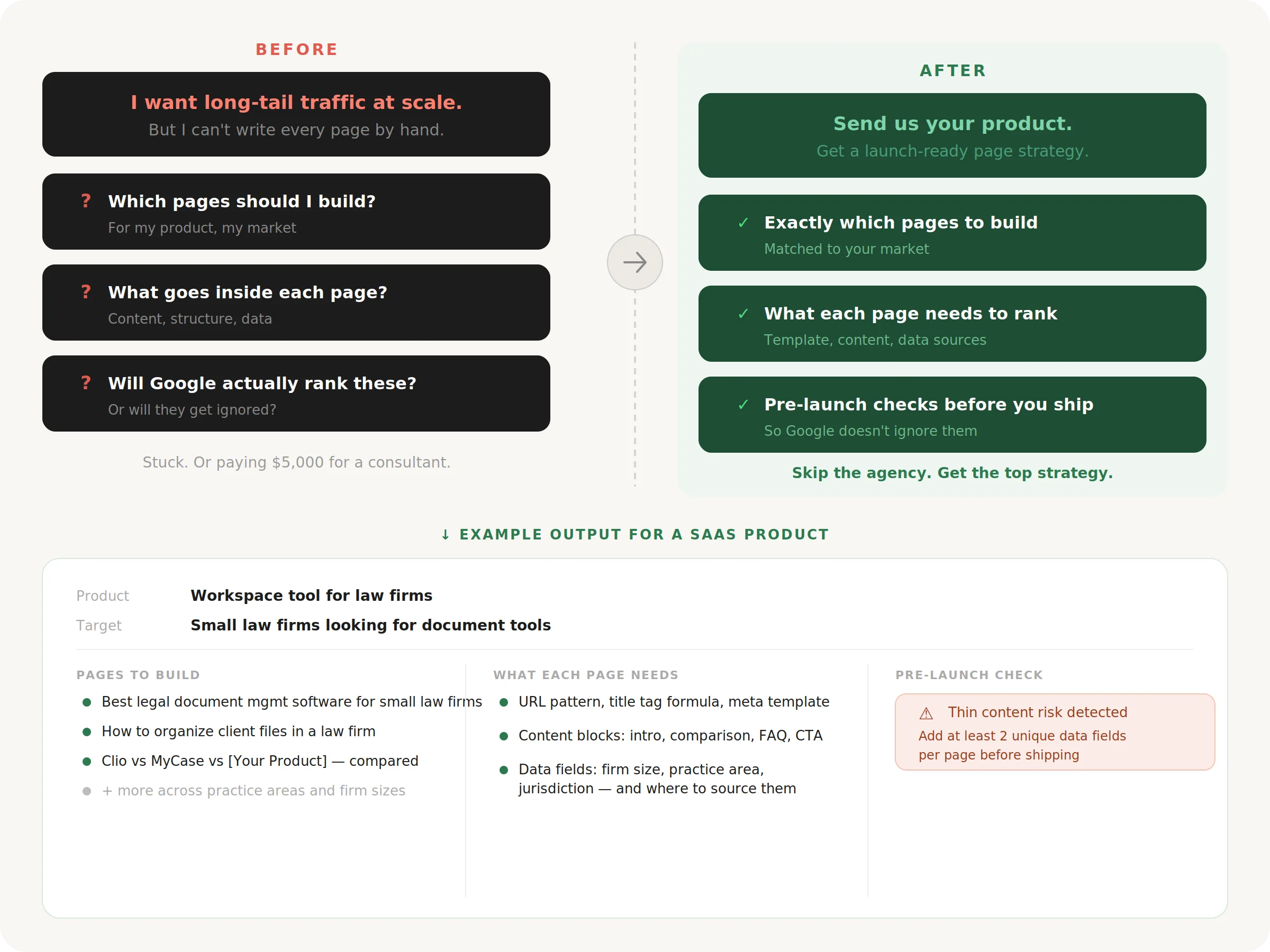
pSEO Strategy: From Keyword Pattern to Launch-Ready Pages
Turn any repeatable keyword pattern into a launch-ready Programmatic SEO strategy for scalable page sets. Designed to replace a $2,000–$10,000 consulting engagement.
The strategy covers playbook selection, page templates, data sources, internal linking, launch checks, monitoring, and pSEO risk notes such as thin content or URL conflicts.
Who It's For
- Growth teams and SEO leads planning a programmatic page set
- Agencies building pSEO strategies across multiple verticals
- Founders who want long-tail traffic without writing every page by hand
What You Get
Keyword Opportunity Analysis — patterns, volume estimates, difficulty, and defensibility scores.
Data Source Plan — every template field mapped to source, update cadence, and thin-content risk flag.
Page Template Specification — URL pattern, title/meta, content blocks, schema, and uniqueness rules.
Internal Linking Architecture — hub-and-spoke structure, cross-linking rules, and orphan-prevention.
Pre-Launch Checklist + Monitoring Plan — gates before go-live, plus metrics, thresholds, and review cadence.
The 12 Playbooks
Locations, Comparisons, Integrations, Personas, Templates, Conversions, Examples, Curation, Glossary, Directory, Profiles, Alternatives.
Playbooks layer: Curation × Locations = “best coworking spaces in [city].”
Example
Input
I'm building a social media SaaS for SMBs. I want to target
[city] social media managementacross US cities.
Output
- Playbook: Locations × Personas
- Page count: 150 pages pilot → 3,000 pages full rollout
- 6 keyword patterns with volume estimates and defensibility ratings
- Data source plan: 8 fields mapped, 3 flagged as thin-content risk
- Page template: URL pattern, title/meta, 7 content blocks, schema spec
- Hub-and-spoke linking rules with breadcrumb structure
- Pre-launch checklist: 12 gates across content, technical, and indexation
- Monitoring plan: 7 metrics with alert thresholds and review cadence
What to Send
Send your product and the repeatable search pattern you want to target.
Example: “I run a social media SaaS. I want to target [city] social media management across US cities.”
Optional: add competitors, target markets, or available data sources.
What Makes This Different
vs generic AI pSEO advice
General AI can suggest “make city pages” or “write comparison pages.” This skill turns a repeatable keyword pattern into a page system: playbook selection, data source planning, page template specs, internal linking, launch gates, and monitoring.
vs keyword tools
Keyword tools show demand. They don’t decide which pSEO playbook fits, what fields each page needs, how to reduce thin-content risk, or how pages should link together. This strategy bridges keyword opportunity and implementation.
vs an agency strategy deck
Agency decks often stop at recommendations. This output is structured for execution: template fields, data source notes, internal linking rules, pre-launch checks, and post-launch metrics.
The result is a pSEO strategy that connects the major pieces: query pattern, playbook, data source, page template, internal linking, launch checks, and monitoring.