Article Writing - Online Skill
Article Writing
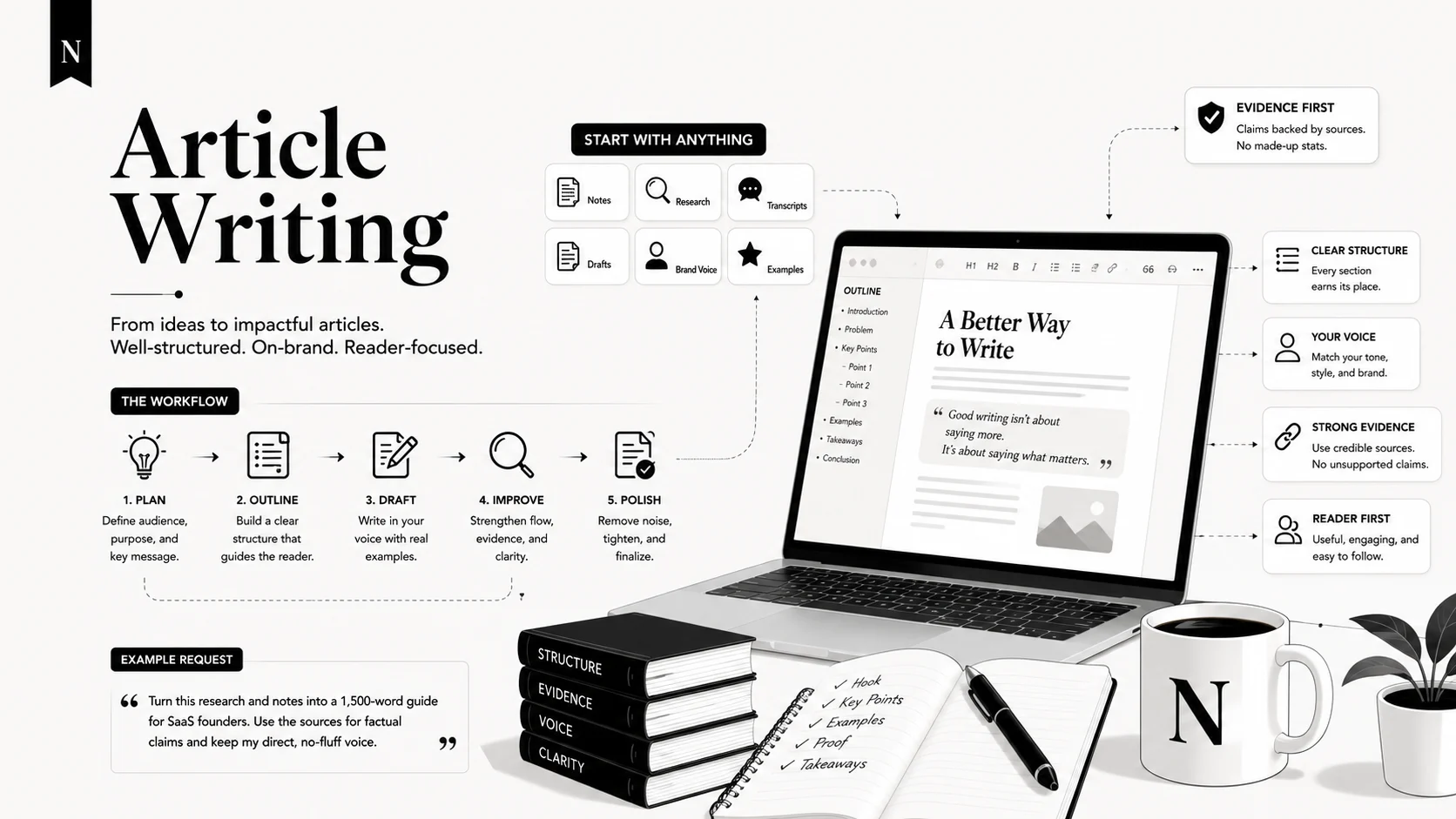
Turn rough ideas, notes, research, transcripts, or existing drafts into long-form content that feels intentional, useful, and written in a distinct voice.
Article Writing is built for blog posts, guides, tutorials, essays, newsletters, launch posts, and other content where structure, voice, and credibility matter. It focuses on getting to the point quickly, using concrete evidence, and cutting the generic language that often makes AI-written articles feel interchangeable.
Write from almost any starting point
You do not need a finished outline before you begin.
Give it:
- Rough notes
- Research
- Interview transcripts
- Meeting notes
- Source material
- A content brief
- An unfinished draft
- Brand guidelines
- Examples of previous writing
- A topic and target audience
The skill can organize the material, find a useful structure, and develop it into a complete article.
Build a clear structure
Before filling pages with copy, the skill works out what each section is actually supposed to do.
It can help:
- Define the audience and purpose
- Find the main argument or takeaway
- Build an outline
- Give each section a clear role
- Reorder ideas that appear in the wrong place
- Remove repetition
- Tighten sections that are overexplained
- Expand areas that need more evidence or context
The goal is not to make an article longer. It is to make every section earn its place.
Start with something concrete
Instead of opening with a long generic introduction, Article Writing prefers to lead with something real.
That might be:
- An example
- A result
- A number
- A screenshot
- A piece of code
- A product
- An observation
- A problem
- A contradiction
- A short anecdote
The explanation comes after the reader has something concrete to care about.
This is especially useful for technical writing, product content, founder writing, and practical guides.
Match an existing voice
If you provide examples of how you or your brand normally writes, the skill can use them as a reference for the article.
It can preserve qualities such as:
- Sentence length
- Directness
- Vocabulary
- Pacing
- Level of formality
- Amount of explanation
- Use of humor or opinion
- Paragraph structure
- Preferred formatting
When a predefined brand voice profile is available, the skill can reuse that direction instead of reinventing the style for every article.
If you do not provide a voice reference, it defaults to a direct, concrete style focused on usefulness rather than marketing language.
Turn research into readable content
Research-heavy articles often fail because they either become a list of facts or make claims that the sources do not actually support.
Article Writing helps turn source material into a coherent piece while keeping the evidence attached to the argument.
It is designed to:
- Use supplied research as evidence
- Connect evidence to specific claims
- Separate facts from opinions
- Avoid unsupported credibility claims
- Avoid inventing statistics, customers, quotes, or results
- Keep important context instead of oversimplifying it
If the source material does not support a claim, the article should not pretend that it does.
Improve existing drafts
You can also give it something that is already written.
Instead of starting over automatically, it can identify what is weakening the piece and revise only what needs work.
For example:
- Weak opening
- Unclear argument
- Repetitive sections
- Slow pacing
- Generic transitions
- Unsupported claims
- Excessive background
- Overwritten explanations
- Inconsistent voice
- Sections that do not add anything new
This makes it useful for both first drafts and final editorial passes.
Avoid generic AI writing
The skill actively removes patterns that make long-form writing sound templated.
That includes language such as:
- “In today's rapidly evolving landscape”
- “Game-changer”
- “Cutting-edge”
- “Revolutionary”
- Empty “here's why this matters” transitions
- Forced vulnerability stories
- Generic introductory filler
- Unnecessary biography padding
- Closing questions added only for engagement
It also avoids stretching a simple idea across several paragraphs just to make the article feel substantial.
The writing should sound like someone has something specific to say.
Write technical guides
For technical articles and tutorials, the emphasis is on showing the reader what they will actually get.
Major sections can be built around:
- Commands
- Code
- Screenshots
- Configuration
- Examples
- Actual outputs
- Step-by-step instructions
Instead of ending with a vague summary, technical guides should leave the reader with something they can use.
Example request:
Turn these setup notes and code snippets into a beginner-friendly guide for installing the project on Windows. Keep the explanations short and include the exact commands.
Write essays and opinion pieces
For essays, the skill can begin with a specific tension, contradiction, or observation rather than a generic introduction.
It helps keep:
- One clear argument thread per section
- Opinions tied to evidence
- Examples close to the claims they support
- Tangents from taking over the article
- The conclusion connected to the actual argument
Example request:
Write an essay from these notes about why AI coding tools are changing how non-engineers build products. Keep my skeptical tone and use the examples I provided instead of making broad claims.
Write newsletters
Newsletter writing benefits from getting useful quickly.
The first screen should already give the reader a reason to continue rather than spending several paragraphs on diary-style filler.
The skill can help with:
- Strong openings
- Clear sections
- Concise commentary
- Links and supporting material
- Consistent recurring formats
- Founder or operator voice
- Useful takeaways
Section labels are used when they improve scanning, not simply because every newsletter is expected to have them.
Use it for
Article Writing works well when you want to:
- Write a blog post
- Create a how-to guide
- Write a technical tutorial
- Turn research into an article
- Turn a transcript into a polished post
- Write a newsletter issue
- Draft an essay or opinion piece
- Write a product or launch article
- Match an existing brand voice
- Rewrite an existing long-form draft
- Improve structure and pacing
- Remove generic AI-style language
- Strengthen claims with supplied evidence
Example requests
Turn these interview notes into a 1,500-word blog post for startup founders. Keep the examples and remove anything that sounds promotional.
Write a technical tutorial from this README and these setup notes. Start with what the reader will build, then walk through the commands.
Rewrite this article in the same voice as the three examples I uploaded. Keep the facts and argument unchanged.
Turn this research into a practical guide. Use the sources for factual claims and do not invent statistics or examples.
Tighten this draft. The middle feels repetitive and the introduction takes too long to reach the point.
Write this week's newsletter from these notes and links. Keep the opening short and make every section useful on its own.
What you get
Depending on the task, the result can include:
- A complete article
- Blog post
- Guide or tutorial
- Essay
- Newsletter
- Launch post
- Structured outline
- Rewritten draft
- Voice-matched content
- Stronger opening
- Revised section structure
- Evidence-backed claims
- Cleaner, more concise copy
Before delivering, the skill checks that the article stays grounded in the supplied material, avoids generic AI transitions, maintains the intended voice, and gives each section a reason to exist.
Source
Article Writing comes from affaan-m's ECC project.
Source:
https://github.com/affaan-m/ECC/tree/main/.agents/skills/article-writing