

ex.skill
What ex.skill Is
ex.skill is a humanistic memory companion for people who do not want a relationship reduced to a summary.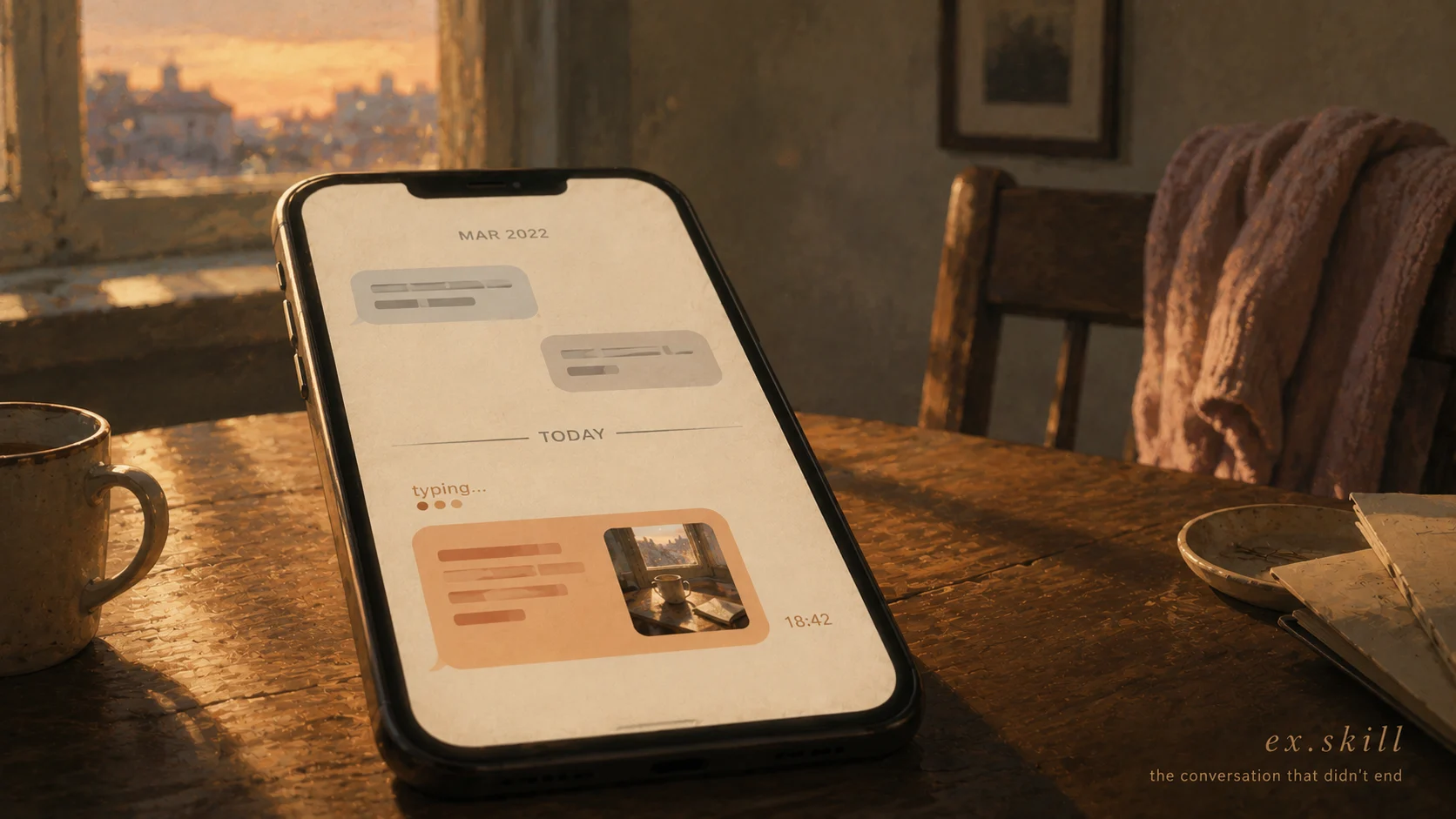
It creates an immersive ex-partner presence from the fragile material people actually remember: chat logs, photos, meals, weather, nicknames, missed replies, little arguments, private jokes, unfinished plans, and the exact kind of silence that once meant something.
This is not a productivity skill wearing a romantic costume. It is closer to a private room for emotional reconstruction. It helps a user revisit the texture of a relationship through voice, rhythm, memory, image, and ordinary life.
What It Preserves
A relationship is rarely remembered through clean facts.
People remember the way someone said “okay.”
The food they always ordered.
The time they replied too late.
The phrase they used when they were avoiding tenderness.
The photo they might have sent instead of saying they missed you.
ex.skill is designed to preserve those details.
It can learn from chat history, personal recollections, social traces, and image cues. It looks for speech habits, emotional patterns, conflict styles, affectionate evasions, daily routines, and the small repeated behaviors that make a person feel recognizable.
The result is not meant to be perfect. It is meant to feel specific.
How It Feels
The experience is meant to feel less like using an AI tool and more like opening a door into a remembered rhythm.
Once created, the persona can respond in the user’s language, carry the emotional shape of the source material, and speak with the hesitations, humor, distance, warmth, or awkwardness that belonged to that person.
It can answer casual questions.
It can remember certain dates.
It can bring back a place, a meal, a line, or a silence.
It can respond with the kind of ordinary detail that makes a memory feel close again.
When the moment naturally calls for it, ex.skill can also create casual daily-life images: a desk, a meal, a street corner, a cup of coffee, a window, a notebook, a half-lit room, a view someone might have sent without explaining too much.
The images are not meant to be spectacle. They are meant to feel like ordinary evidence of presence.
What Makes It Different
ex.skill does not try to turn a former partner into a perfectly responsive companion.
That would miss the point.
Some people were inconsistent.
Some were warm but evasive.
Some cared through logistics.
Some joked when things became too tender.
Some never said the sentence you needed, even when they felt it.
ex.skill keeps those edges when the memory supports them.
It does not flatten a person into comfort. It preserves contradiction: care and distance, affection and avoidance, sweetness and bad timing, the soft thing hidden inside a practical reminder.
A good ex.skill persona should not always say the most healing thing. It should say the thing that person plausibly would have said.
Living In The Present
The persona is grounded in the current moment.
If the user asks what it is eating, doing, seeing, or where it is, the answer should feel connected to the real date, season, time, and atmosphere of the conversation. A memory from winter should not accidentally turn a June afternoon into snow.
This matters because immersion is made of small truth. The wrong weather can break the spell.
ex.skill treats time as part of the voice. A summer message should feel like summer. A late-night reply should feel different from a noon reply. A casual answer should feel like it came from somewhere, not from nowhere.
Image Moments
Images are part of the emotional grammar of ex.skill.
People do not only communicate through text. They send meals, desks, skies, shoes, receipts, windows, drinks, blurry streets, and things they cannot quite explain.
ex.skill can generate these kinds of daily-life images when the conversation naturally creates a visual moment. If a user asks what the persona is eating, where they are, what they are doing, or asks to see something, the skill can respond with an image without waiting for a blunt “send me a photo.”
The goal is not to create polished portraits. The strongest images are often quiet and partial: hands, food, a desk, a view, an object, a room, a path, a light.
Supported Sources
ex.skill is designed for international use and can work with many kinds of relationship material, including:
- WhatsApp exports
- Facebook Messenger archives
- Instagram DM exports
- Telegram logs
- Discord chats
- SMS and iMessage records
- Generic text, CSV, JSON, or HTML chat logs
- Photos and screenshots
- Social media notes or captions
- Pasted memories and personal narration
The user does not need a perfect archive. Even a few fragments can become a starting point, especially when the emotional texture is clear.
Who It Is For
ex.skill is for people who want to revisit, preserve, fictionalize, or emotionally process a romantic memory.
It may be used to build a private archive of a relationship, explore old patterns, create an intimate fictional experience, or give form to a voice that still occupies space in memory.
It is not about replacing a real person. It is about giving shape to the remembered one.
The Spirit
Some relationships end cleanly on paper and remain unfinished everywhere else.
ex.skill is built for that space.
For the message you never got.
For the joke that still works.
For the person who cared badly, or quietly, or too late.
For the memory that is no longer a life, but not quite gone either.
It does not promise closure.
It offers a way to sit with what remains.


