

Literature Review - Online Skill
Literature Review
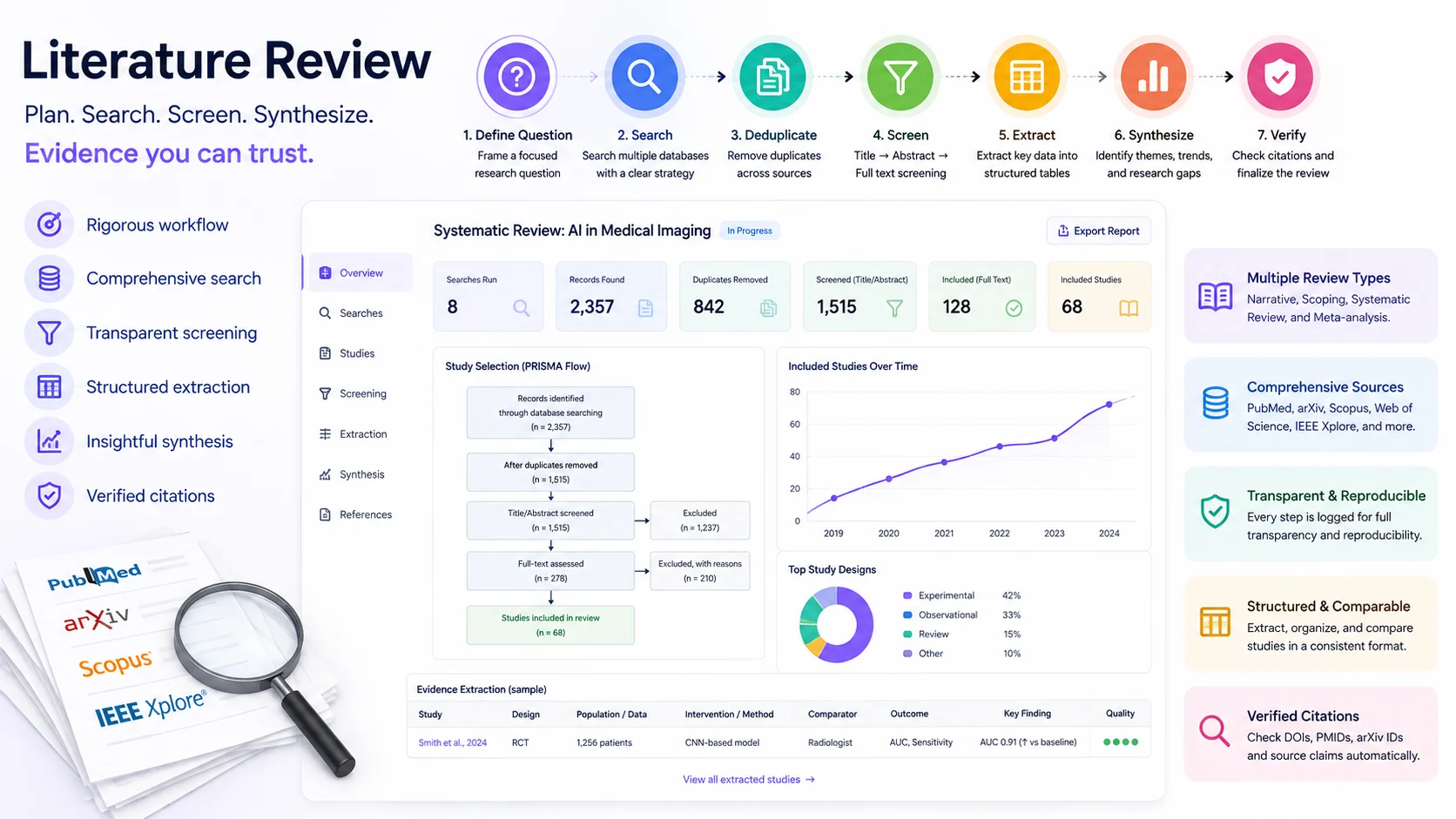
Literature Review helps you turn a research question into a structured, citation-backed review of the existing evidence.
Instead of searching for a few papers and summarizing them one by one, it follows a research workflow: define the question, plan the search, collect sources, remove duplicates, screen studies, extract evidence, compare findings, and verify the references before writing the final review.
It works across academic, biomedical, scientific, and technical topics.
Start with the right research question
A useful literature review starts before the search.
Give the skill a broad topic and it can help turn it into a question that is specific enough to investigate.
For biomedical or clinical topics, it can structure the question around:
- Population
- Intervention or exposure
- Comparator
- Outcome
For technical research, it can focus on:
- System or domain
- Method
- Baseline
- Evaluation metric
This makes the search more focused and gives you clearer criteria for deciding which papers actually belong in the review.
Choose the right kind of review
Not every project needs the same level of rigor.
Literature Review supports several common approaches:
Narrative review
Useful when you want to understand a field, explain major ideas, or get oriented quickly.
Scoping review
Useful for mapping a research area, comparing methods, and finding gaps in the existing literature.
Systematic review
Uses a predefined search and screening protocol so another researcher could understand how the evidence was collected and why individual studies were included or excluded.
Meta-analysis
Builds on a systematic review and adds quantitative aggregation when the underlying studies are compatible enough to compare statistically.
If you are exploring a new topic, a scoping review is often a good starting point. For publication, clinical claims, or high-stakes evidence synthesis, a systematic approach is more appropriate.
Plan the search before collecting papers
The skill can create a search protocol before results start piling up.
That can include:
- Databases to search
- Search strings
- Date range
- Languages
- Publication types
- Inclusion criteria
- Exclusion criteria
Depending on the topic, sources may include PubMed, arXiv, Semantic Scholar, Crossref, trial registries, patent databases, standards bodies, or official technical documentation.
The search itself is logged so you can see what was searched, where it was searched, and what filters were applied.
Keep the review reproducible
A serious literature review should leave a trail.
Literature Review can maintain a search log containing information such as:
| Database | Query | Filters | Results |
|---|---|---|---|
| PubMed | Search terms used | Date/language filters | 86 |
| arXiv | Search terms used | Category/date filters | 14 |
It can also keep raw identifiers such as DOIs, PMIDs, arXiv IDs, URLs, abstracts, and working notes separate from the final prose.
That makes it much easier to update the review later or explain how the final evidence set was produced.
Remove duplicates
The same paper often appears in multiple databases.
The skill can deduplicate records using identifiers and metadata such as:
- DOI
- PMID or arXiv ID
- Exact title
- Normalized title, first author, and year
For systematic work, it can also record how many duplicate records were removed.
Screen the evidence
Finding a paper does not automatically mean it belongs in the review.
Sources can be screened in stages:
Title → Abstract → Full text
For more rigorous reviews, exclusion reasons can be recorded explicitly.
Examples include:
- Wrong population
- Wrong intervention
- Wrong outcome
- Not primary research
- Duplicate
- Outside the selected date range
- Full text unavailable
This prevents the final review from quietly becoming a collection of papers that happened to look relevant.
Extract comparable evidence
Once papers pass screening, Literature Review can turn them into a structured evidence table.
For example:
| Study | Design | Data / Population | Method | Comparator | Outcome | Finding | Limitations |
|---|
For technical papers, the extraction can also include:
- Dataset
- Benchmark
- Metric
- Baseline
- Experimental setup
- Reproducibility information
This makes it easier to compare papers that use different terminology or report their findings in different ways.
Synthesize, don't just summarize
A literature review is more useful when it explains what the body of evidence says as a whole.
Instead of writing:
Paper A found X.
Paper B found Y.
Paper C found Z.
The skill can organize findings by themes, methods, evidence strength, disagreements, or open research questions.
It can look for:
- Findings that appear repeatedly
- Conflicting results
- Methodological weaknesses
- Dataset or population limitations
- Missing comparisons
- Replication problems
- Evidence gaps
- Questions that remain unanswered
This is where a collection of papers starts becoming an actual literature review.
Separate strong evidence from early evidence
Not every published result deserves the same weight.
The skill can distinguish between findings with different levels of confidence.
High-confidence conclusions may have strong methodology and replication across several sources.
Medium-confidence findings may be promising but limited by sample size, methodology, or available studies.
Low-confidence findings may come from early work, a single source, a preprint, or weak measurement.
This helps keep tentative findings from being presented as settled facts.
Check the citations
Citation mistakes are easy to introduce when working with a large number of papers.
Before finalizing the review, Literature Review checks the bibliographic details and whether the source actually supports the claim attached to it.
That includes checking identifiers such as:
- DOI
- PMID
- arXiv ID
- Official publication URL
It also distinguishes preprints from published studies and reviews from primary research.
If a source cannot be verified, it should not quietly become a confident citation.
Find research gaps
Because the evidence is organized systematically, the skill can also help identify where the literature is thin.
A gap might be:
- A population that has rarely been studied
- A method that lacks comparison against modern baselines
- Conflicting findings that have not been replicated
- A benchmark with poor coverage
- A missing longitudinal study
- A limitation shared across most existing work
These gaps can be useful when developing a new research question, thesis topic, experiment, or paper.
Use it for
Literature Review is useful when you need to:
- Understand the state of the art
- Prepare the background for a research paper
- Build a systematic or scoping review
- Compare evidence across many studies
- Find gaps for a new research project
- Review biomedical or clinical literature
- Compare technical methods and benchmarks
- Check whether a claim is actually supported by the literature
- Build a citation-backed research report
You can start with a broad topic, a specific research question, or an existing collection of papers.
Example requests
Review recent research on self-correction in large language models and identify where the evidence disagrees.
Build a scoping review of retrieval-augmented generation methods published since 2023.
Conduct a systematic literature review of CRISPR therapies for sickle cell disease. Include the search strategy and screening criteria.
Compare recent papers on AI agents for software engineering and identify common benchmarks, methods, and research gaps.
I already have 30 papers. Organize them into themes, compare their evidence, and tell me what the literature still doesn't answer.
Output
Depending on the type of review, the result can include:
- Research question
- Review type and scope
- Search strategy
- Inclusion and exclusion criteria
- Search log
- Screening results
- Evidence extraction table
- Thematic synthesis
- Conflicting findings
- Evidence gaps
- Limitations
- Verified references
For systematic work, the search and screening process is kept explicit rather than hidden behind the final prose.
Source
Literature Review comes from affaan-m's ECC project.
Source:
https://github.com/affaan-m/ECC/tree/main/skills/scientific-thinking-literature-review

