

Production-grade code quality standards for AI coding agents: no-hacks policy, core values hierarchy, universal clean code principles, language-agnostic pitfalls, multi-stack security checks, and TypeScript-first depth with coverage-gap patterns. Grounded in real production failure modes, with standards and tooling spanning 19 languages.
Turn open-ended survey responses into a reviewable codebook, coded CSV, theme summary, quote table, and insight deck outline. 将开放式问卷回答整理成可人工复核的 codebook、编码表、主题摘要、引用表和洞察汇报大纲。No fabrication, no PII leakage, no statistical overclaiming.

Grill Me interviews you like a senior architect would before you build grounded in 18 curated architecture references, then writes your planning docs for you. 1. README — project overview 2. PRD — product requirements doc 3. Architecture doc — tech stack, service topology, integration patterns, security posture 4. Phase plan — locked decisions, delivery methodology, risk register, KPI summary 5. Use-cases — Mermaid sequence diagrams 6. Deliverables guide — phase-by-phase deliverables

Four independent AI reviewers — Security Skeptic, Reliability Realist, Maintainability Pragmatist, and Performance Pessimist — each review your diff blind to the others' verdicts, so real bugs don't get averaged away into one polite summary.

I have spent more than 25 years in programming and web development, with a strong focus on performance, security, and writing lean code that does not waste resources. Good code should be clear, fast, safe, and practical to maintain. That same mindset is what I bring to this skill.

Japanese-language skill for startup CTOs, PMs, and contract developers. Drop a one-line app idea — get five aligned definition docs in Japanese: 要求定義書 (Requirements), 要件定義書 (Functional Spec), 技術定義書 (Technical Design), 工程定義書 (Project Plan), 品質定義書 (Quality Plan). Each doc is internally consistent. Mermaid diagrams embedded automatically. Pre-tuned for Cloud Run / Next.js / Python stacks. Output is Markdown, ready to paste into Notion, GitHub, or Cursor. Cuts a week of spec work to under an hour.

Turn website, social, email, support replies, and docs that no longer sound like one brand into a fixable brand-consistency audit. This download skill uses a voice guide baseline, checks voice axes, Do / Don't words, grey-area rules, and cross-channel samples, then classifies drift and produces item-level fixes plus system improvements. Built to prevent off-brand new-hire copy, fragmented support tone, and voice guides that stay on paper.
Turn pasted operating metrics, risks, and decision requests into a concise board-update storyboard. Keep values traceable, expose gaps, and separate supplied facts from proposals.
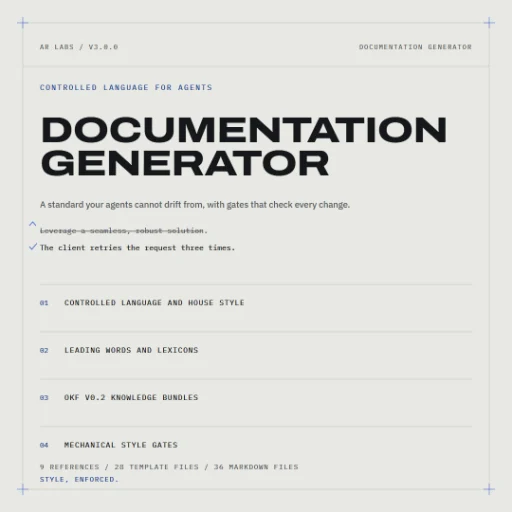
Generate, audit, co-author, and maintain software documentation under a style your agent cannot drift from. Version 3.0.0 adds controlled language (STE-derived), a distilled house style enforced by mechanical gates (vale, markdownlint, cspell), canonical vocabulary that steers agents, OKF v0.2 knowledge bundles with a working attester, and the 2026 spec-driven development landscape with 11 tool-neutral templates. Works across software, hardware, firmware, and embedded projects in any runtime.