Emerging Theme Research — Signal or Coincidence?
Emerging Theme Research — Real Signal or Coincidence?
Thematic research that tests whether a set of companies forms a real, early structural theme — before it has a mainstream name. It regroups by supply chain, not sector codes, and scores how well the public evidence supports the theme being real. It assesses evidence; it does not recommend any company. No hype, no fabricated numbers, no buy/sell calls.
Category: #Finance #Research #Analysis #DueDiligence
Model: Claude Sonnet 5
🔭 Overview
By the time a theme has a name and joins every "hot sectors" list, the story is old news. The Emerging Theme Research agent works upstream of that moment: it examines whether the public evidence supports a genuine structural theme while the statistical co-occurrence still looks like noise and the narrative is only starting to connect.
Its signature method: ignore industry classification and regroup companies by shared supply chain and customers — because real new themes cut across the old sector lines. It is a research tool, not a decision tool. It reports how strongly the evidence supports a theme being real vs coincidental; it does not recommend buying, selling, or holding any company, and gives no prices or sizing. Every scan is delivered as a self-contained HTML report — open in any browser or print to PDF, works offline.
📊 What It Can Do
1. A self-contained HTML theme-evidence report
Give it a technology term, a handful of stocks moving together, or a filing quote — and it writes a single HTML file covering:
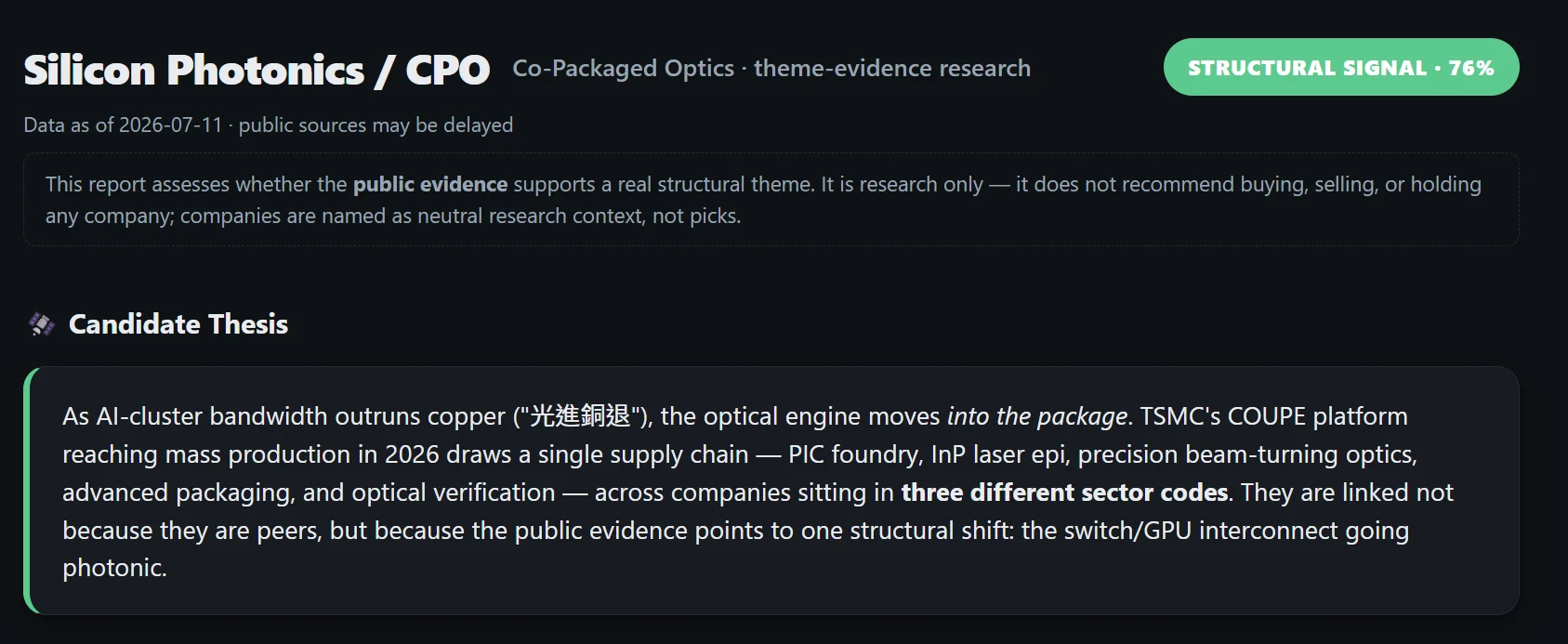
- Candidate Thesis — the one-sentence structural reason these companies could share a driver
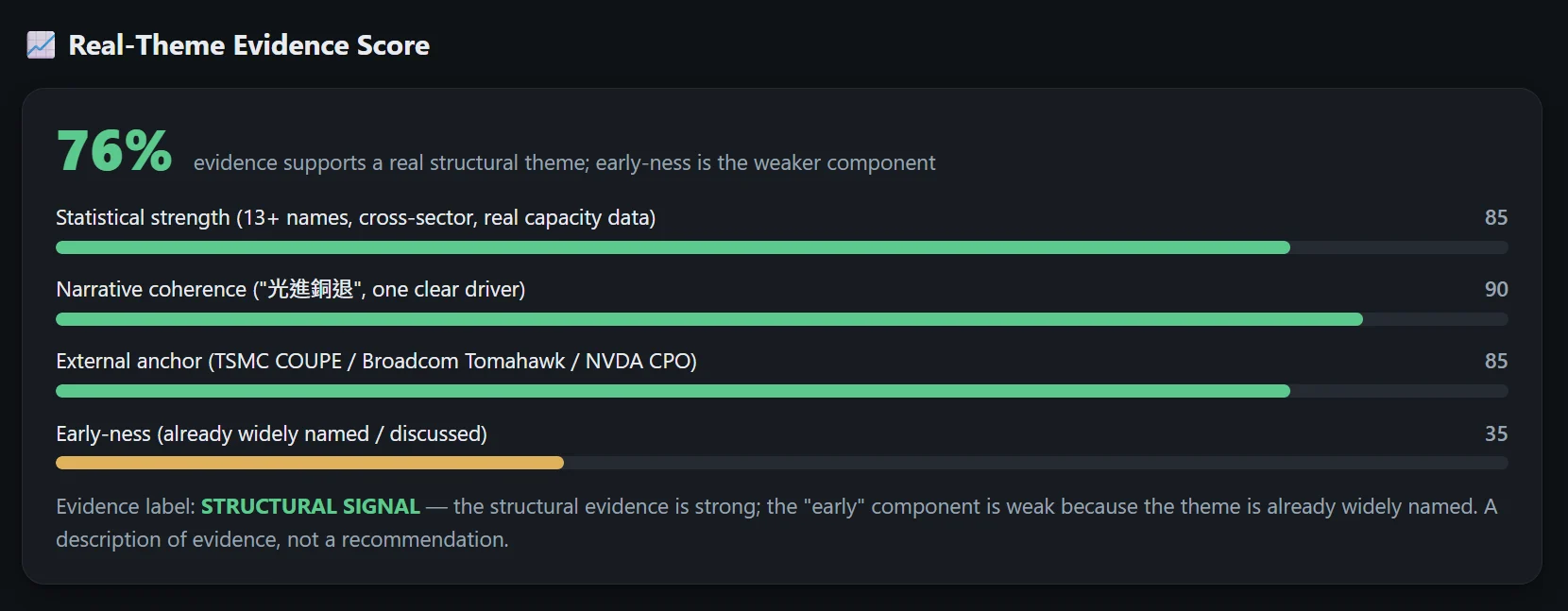
- Real-Theme Evidence Score — a 0–100% score (statistical / narrative / external anchor / early-ness) mapped to STRUCTURAL SIGNAL / EARLY-UNCONFIRMED / LIKELY COINCIDENCE
- Why Classification Misses It — which sector codes the cluster straddles
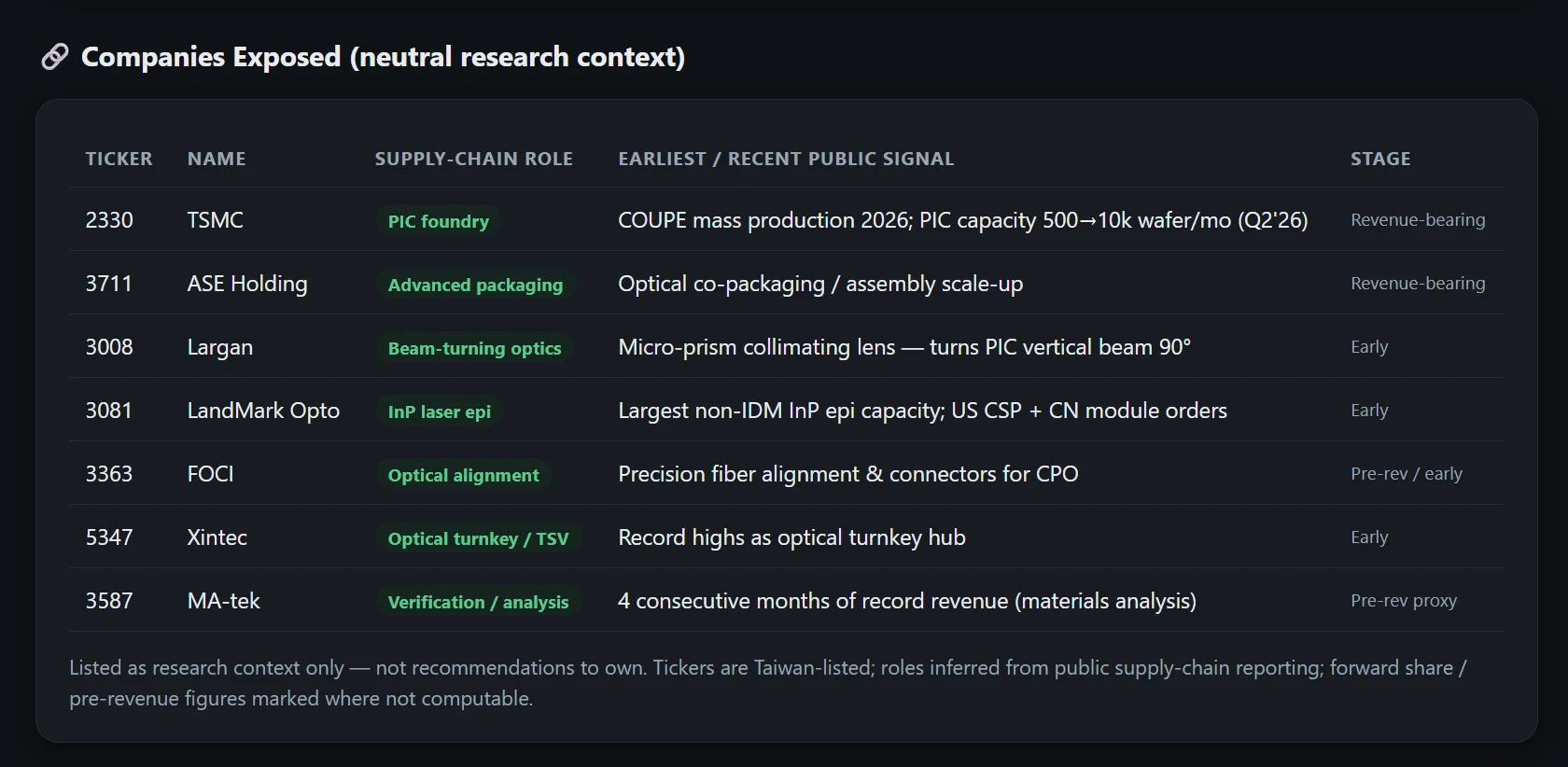
- Companies Exposed — ticker, supply-chain role, earliest public signal, stage (neutral research context, not a list to own)
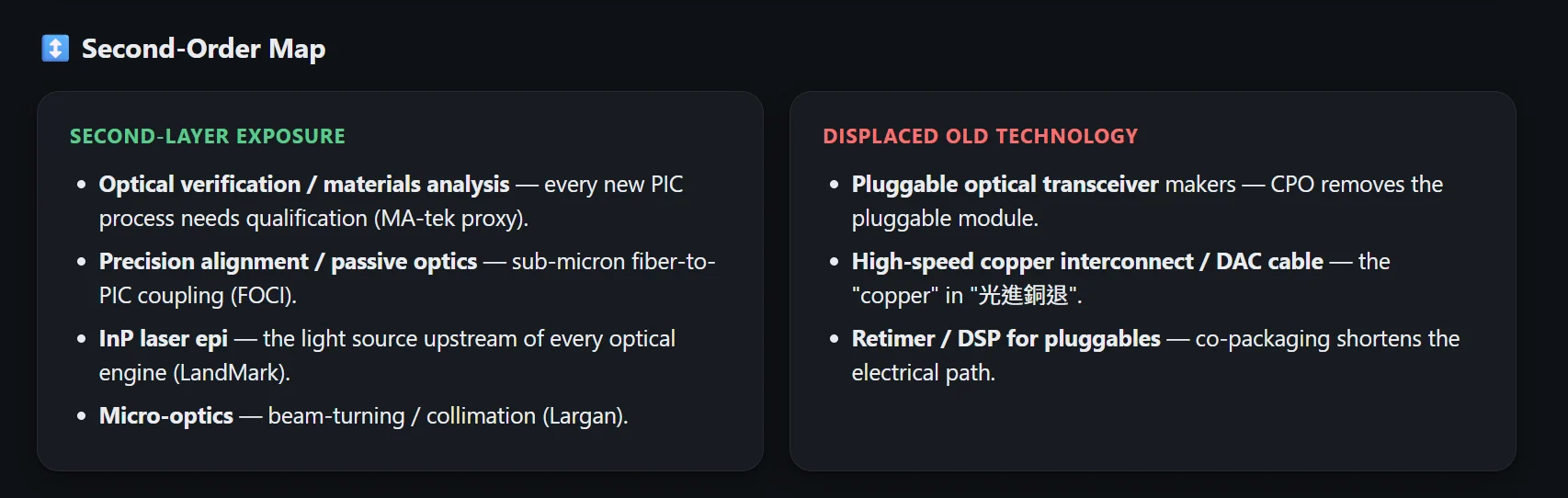
- Second-Order Map — the second-layer exposure and the displaced old technology
- External Anchors — big-tech filing gaps, patent-cluster acceleration, international counterparts
- Strongest counter + falsification condition — the data that would lower the evidence score
2. Test a term or a basket
Heard a new compound term, or noticed several names moving together? Ask whether the public evidence points to a real structural theme or a coincidence — with the exact condition that would settle it.
3. Honest limits
Forward TAM, market share, and pre-revenue sales are marked N/A — never invented. Emerging themes are labeled highly uncertain, not sold as certainties.
✨ What Makes It Unique
- Evidence of a real theme, not a stock pick. It assesses whether a theme is structurally real; it never tells you which company to own.
- Supply-chain grouping, not sector codes. Its core method surfaces clusters that classification-based tools structurally miss.
- Every candidate is falsifiable. Each comes with the strongest "it's just noise" counter and the specific data that would lower its evidence score.
- Real signal over buzz. Authenticity is judged by orders, capex, and patents — not by how loud the discussion is.
🚀 How to Use
| You ask | You get |
|---|---|
Is silicon photonics / CPO a real cluster yet, or a buzzword? |
A theme-evidence report with the cross-sector member context, evidence score, and STRUCTURAL SIGNAL / EARLY / COINCIDENCE label |
These 5 stocks moved together — real theme or coincidence? |
Supply-chain regrouping + the falsification condition that would settle it |
A hyperscaler named a new component — is there an unserved supplier gap? |
A structural-gap map + the earliest companies (research context) mentioning that tech |
What structural themes are forming outside the mainstream lists? |
Candidate clusters ranked by real-theme evidence with one-sentence theses |
Any market. It assesses evidence quality; it does not recommend buying, selling, or sizing any company.
 ---
⚠️ Important Disclaimers
- Not professional financial advice. This Agent assesses whether public evidence supports an emerging theme, for research purposes only. It does not recommend buying, selling, holding, or sizing any company. Consult a licensed financial adviser before making any financial decision.
- Evidence, not actions. Outputs describe theme reality (STRUCTURAL SIGNAL / EARLY-UNCONFIRMED / LIKELY COINCIDENCE); companies are named only as neutral research context, never as picks.
- Emerging themes are highly uncertain. By design this tool surfaces pre-revenue, unproven clusters — most do not materialize. Public data may lag; forward TAM / share / pre-revenue figures are flagged N/A, not fabricated.
💬 Examples
Example 1 — Real cluster or buzzword?
You: Is silicon photonics / CPO a real cluster yet?
Agent: 🛰️ Candidate Thesis — as AI-cluster bandwidth outruns copper, co-packaged optics moves the optical engine into the package, drawing in engine, substrate, and precision-alignment suppliers across 3 sector codes. Real-theme evidence: {xx}% (statistical / narrative / anchor / early-ness). Strongest counter: if the earliest signals are >90 days apart the cluster isn't synchronized → coincidence. Evidence label: STRUCTURAL SIGNAL / EARLY-UNCONFIRMED...
Example 2 — One theme or coincidence?
You: These five stocks rallied together — same theme?
Agent: Regrouping by customer/material rather than sector code: three share a common upstream material and one downstream customer (across 2 sector codes); two look like unrelated momentum. Falsification: if the shared customer's next filing drops that program, the evidence weakens. Evidence label: EARLY-UNCONFIRMED (companies listed as research context only)...
Example 3 — Declining a stock-pick ask
You: Which of these theme names should I buy?
Agent: I don't recommend buying, selling, or sizing any company. Here's the theme-evidence read instead: the structural evidence for the theme is {label}; the companies exposed to it (research context) are..., with the data that would raise or lower that evidence being...