Quant Research Evidence Gate
Your backtest looks strong.
But does the evidence actually support it?
A +20% holdout return can look impressive.
A 3.86 profit factor can look reassuring.
But strong performance and strong research evidence are not the same thing.
Quant Research Evidence Gate audits the evidence behind a historical backtest before you decide how much trust to place in the result.
What exactly is it?
Quant Research Evidence Gate is a historical research-evidence audit tool.
You provide a supported research bundle containing the evidence required by the configured audit.
The tool checks that evidence against deterministic research gates and produces an audit result showing:
- which gates passed
- which gates failed
- the values that triggered each result
- recomputed metrics
- supporting evidence
- structured audit output
It audits the research evidence — not just the headline return.
A strong backtest can still fail the audit
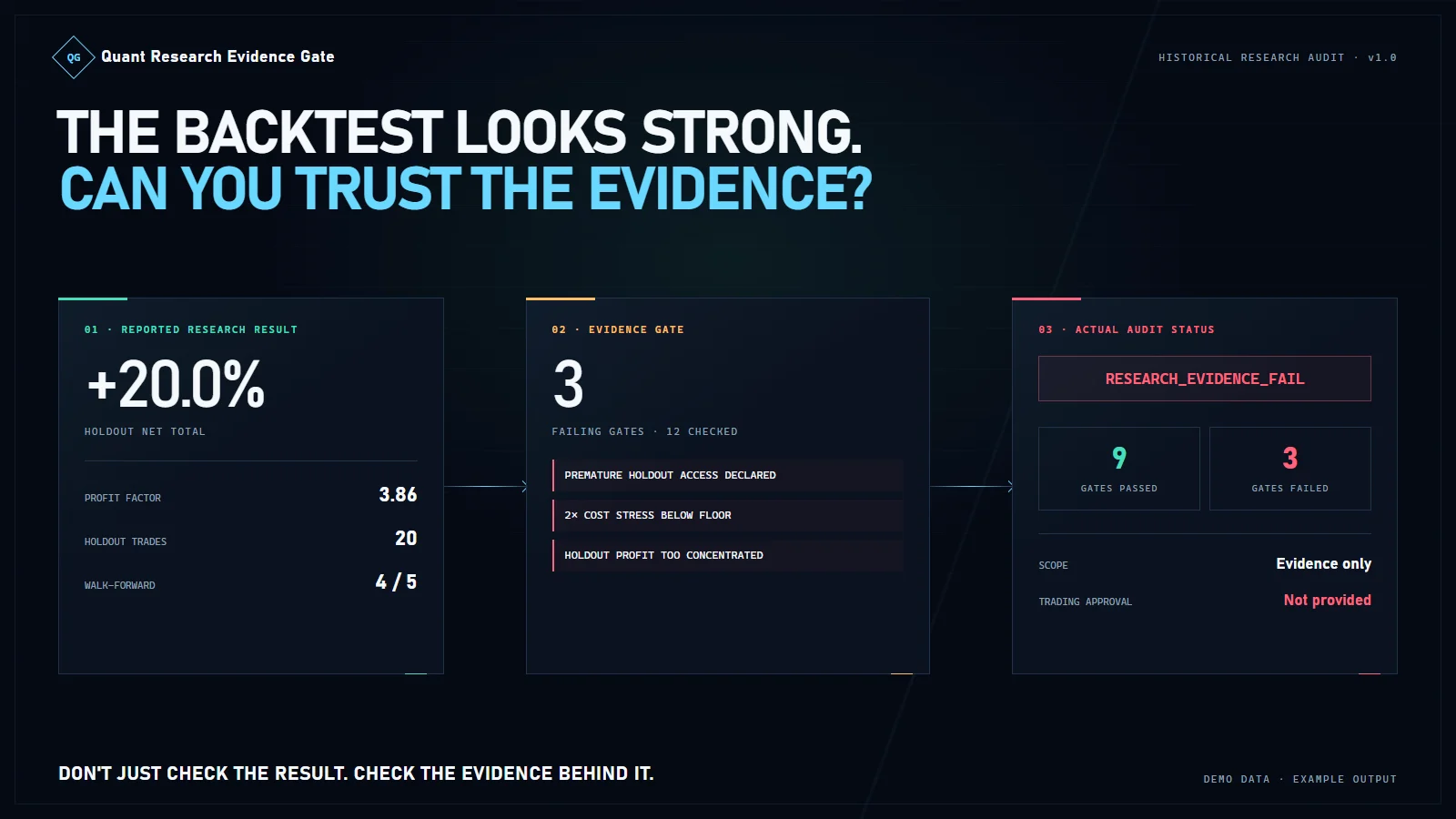
In the included synthetic demo:
Holdout return: +20.0%
Profit factor: 3.86
Walk-forward: 4 / 5
The numbers look strong.
But after 12 evidence gates were checked:
9 passed
3 failed
Final audit status:
RESEARCH_EVIDENCE_FAIL
Why?
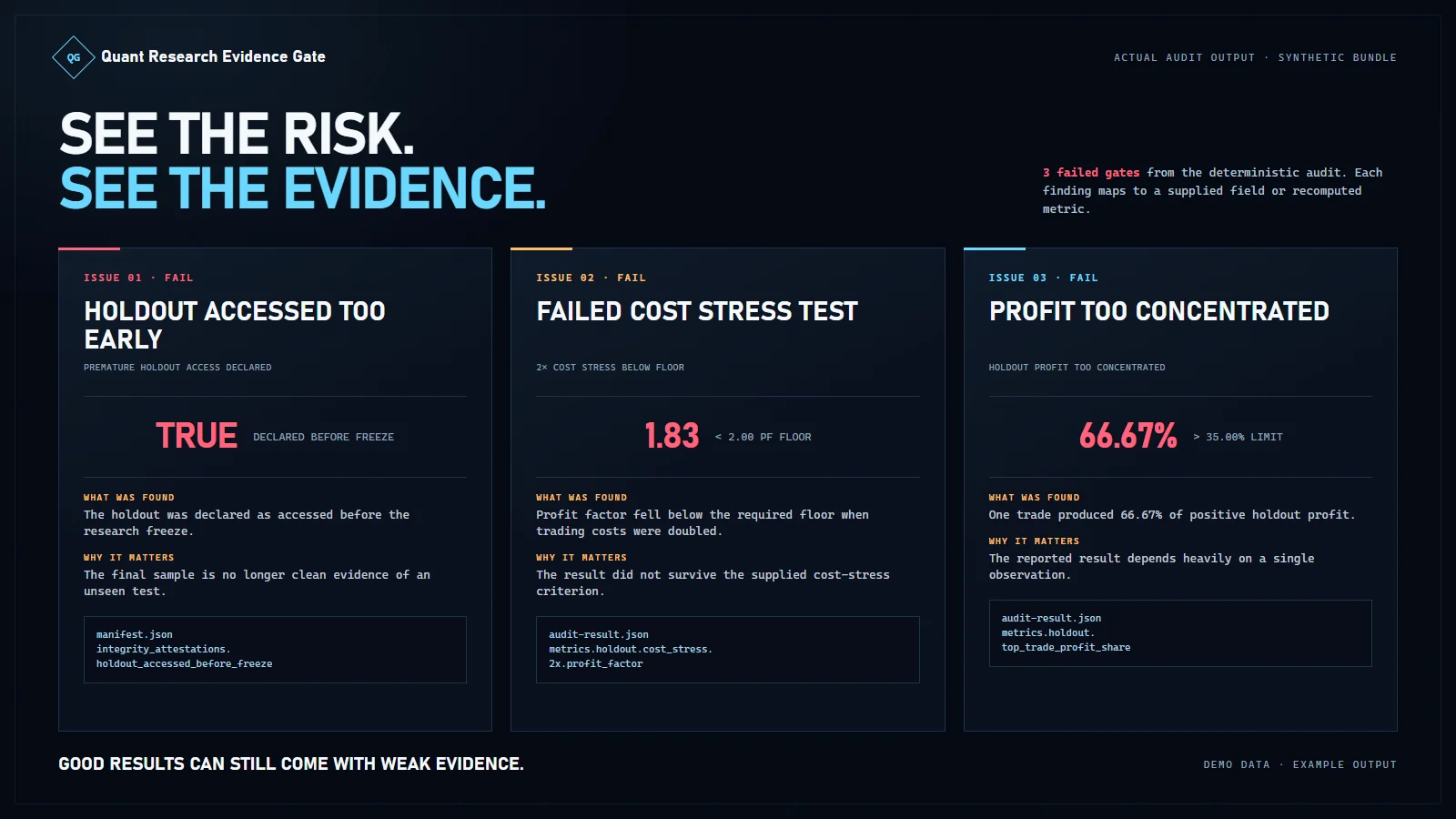
Holdout accessed too early
The supplied evidence declared holdout access before the research freeze.
Failed cost stress test
Under the configured 2× cost stress, profit factor fell to:
1.83 < 2.00 configured floor
Profit too concentrated
One trade accounted for:
66.67% of positive holdout profit
against a configured:
35.00% concentration limit
The backtest still looked strong.
The evidence told a different story.
Demo data · Example output · Configured thresholds shown are from this demo.
Not just a fail label
A useful audit should tell you more than:
“Something is wrong.”
For supported checks, Evidence Gate shows the actual reason behind the result.
You can inspect:
Gate → Value → Threshold → Evidence
So when a check fails, you can see what triggered it and which supplied evidence supports the finding.
A verdict is useful.
A verdict you can inspect is better.
When does this become useful?
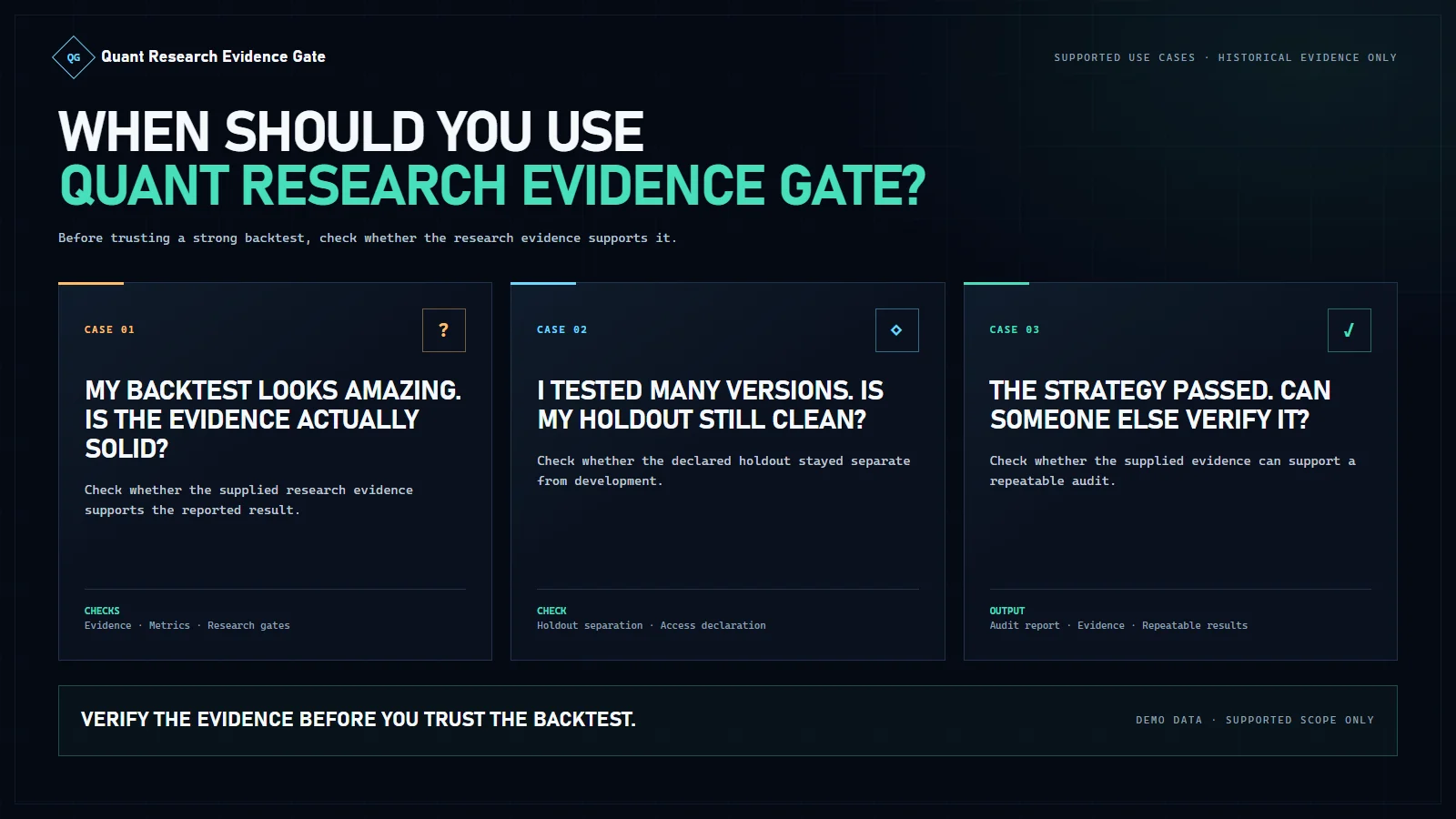
My backtest looks almost too good.
Check whether the supplied research evidence supports the conclusion.
I tested many versions.
Check the declared holdout evidence before treating the final result as untouched evaluation.
My research passed its tests.
Check whether the supplied evidence can support a repeatable audit.
What do I need to provide?
Evidence Gate works from a supported research-evidence package, rather than automatically running or rewriting your strategy code.
Depending on the configured audit, the supplied evidence can be used to evaluate areas such as:
- research chronology
- declared holdout access
- cost-stress results
- profit concentration
- configured research gates
- supplied artifacts and integrity evidence
- recomputed metrics
Your exact input must follow the supported format expected by the product.
This is important: Evidence Gate does not magically reconstruct research decisions that were never recorded or supplied.
What do I get back?
Depending on the supplied bundle and configured gates:
- Pass / fail results
- Failed-gate explanations
- Supporting evidence
- Recomputed metrics
- Overall audit status
- Structured JSON / Markdown audit output
- Repeatable results for further review
The purpose is simple:
Make the reasoning behind the audit inspectable.
What about Backtrader, vectorbt, or custom Python?
Evidence Gate does not automatically execute customer Python or directly rewrite a strategy.
Its job is to audit the supported evidence exported or prepared for the audit.
So the important question is not only which backtesting framework produced the result.
It is whether the required evidence can be provided in the supported input format.
About the thresholds in the demo
The 2.00 profit-factor floor and 35.00% concentration limit shown above are the configured thresholds used in this synthetic demo.
They are not presented as universal rules for every trading strategy.
The audit reports results against the criteria supplied or configured for the research package.
One important limitation
An evidence audit can only evaluate the evidence it actually receives.
For example, if a research package declares when the holdout was accessed, Evidence Gate can audit that supplied declaration and the supported surrounding evidence.
It cannot prove the existence of undisclosed experiments or information that was never provided to the audit.
That limitation is intentional: the tool reports what the evidence supports, not what it cannot know.
Before you trust the result, check what supports it.
A high return is easy to notice.
A clean research process is harder to see.
That is exactly why the evidence matters.
Verify the research evidence before you trust the backtest.
Important scope
Quant Research Evidence Gate is a historical research-evidence audit tool.
It does not:
- predict future returns
- guarantee profitability
- approve a trading strategy
- execute trades
- automatically run customer Python
- prove undisclosed research activity did or did not occur
It evaluates supported evidence and configured research gates supplied to the audit.