Scholar Evaluation - Online Skill
Scholar Evaluation
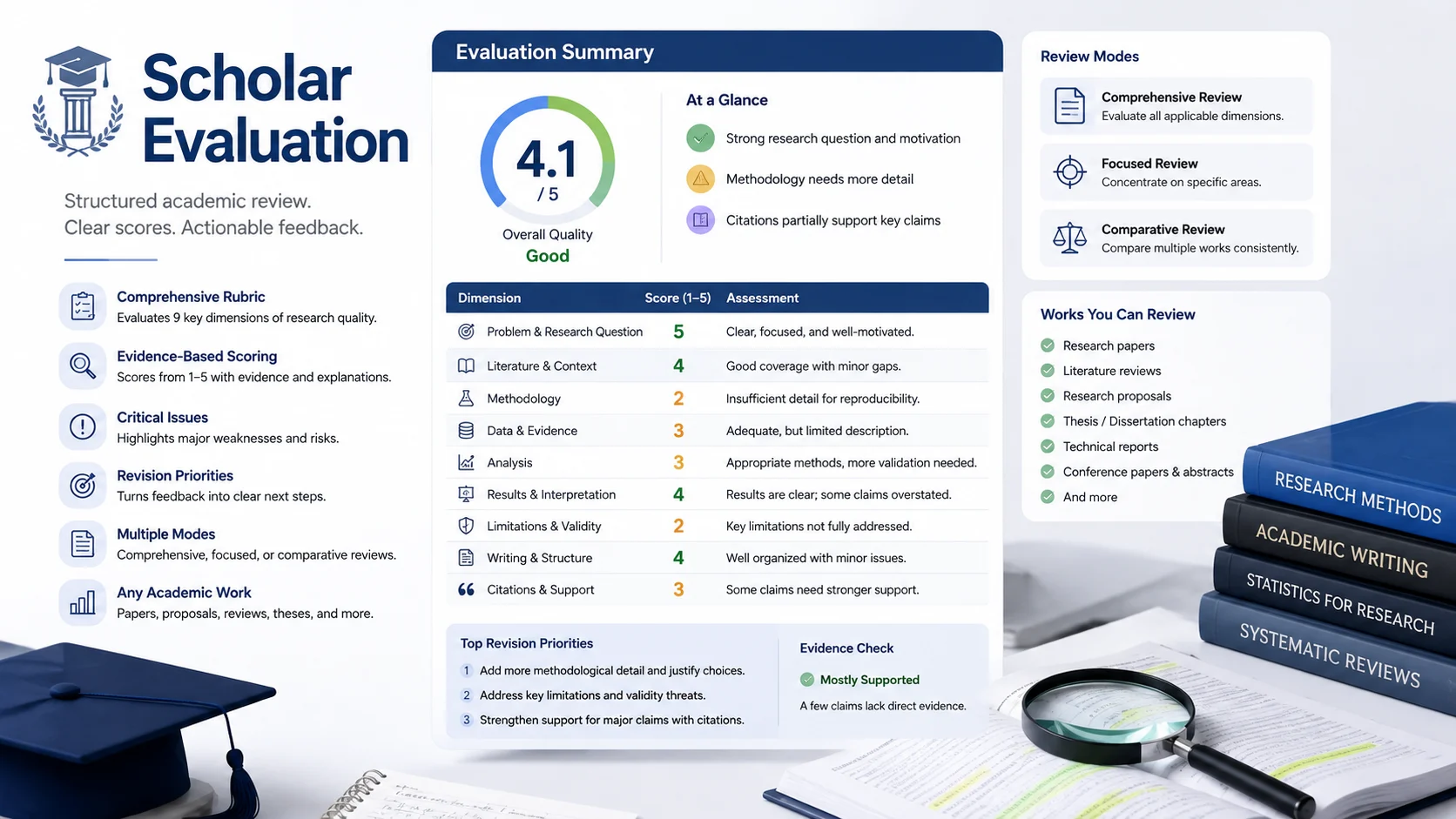
Scholar Evaluation is a structured academic review skill from affaan-m’s ECC project. It helps assess research papers, proposals, literature reviews, thesis chapters, technical reports, and other scholarly work using a consistent evaluation rubric.
Rather than giving vague feedback, it reviews the work across clear dimensions, scores relevant areas from 1–5, identifies critical weaknesses, and turns the evaluation into practical revision priorities.
What it does
Evaluate research quality
Review whether the research problem, questions, contribution, scope, and assumptions are clearly defined and well aligned.Assess literature and context
Check whether relevant prior work is covered, synthesized effectively, and used to support a clearly identified research gap.Review methodology
Evaluate study design, variables, datasets, participants, materials, reproducibility, and whether the chosen methods fit the research question.Check evidence and analysis
Examine data quality, sample coverage, preprocessing decisions, bias risks, analytical methods, baselines, controls, and robustness.Evaluate results and interpretation
Review whether results are clearly presented and whether conclusions stay within what the evidence actually supports.Review limitations and validity
Identify weaknesses related to internal, external, construct, or conclusion validity and check whether limitations are discussed specifically.Assess writing and structure
Check clarity, organization, terminology, argument flow, and whether the writing fits an academic context.Review citation support
Examine whether cited sources actually support the claims they are attached to and whether primary sources, reviews, and preprints are represented appropriately.
Supported review types
Scholar Evaluation can be used for:
- Empirical research papers
- Theoretical papers
- Technical reports
- Systematic literature reviews
- Narrative literature reviews
- Research proposals
- Thesis or dissertation chapters
- Conference abstracts
- Short academic papers
Evaluation modes
Comprehensive review
Evaluate all applicable dimensions of the work using the full rubric.
Focused review
Concentrate on one or two areas, such as:
- Methodology
- Evidence quality
- Citations
- Analysis
- Writing
- Limitations
Comparative review
Evaluate multiple papers or research works using the same rubric so their strengths and weaknesses can be compared consistently.
Scoring system
Applicable dimensions are scored from 1 to 5:
- 5 — Excellent: Clear, rigorous, and ready for publication
- 4 — Good: Strong overall with minor improvements needed
- 3 — Adequate: Usable but contains meaningful gaps
- 2 — Weak: Requires substantial revision
- 1 — Insufficient: Contains major validity or clarity problems
- N/A: Used when a dimension does not apply to the work
Scores are paired with evidence and revision suggestions rather than used as standalone judgments.
Example use cases
- Review a research paper before submission
- Identify the weakest sections of a thesis chapter
- Evaluate whether a methodology is appropriate for the research question
- Check whether major claims are supported by cited evidence
- Compare two papers using the same quality criteria
- Review a literature review for coverage and synthesis
- Identify missing limitations or validity concerns
- Turn general academic feedback into specific revision tasks
- Review a research proposal before sending it to a supervisor or committee
Typical inputs
You can provide:
- A research paper
- A manuscript draft
- A research proposal
- A literature review
- A thesis or dissertation chapter
- A methodology section
- A conference paper or abstract
- Multiple papers for comparison
- A specific review request, such as “focus only on methodology and citations”
For more focused feedback, you can also specify the evaluation areas that matter most.
Typical outputs
Scholar Evaluation can return:
- An overall assessment
- A 1–5 score for each applicable dimension
- Evidence supporting each score
- Critical issues that need attention
- Revision priorities
- Specific recommended edits
- Areas that require further evidence checking
- A confidence level for the evaluation
A typical evaluation may include a structured score table covering:
- Problem and research question
- Literature and context
- Methodology
- Data and evidence
- Analysis
- Results and interpretation
- Limitations
- Writing and structure
- Citations
How it works
The skill follows a structured review process.
It first identifies the type of academic work and the requested evaluation scope. It then examines the claimed contribution, methodology, evidence, results, and supporting citations before scoring each relevant dimension.
The review separates critical blockers from normal revision suggestions, helping you distinguish problems that may undermine the work from improvements that mainly strengthen clarity or presentation.
The final output focuses on concrete next edits rather than scores alone.
Review principles
Scholar Evaluation is designed to avoid several common review mistakes:
- It does not treat citation count as proof of research quality.
- It does not assume a prestigious publication venue or well-known author means the work is strong.
- It does not penalize a paper for dimensions that are outside its scope.
- It does not accept a claim simply because it appears in the abstract.
- It separates evidence-backed findings from unsupported or speculative conclusions.
Source
Based on the Scholar Evaluation skill from affaan-m’s ECC project.