WoWS — Trading Strategy Validator
WoWS — Trading Strategy Validator
A rigorous validation protocol for algorithmic trading strategies. It doesn't try to make your strategy
look good — it tries to kill it with every honest statistical test available, and reports exactly
what survives and what doesn't.
This is analysis, not advice. It reports which pre-defined, objective statistical criteria a
strategy meets or fails — it never tells you whether to deploy, never recommends or prohibits a specific
allocation or leverage level, and never computes an "optimal" weight. Those decisions are yours, made
with a licensed financial advisor if needed. See Disclaimer at the bottom.
Illustrative example results shown below (charts + numbers) are synthetic — they demonstrate the shape
of the protocol's output, not real trading performance.
Why this exists
Most "backtest my strategy" prompts produce a flattering Sharpe ratio and stop there. This one enforces
the checks that actually separate a real edge from a lucky curve fit: correct fees, the longest history
available, plateau-not-peak parameters, walk-forward on unseen folds, and an honest read of which part
of the improvement is real versus which part is one lucky year.
What it does
1. Asks for your setup first, as fixed test inputs. No number gets produced until it knows your
market, timeframe, entry, and exit — it asks in one grouped message, guided, no quant background needed.
Capital, TP/SL, and leverage are optional and never defaulted: if you state them, they're tested exactly
as given; if you don't, the checks that depend on them are simply skipped and it says so.
2. Develops the strategy in depth, not just a parameter sweep:
- Parameter plateaus (never picks an isolated spike)
- 4+ distinct entry mechanisms tested by name
- 4+ distinct exits tested by name
- Confirmation filters tested one at a time (never stacked)
- Full per-timeframe x per-asset breakdown
3. Runs the anatomy — three questions on every strategy: is it symmetric long/short? what's the
entry bottleneck? when exactly does it win and lose (trade-level, with dates)?
4. Validates with hard gates — random control (z > 1.5), sub-period consistency, real walk-forward,
fixed parameters across assets, minimum trade count.
5. Reports whether a candidate historically pulled its weight in a portfolio — not as a weight
figure or formula (sizing math is out of scope), but as a plain finding about the historical numbers.
For example: "Adding this leg's signal moved the reference portfolio's historical max drawdown from
-12% to -8%, while the leg's own standalone track record was roughly break-even — a diversification
finding, distinct from whether the leg looked good on its own." That distinction catches two classic
traps: the "affordable seat" that's really just rent (looks cheap standalone, adds nothing to the book),
and over-concentration on this year's best solo performer (looks great alone, adds redundancy not
diversification).
6. Refuses to round hype up to certainty. The grand-final walk-forward reports the change fold-by-
fold — if the gain is concentrated in old data, it says so, and states the honest statistical
expectation as the most recent fold, not the flattering full-history average. It's still a backtest
statistic, not a promise.
See it in action — a live demo
Here's what happened when this protocol was asked to validate a plain two-moving-average crossover
(a real, unscripted run — nothing hidden):
Step 1 — it refuses to guess the setup:
Before I can validate this honestly I need the setup. Please tell me:
- Market & venue 2) Timeframe(s) 3) Exact entry rule 4) Exit rule
- TP/SL management 6) Starting capital 7) Max leverage.
Step 2 — full parameter sweep, reads the shape, not just the winner:
fast\slow        50           100          200          400
   10       -65.9%/-1.20  -45.0%/-0.49  -24.7%/-0.04   -8.2%/+0.23
   20       -45.7%/-0.58  -37.0%/-0.32  -17.9%/+0.07   +2.1%/+0.38
   50            -        -13.9%/+0.12   -7.5%/+0.23   +2.3%/+0.38

best cell: fast 20 / slow 400 -> Sharpe 0.38
neighbors checked -> ISOLATED SPIKE — plateau rule fails (X)
Step 3 — gates, printed with real numbers, not adjectives:
sub-periods: [+64%, +73%, -28%, -45%] -> 2/4 positive (X)
walk-forward OOS Sharpe: +0.02 (barely positive, unstable pick per fold)
random control z: +3.89 (checkmark) (the edge is not noise...)
fixed params SOL: ann -2.0% (X)   fixed params ETH: ann -15.6% (X)
Verdict the protocol would print: VALIDATION GATES FAILED (1/4 gates passed) — the random-control
gate passes (there IS a real, non-random effect distinguishable from noise), but the strategy fails
parameter robustness, sub-periods, and per-asset consistency. A strategy that looks interesting on a
data-mined chart, caught falling apart in minutes with the reasoning shown — instead of one flattering
Sharpe number.
Illustrative output: what a validated result reports
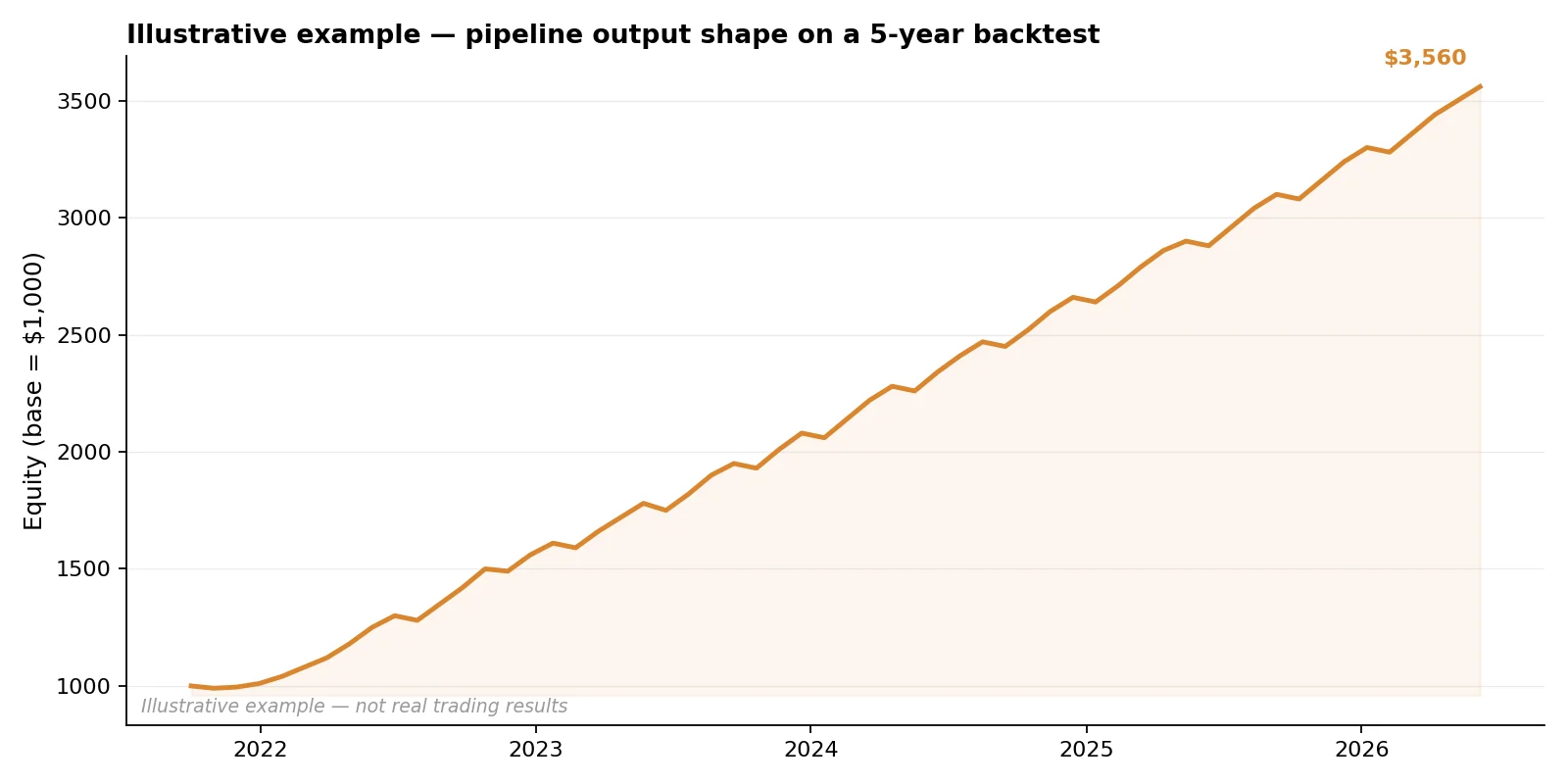
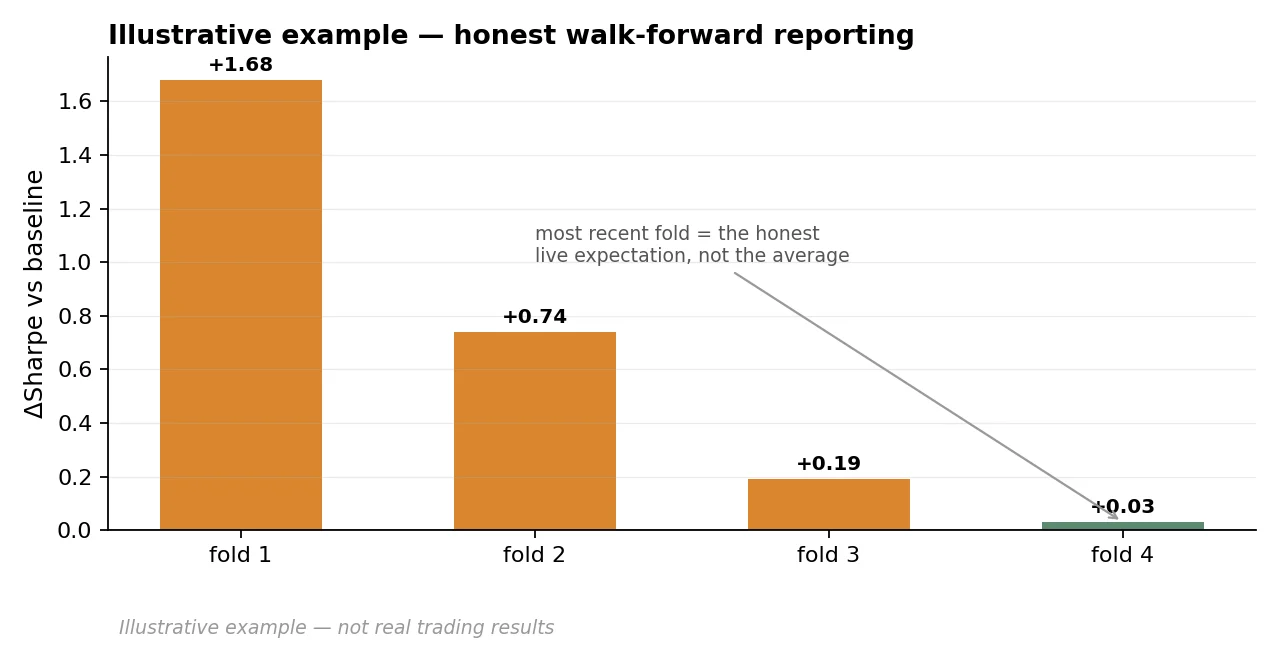
Note the second chart: it's not selling you the average. It's showing you that most of a strategy's
apparent improvement often lives in the years already used to pick it — and stating plainly which fold
is the honest forward-looking number.
The validation gates verdict
Before summarizing anything, it prints this checklist exactly as it comes out, then one of exactly
three words — never softened into "ready to deploy" even if you ask it to:
[ ] FRESH data          -> fetched this session, not stale files
[ ] REAL fees           -> read from the code now, per side, taker + slippage
[ ] Slippage included   -> at least an empirical estimate, never zero
[ ] Overlays REALLY in the validation script -> verified, not assumed
[ ] TRUE walk-forward   -> decisions from train only, tested on unseen folds
[ ] OOS positive or beats the incumbent baseline

VERDICT: VALIDATION GATES PASSED / VALIDATION GATES FAILED / INSUFFICIENT EVIDENCE
Passing means the historical evidence held up under these tests — nothing more (see intro and
Disclaimer below for what this deliberately stops short of).
What you bring
Your own market data source — any venue, any asset class (crypto, stocks, forex, futures). This skill
doesn't ship a data feed or a subscription; it's a protocol (plus a small generic statistics library,
validation_helpers.py, included in the package) your agent runs against whatever backtest stack or
market-data access you already have. No maintenance dependency on any specific exchange API. If no data
source is available, the agent will say so plainly and tell you what's needed — it will not guess.
Data sharing
This skill does not access your exchange account, transaction history, credit information, or any
financial account data. It analyzes whatever price/OHLCV data you provide or paste into the
conversation — nothing more.
Anti-pattern checklist built in
Verdicts before the protocol completes, sweeps sold as thorough testing, one-lucky-year "improvements",
Sharpe gains from volatility dilution disguised as edge, stacked untested filters, hand-typed
numbers in reports instead of machine-generated, dated files.
Disclaimer
This Agent does not constitute professional financial advice. Users should consult a licensed
financial advisor before making financial decisions.
(Questo Agente non costituisce consulenza finanziaria professionale. Gli utenti dovrebbero consultare
un consulente finanziario autorizzato prima di prendere decisioni finanziarie.)
This skill is a research and validation methodology tool. It reports statistical test results — it does
not provide financial, investment, or trading advice, does not tell you whether to deploy a strategy,
does not recommend or prohibit any allocation or leverage level, does not optimize portfolio weights,
and does not execute trades. Nothing in this listing or in the skill's output is a recommendation to
buy, sell, or hold any asset, and nothing here promises or guarantees any return, profit, or specific
market outcome. All example figures and charts in this listing are illustrative/synthetic, used
only to show the shape of the protocol's output — they are not real trading results and do not
represent expected returns. Backtested and validated performance, real or illustrative, is never a
guarantee of future results. Trading involves risk of loss, including total loss of capital; you are
solely responsible for your own trading decisions, position sizing, leverage, risk management, and
compliance with your venue's terms and applicable law.