Groupthink Guard
Groupthink Guard
The Problem
Everyone agrees. The analysis is consistent. The recommendation is clear.
This is the most dangerous moment in any decision process.
Consensus feels like confidence. It isn't. When all reviewers align on the same conclusion, the shared assumptions behind that alignment go unexamined. The errors that every reviewer made in the same direction are invisible — because no one is looking for them.
Groupthink doesn't announce itself. It arrives as efficiency.
How It Works
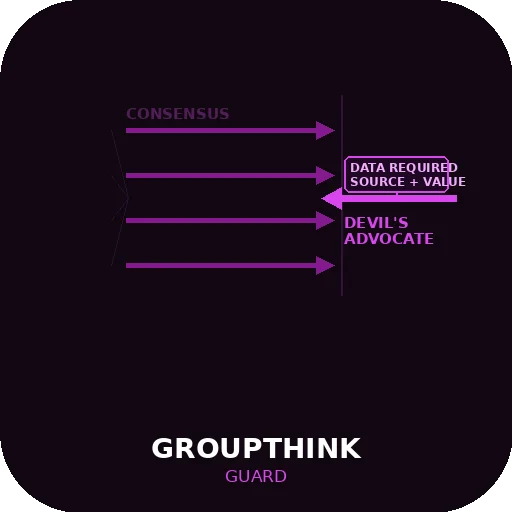
This skill monitors the output of multi-party analysis or review processes. When consensus is detected — when all reviewers are converging on the same conclusion — it activates a mandatory devil's advocate role.
One designated party must produce a specific, data-backed counterargument before the final conclusion can be output. The rebuttal is not optional. The final output cannot be generated until it is provided.
The rebuttal does not cancel the consensus conclusion. It is integrated into it — adjusting confidence levels, surfacing the conditions under which the consensus breaks down, and making the final output more honest about its own limits.
Consensus Detection
Consensus is detected when:
- All reviewers or analysis streams produce the same directional conclusion
- No significant dissenting signal exists among the available evidence
- The aggregate confidence across reviewers is high and uniform
When consensus is detected:
[Groupthink Guard: ACTIVE]
Consensus detected: [summary of the shared conclusion]
Devil's advocate role: [assigned party]
Final output: BLOCKED until rebuttal is submitted
The Devil's Advocate Role
The devil's advocate must produce:
- A specific failure scenario — a concrete description of how the consensus conclusion could be wrong
- Data backing — at least one specific numeric value or measurable indicator supporting the failure scenario
- A source — URL or verifiable reference with date
- A confidence revision — a proposed adjustment to the consensus confidence level
Output format:
[Devil's Advocate]
Failure scenario: [specific description — not "it might be wrong" but "X condition causes Y failure"]
Data: [numeric value or measurable indicator] (Source: [URL or reference], [date])
Confidence revision: [current %] → [proposed %]
What Counts as a Valid Rebuttal
Valid:
- A specific failure condition tied to a measurable indicator
- A data point that conflicts with or limits the consensus assumption
- A scenario where the consensus conclusion reverses under plausible conditions
Not valid:
- "It might not work out" — no scenario
- "I'm not sure about this" — no data
- "There's uncertainty" — everyone already knows; this adds nothing
- Emotional or intuition-based objections without supporting evidence
An invalid rebuttal must be resubmitted. The final output remains blocked until a valid rebuttal is produced.
Integration, Not Withdrawal
The devil's advocate rebuttal is not a veto.
After the rebuttal is submitted:
- The consensus conclusion is not withdrawn
- The rebuttal is integrated — incorporated into the final output as a confidence adjustment and an explicit risk condition
- The final output states both the consensus conclusion and the conditions under which it breaks down
Integration format:
[Final output — integrated]
Conclusion: [original consensus conclusion]
Confidence: [adjusted value, incorporating devil's advocate revision]
Risk condition: [the specific scenario from the rebuttal — when this conclusion may not hold]
Source: [devil's advocate data reference]
Before / After
Before:
Four analysts all conclude: "Option A is the correct path. Confidence: 85%."
Output: "Recommendation: Option A (85% confidence)"
After (with Groupthink Guard):
[Groupthink Guard: ACTIVE] — consensus detected.
Devil's Advocate: "Failure scenario: Option A depends on Q3 delivery timeline. Current supplier lead time has extended 6 weeks (Source: supplier update, 2025-03-01). If delayed, Option A cost advantage inverts."
Confidence revision: 85% → 61%Final: "Recommendation: Option A (61% confidence). Risk: timeline dependency on supplier delivery. If Q3 slips >4 weeks, Option B becomes preferable."
Hard Rules
Consensus triggers the guard, every time. When all reviewers align, the guard activates. There is no "obvious enough to skip" threshold. The times the rebuttal feels unnecessary are the times it is most needed.
The rebuttal must be data-backed. A failure scenario without a specific numeric indicator and a verifiable source is not a valid rebuttal. It must be resubmitted.
Final output is blocked until a valid rebuttal is submitted. The guard is not a suggestion. The conclusion cannot be finalized while the devil's advocate slot is empty.
The rebuttal is integrated, not used to veto. The goal is a more calibrated conclusion, not the destruction of consensus. Withdrawal of the conclusion after a rebuttal is a misuse of this protocol.
Emotional or intuition-based objections are not valid. "Something feels off" is not a rebuttal. The failure scenario must be specific, the data must be real, and the source must be verifiable.
The confidence revision is mandatory. The devil's advocate must propose a specific adjusted confidence level, not just describe a risk. An unquantified rebuttal cannot be integrated into the final output.